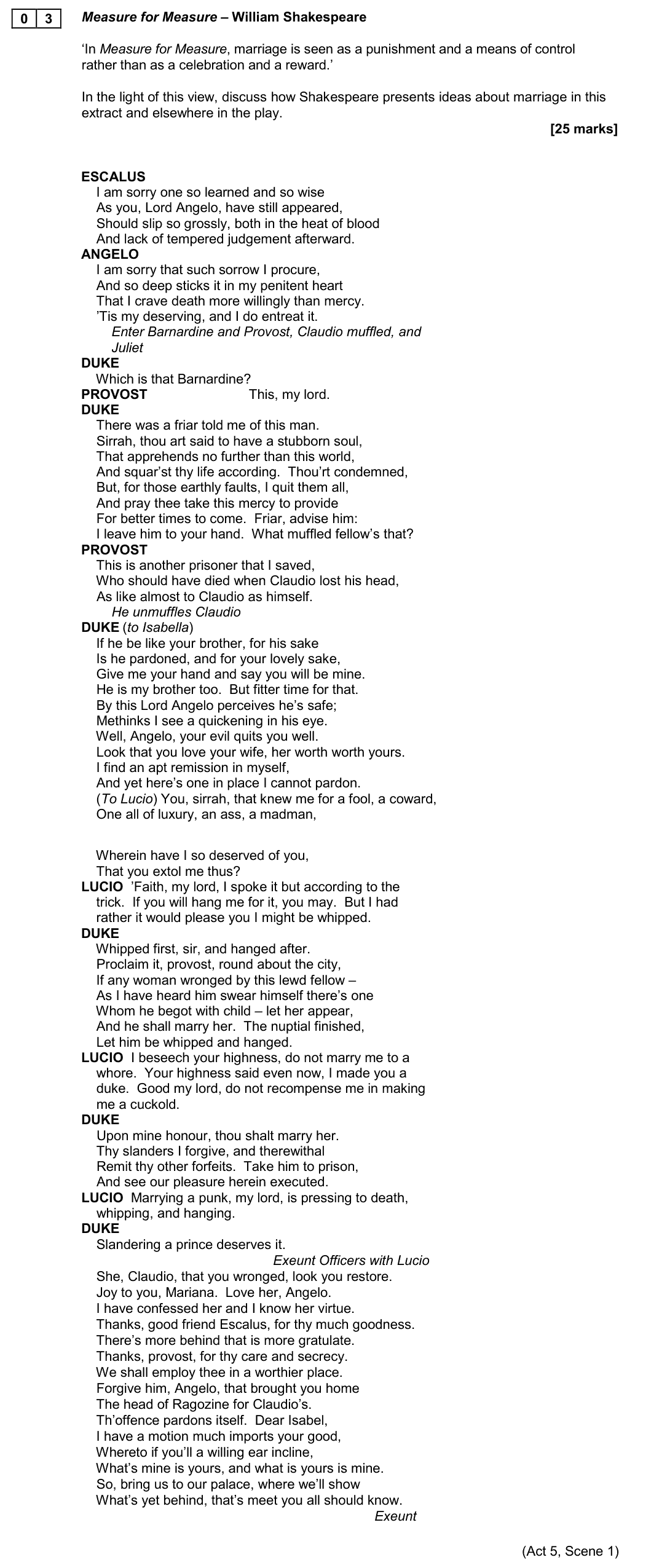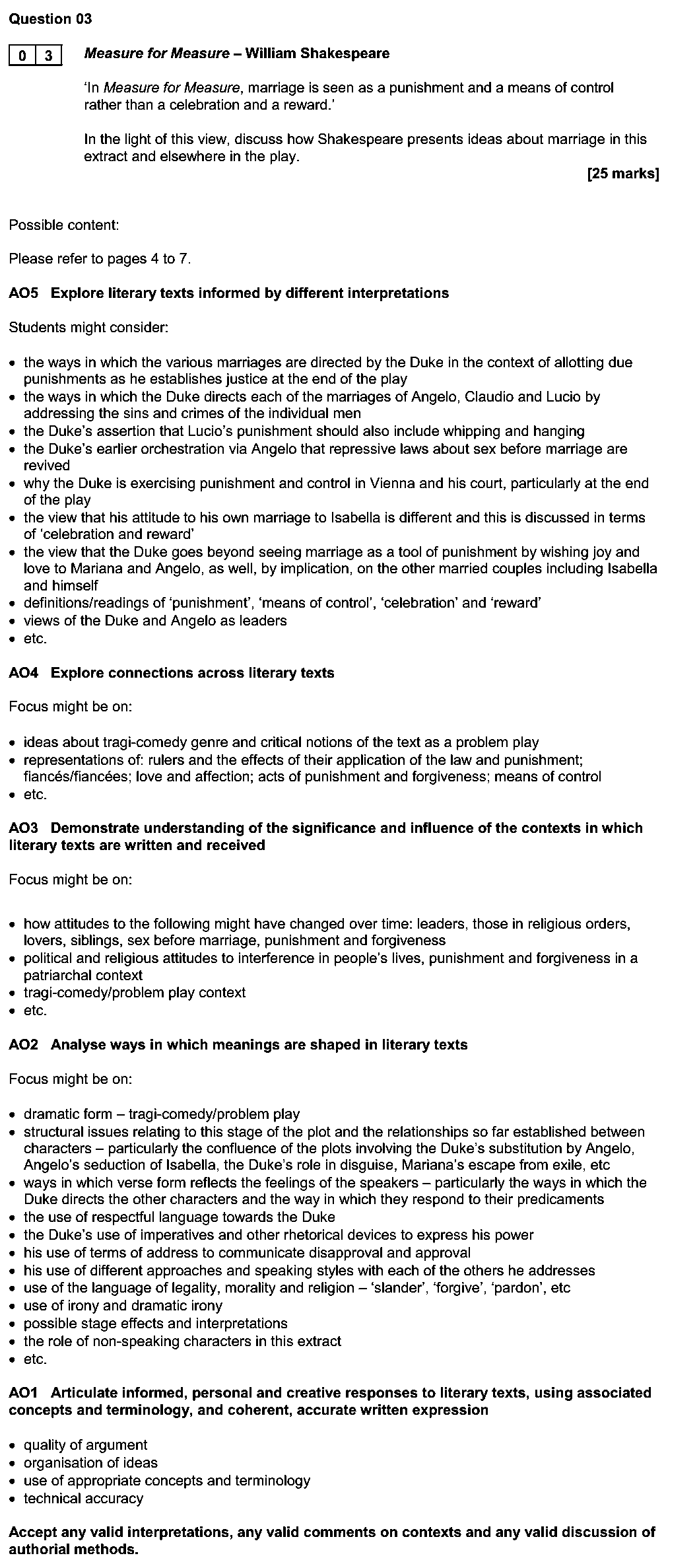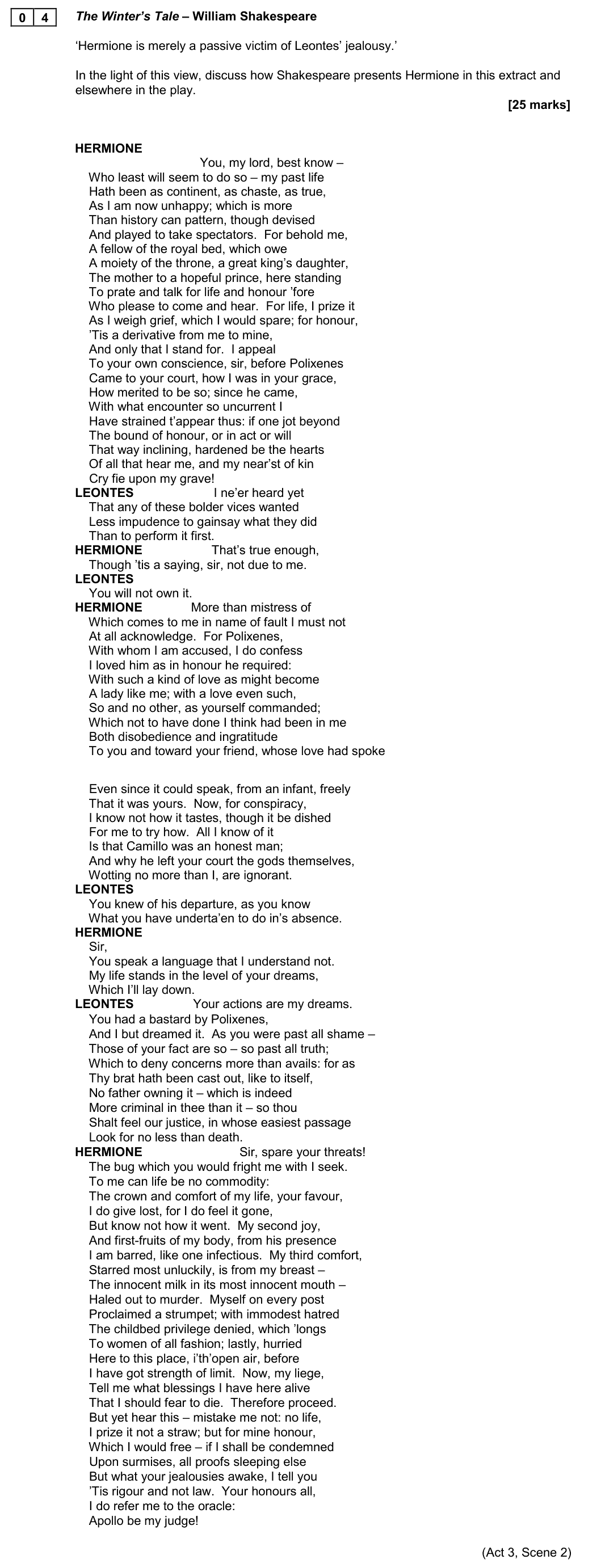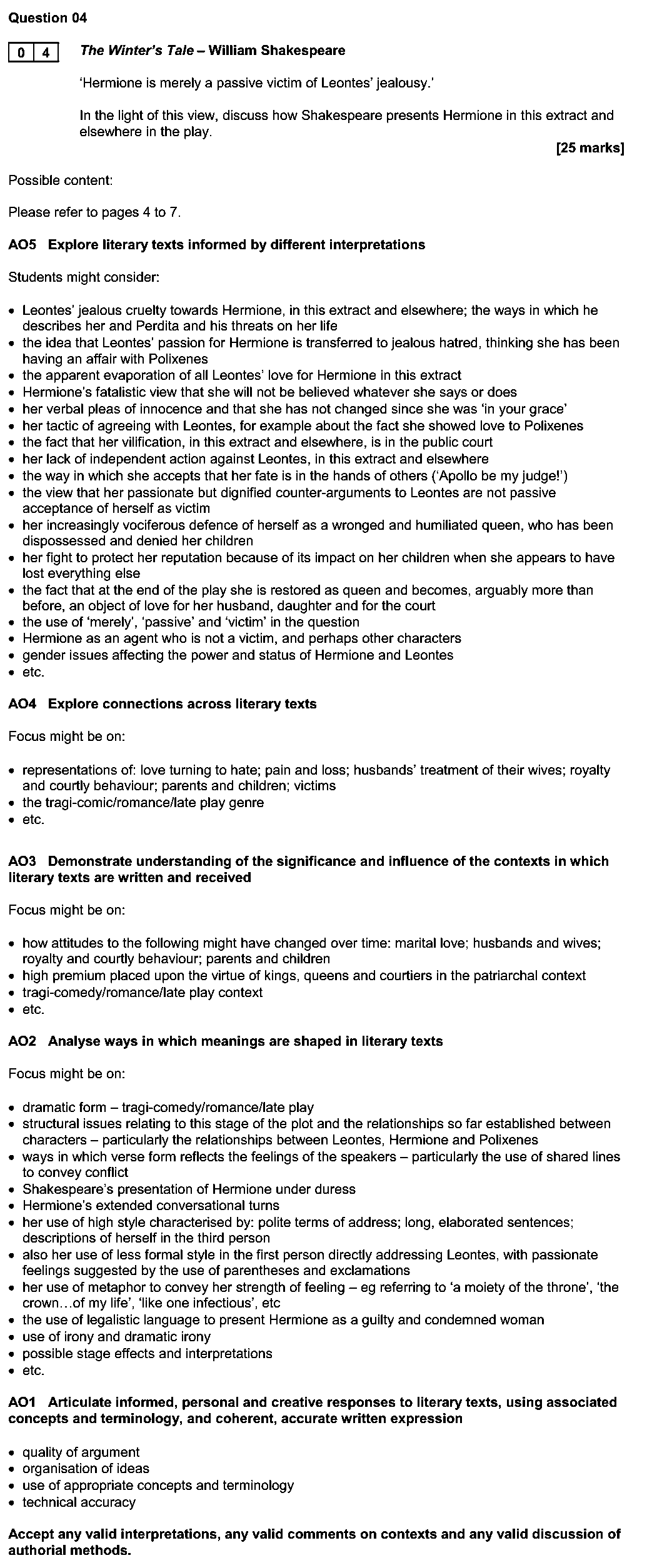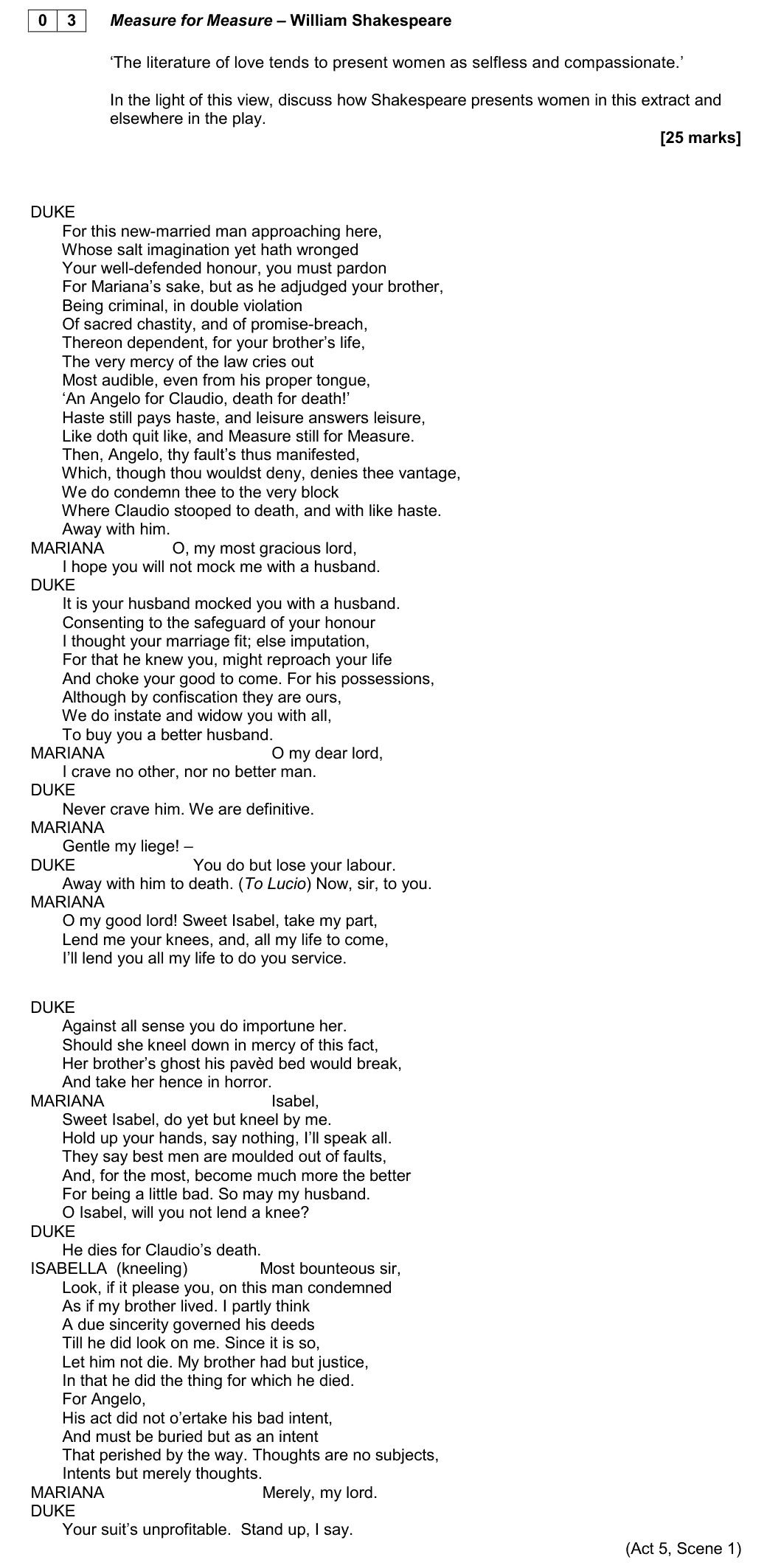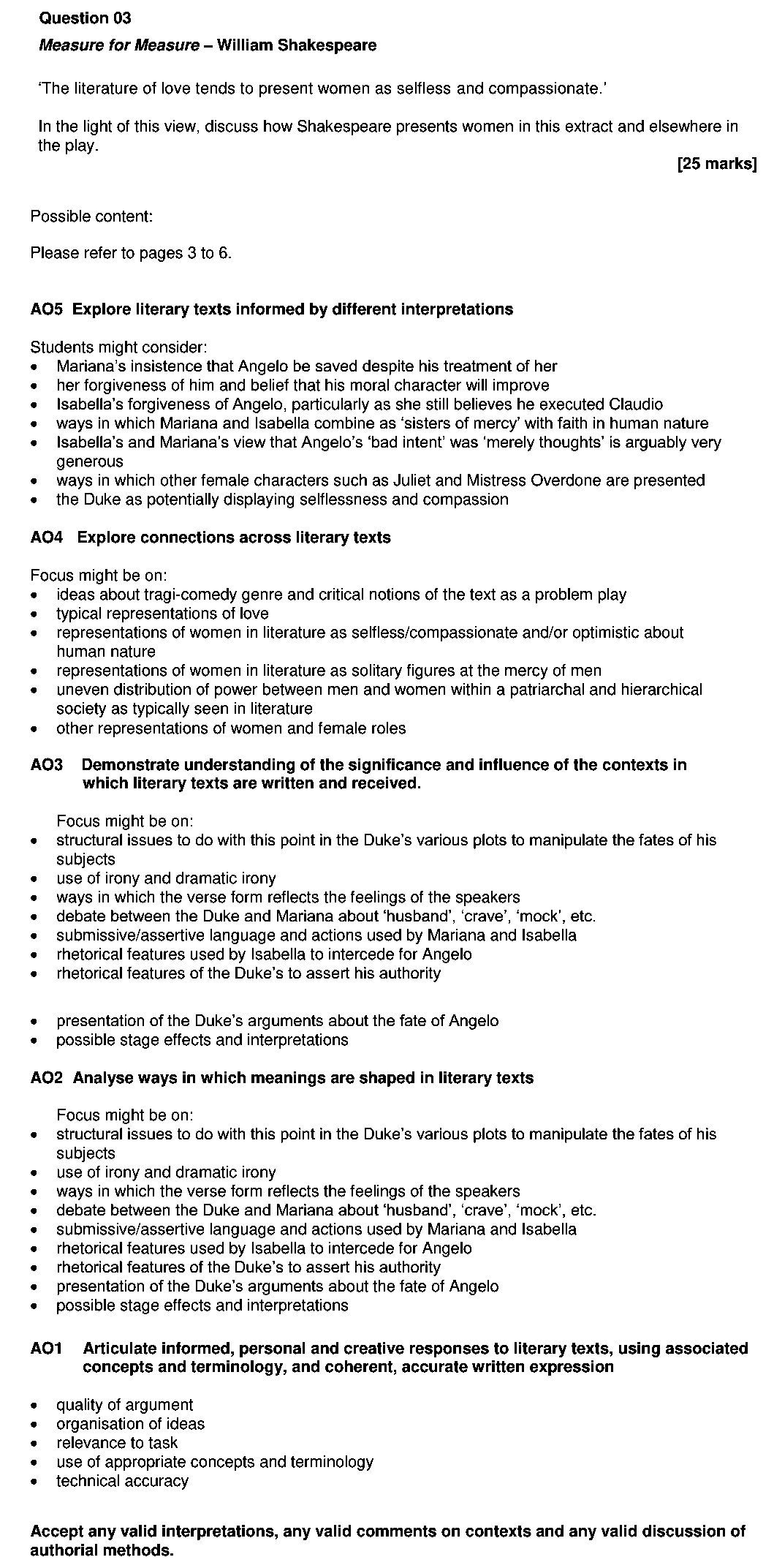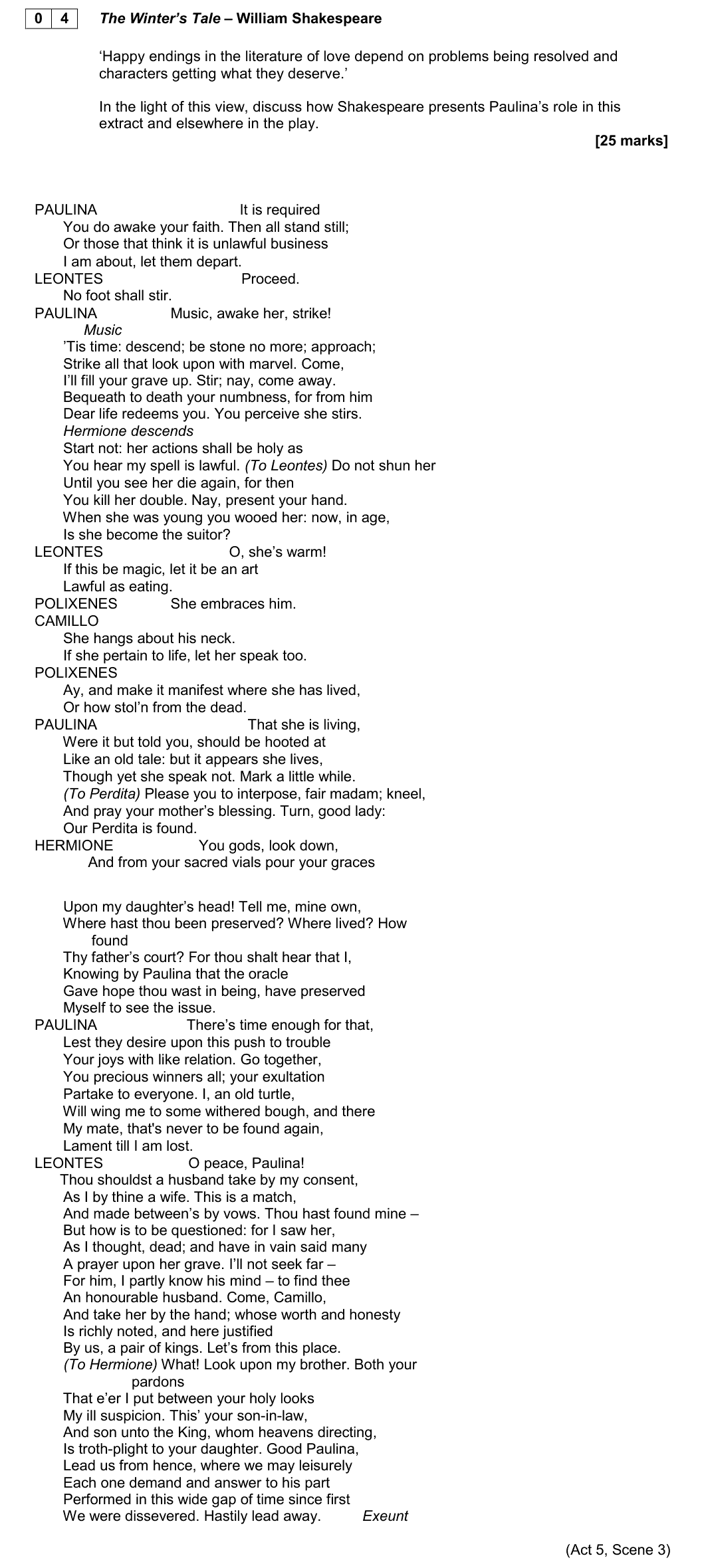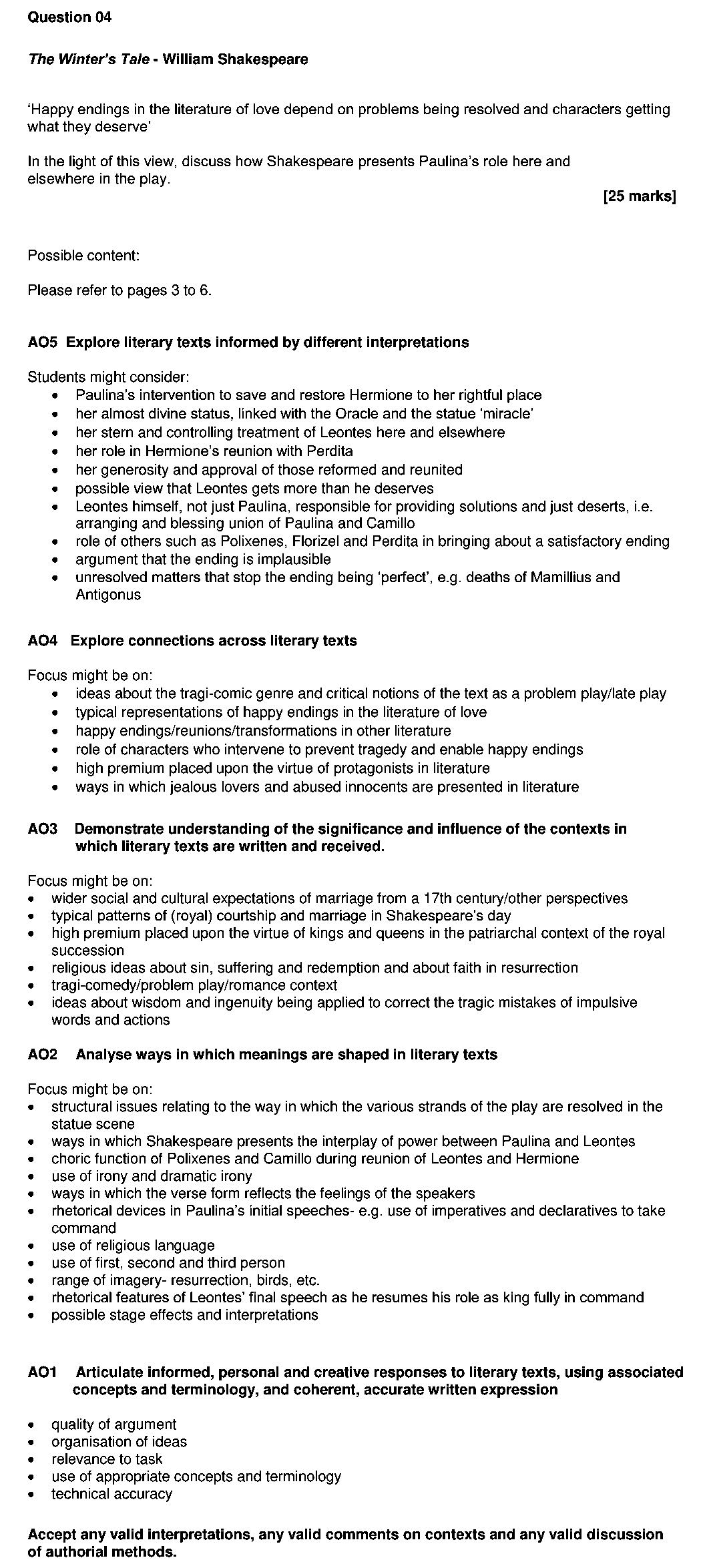
Shakespeare: extract and whole play (25 marks)

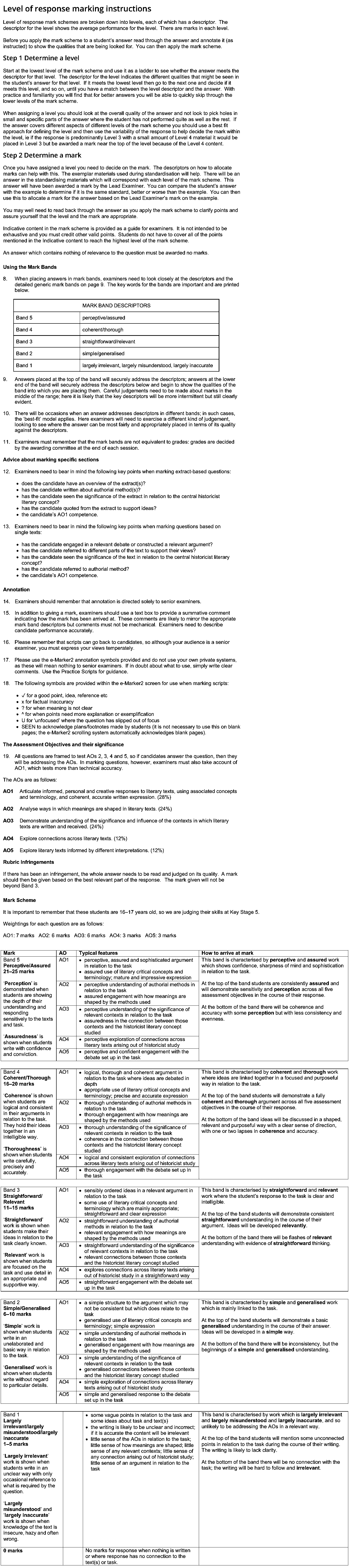
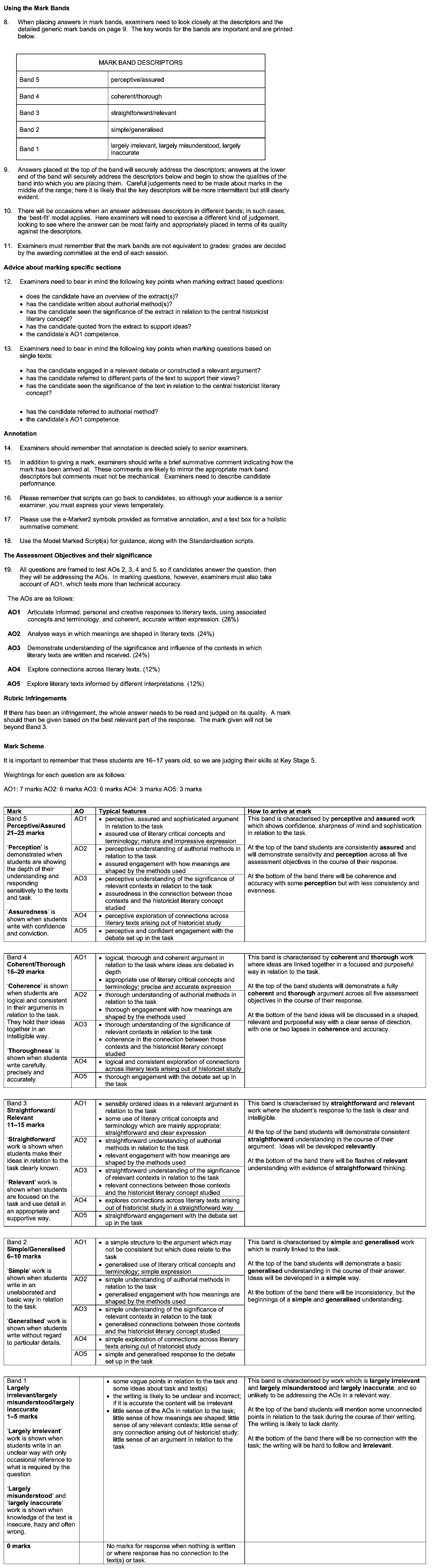
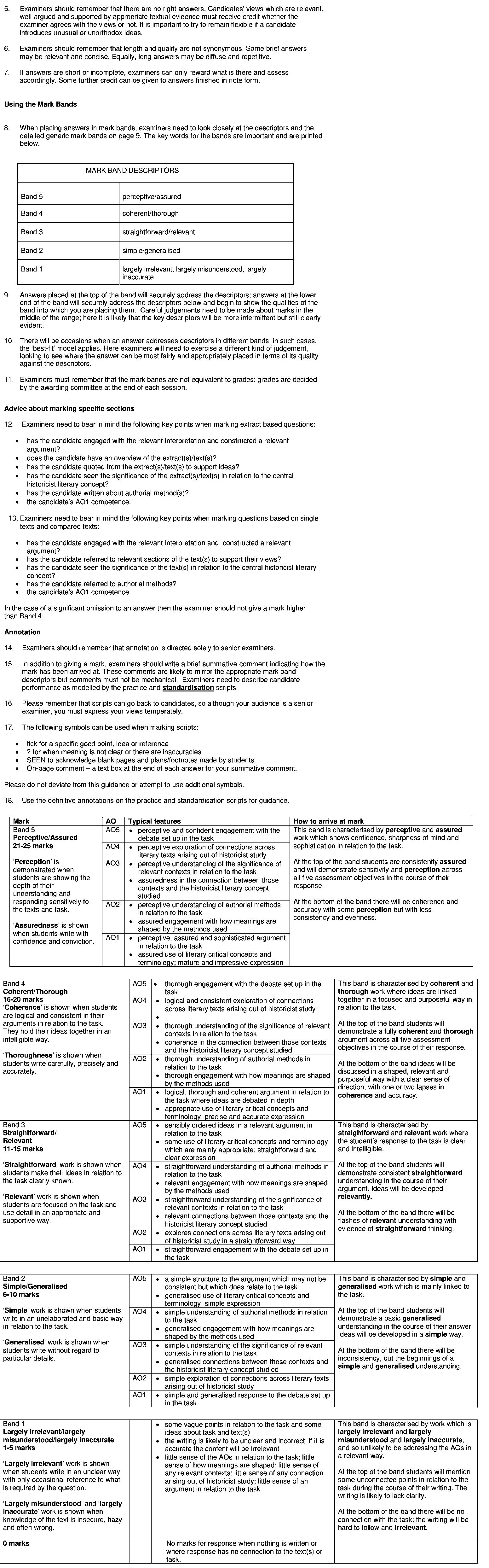
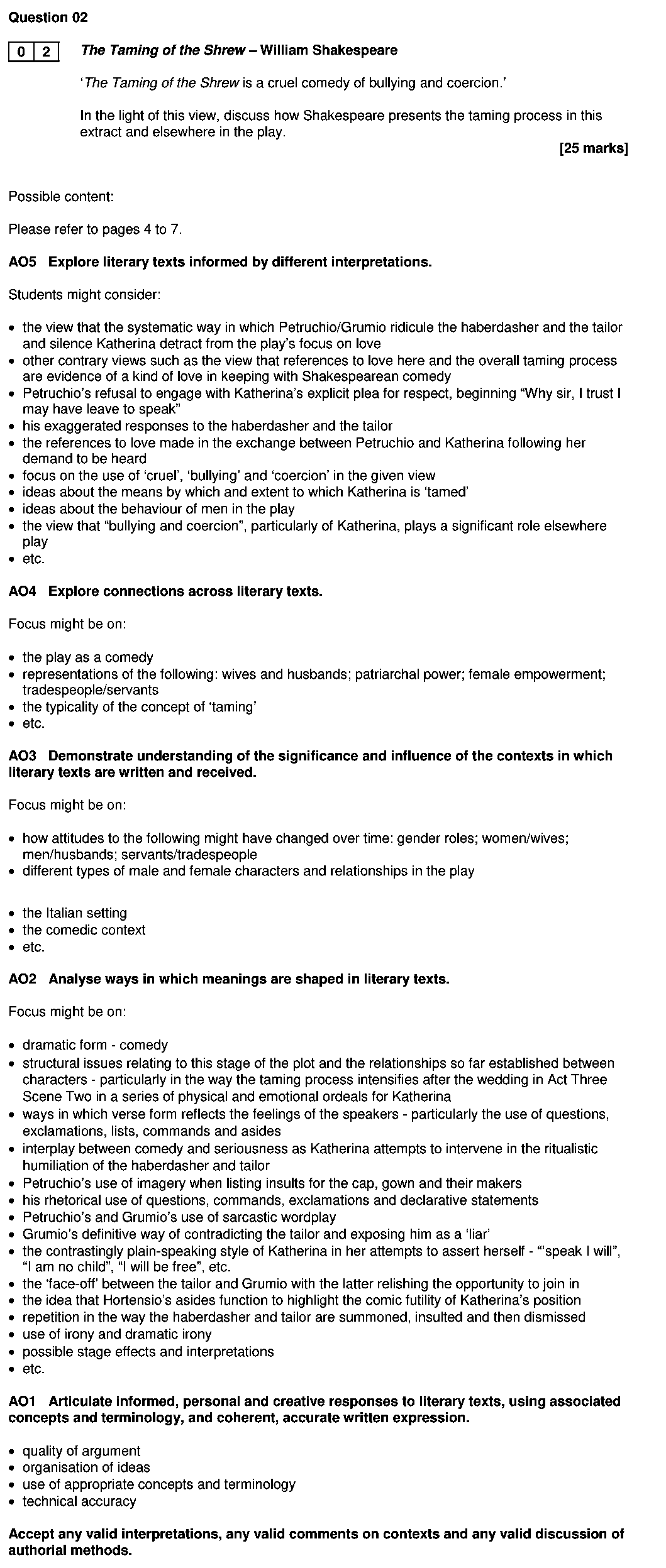
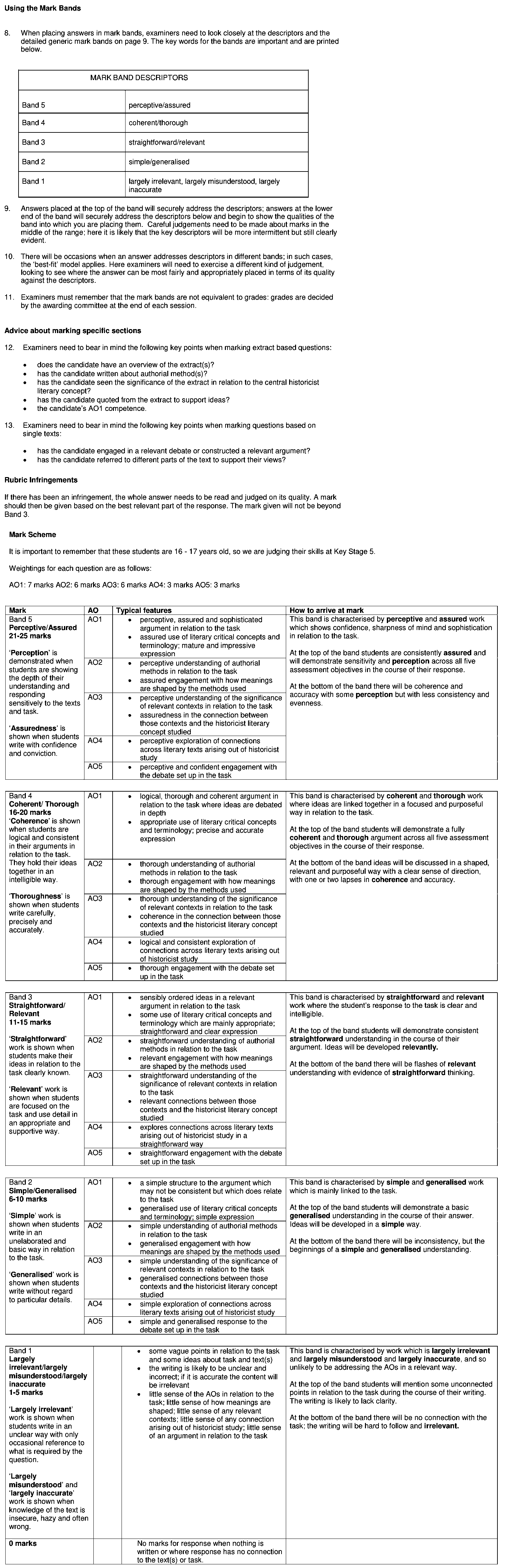
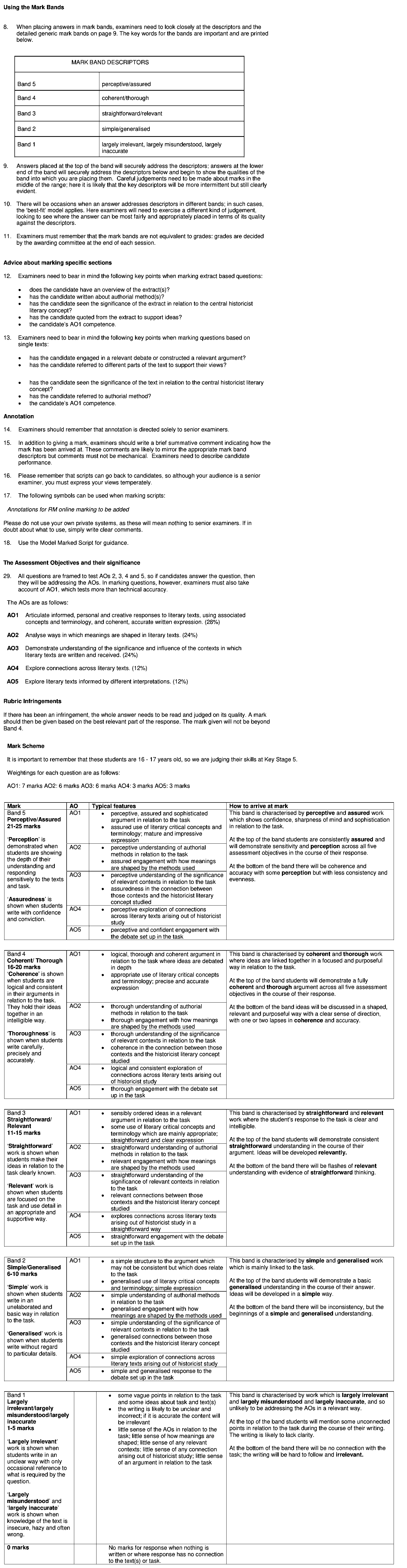
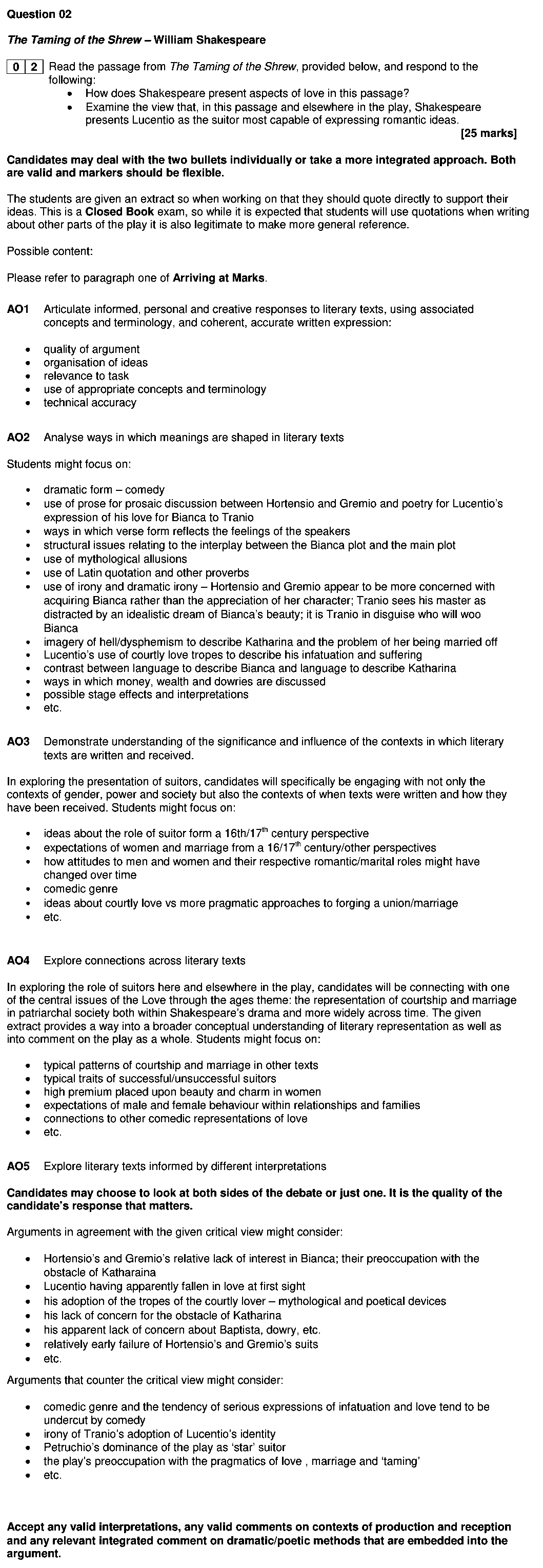
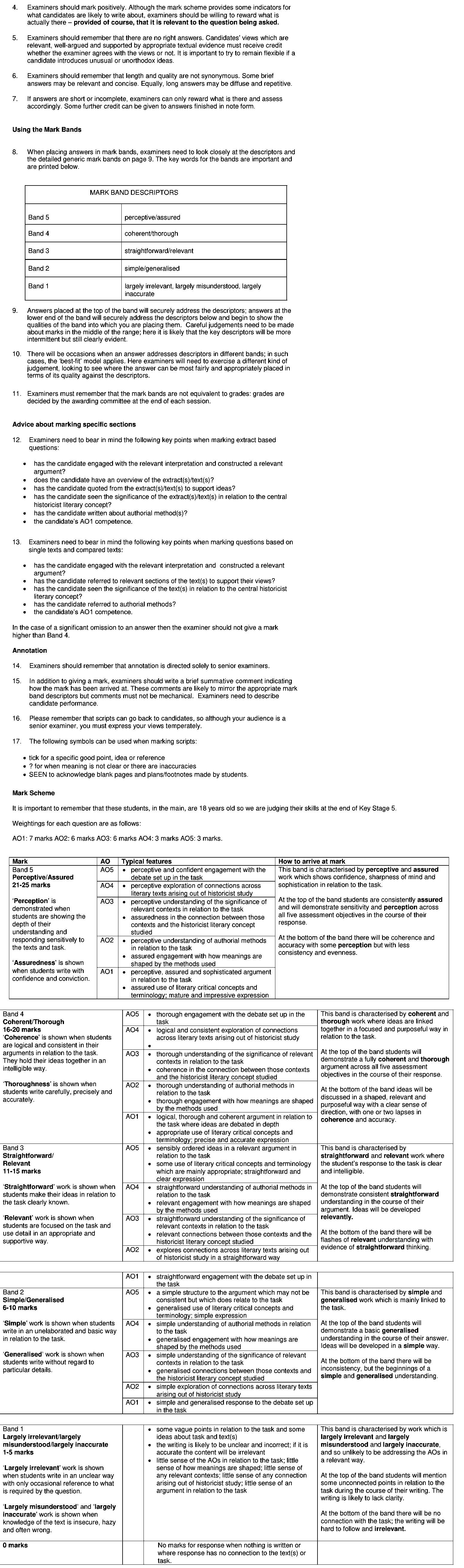
Paper 1 Section A (A level and AS): read the printed extract and respond to a view about the play, looking at the extract and the play as a whole. AO2 (dramatic methods) and AO5 (other interpretations) carry the top band. 72 questions.

Other types: Paper 2 set-text essays (25 marks) · AS: the love poetry anthology (25 marks) · Unseen poetry comparison (25 marks) · AS: unseen prose (25 marks) · Comparing texts: love through the ages (25 marks) · Paper 2: the unseen extract (25 marks) · Paper 2: comparing two texts (25 marks)

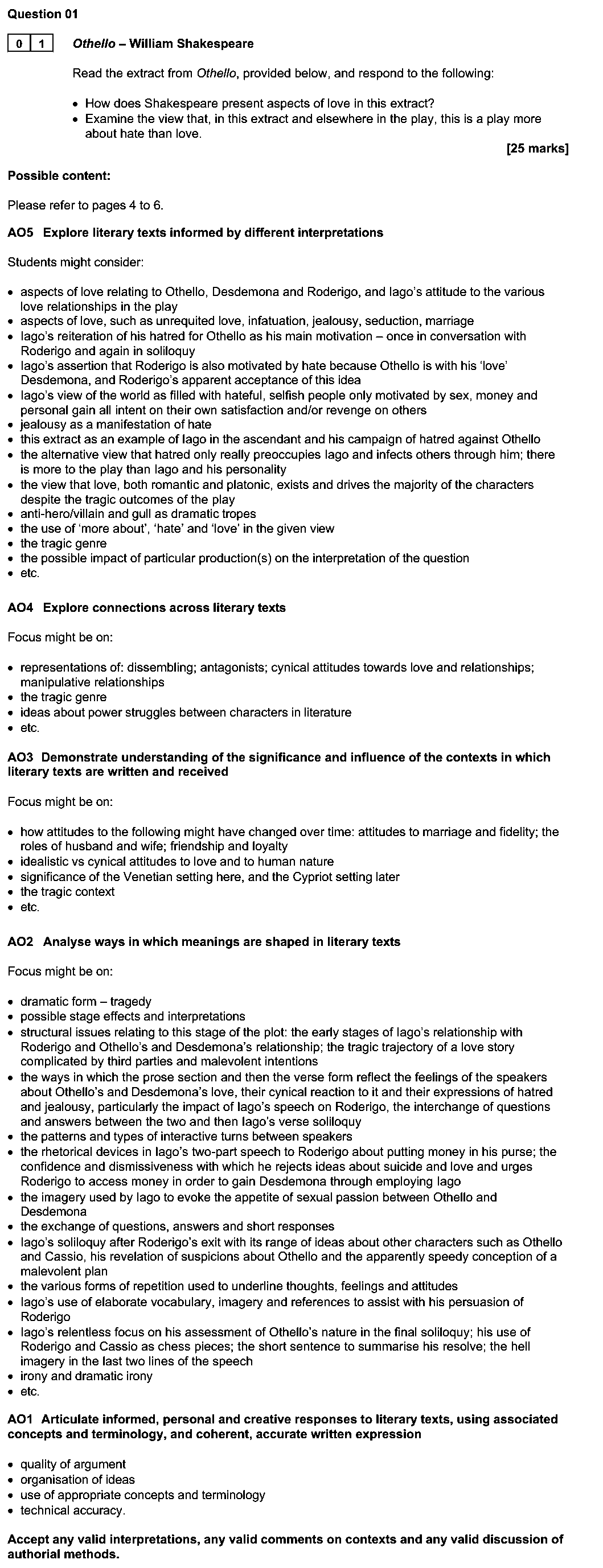
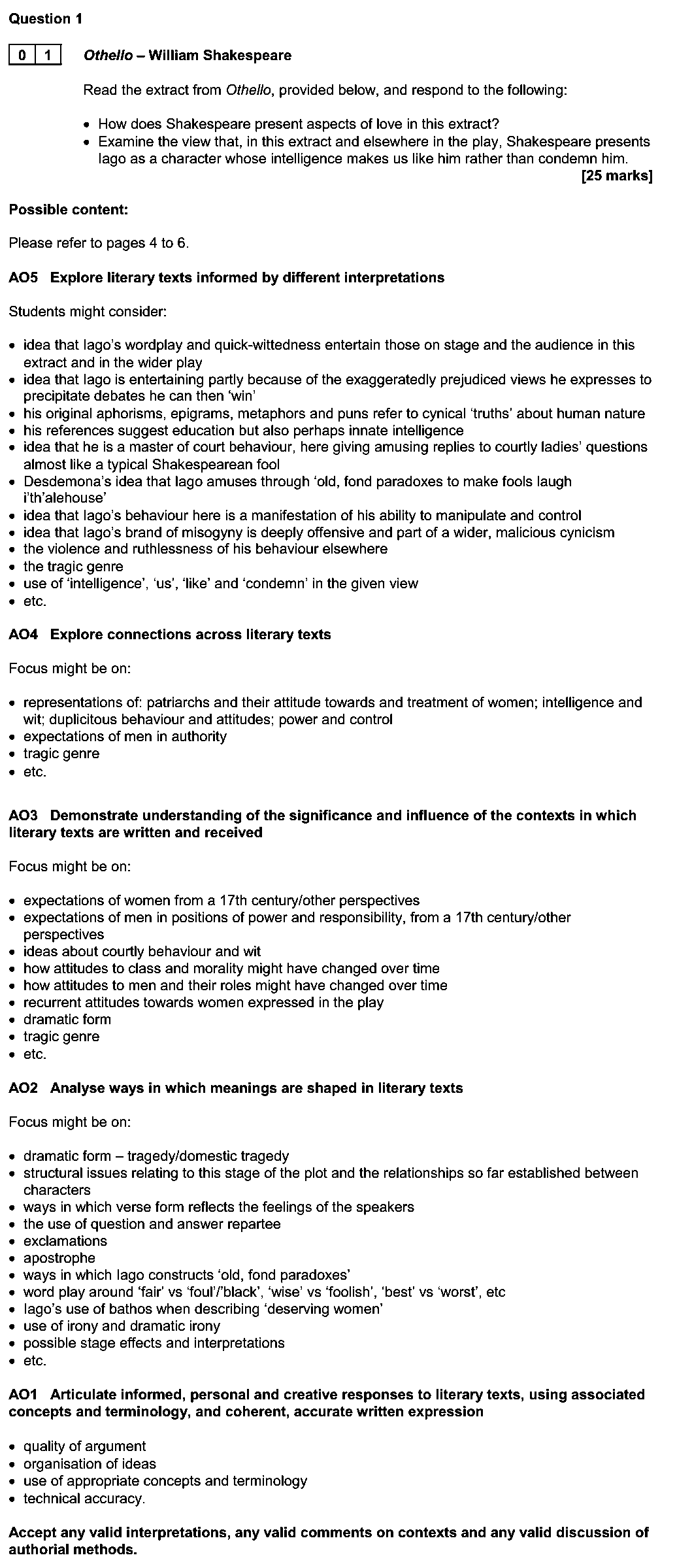
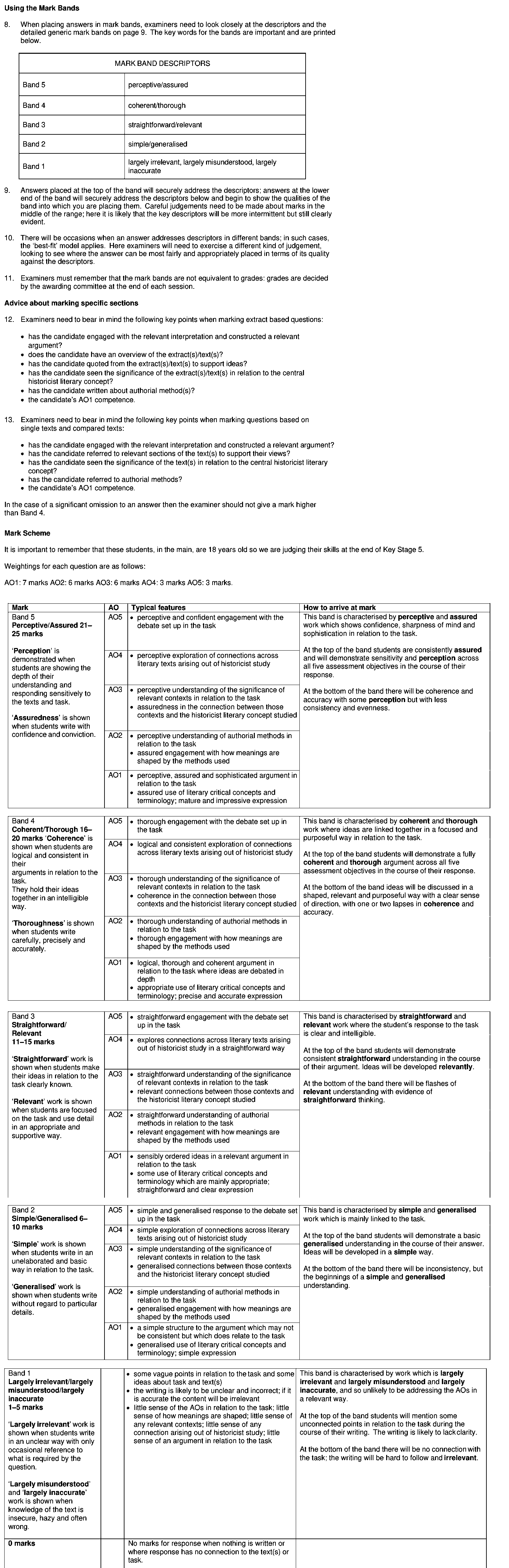
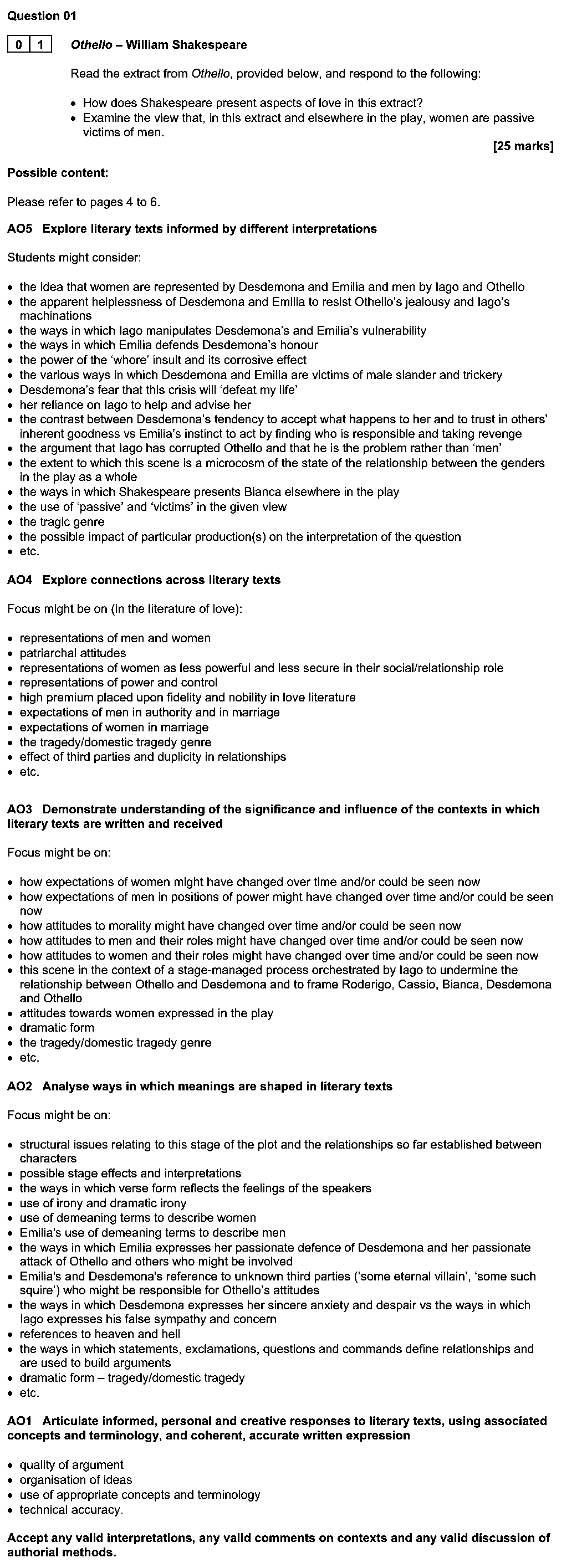
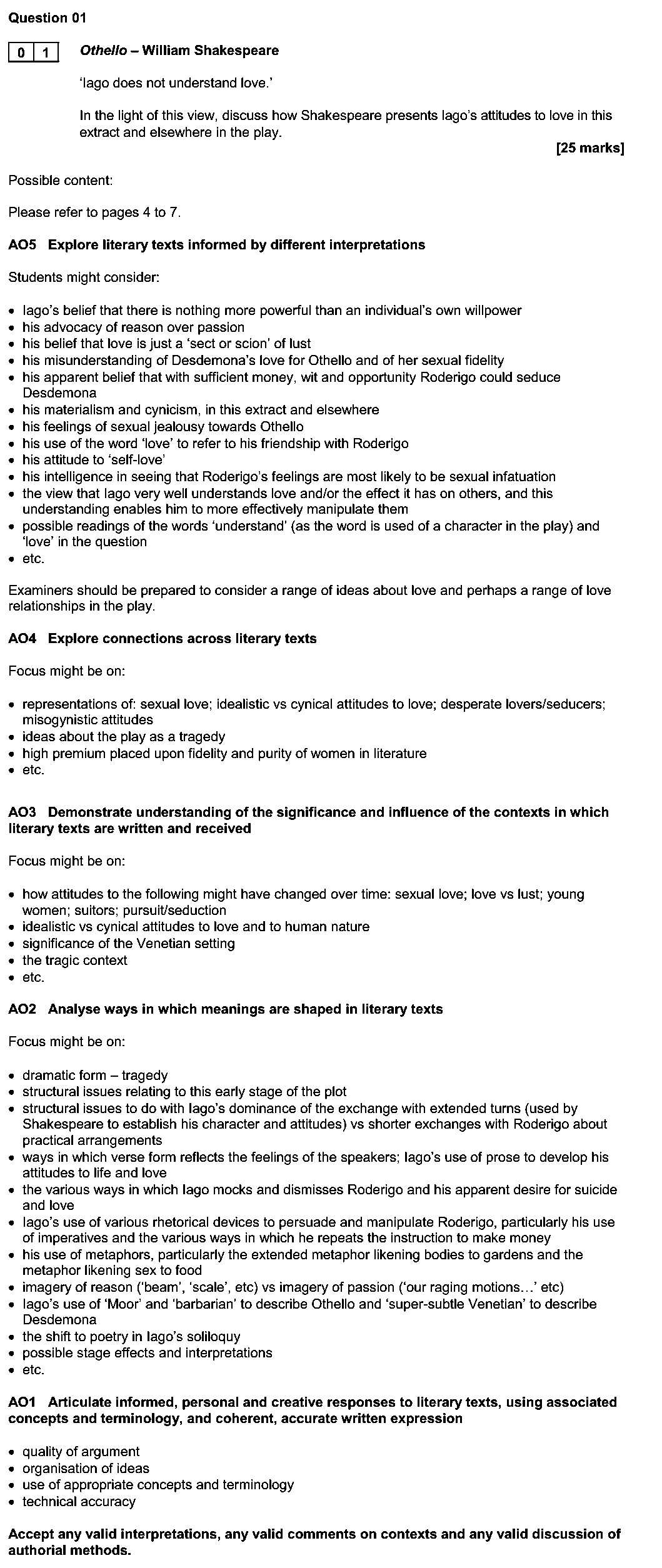
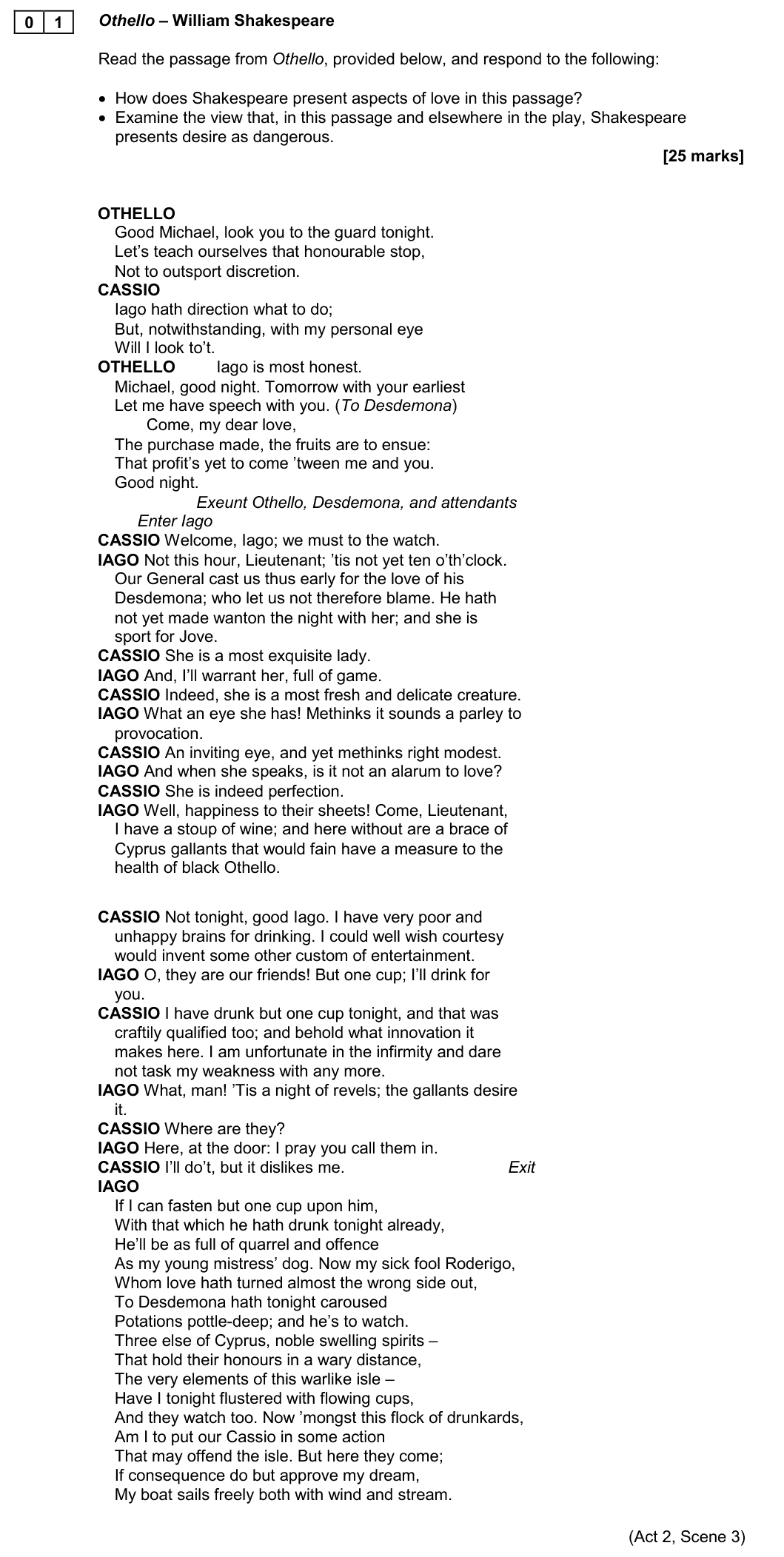
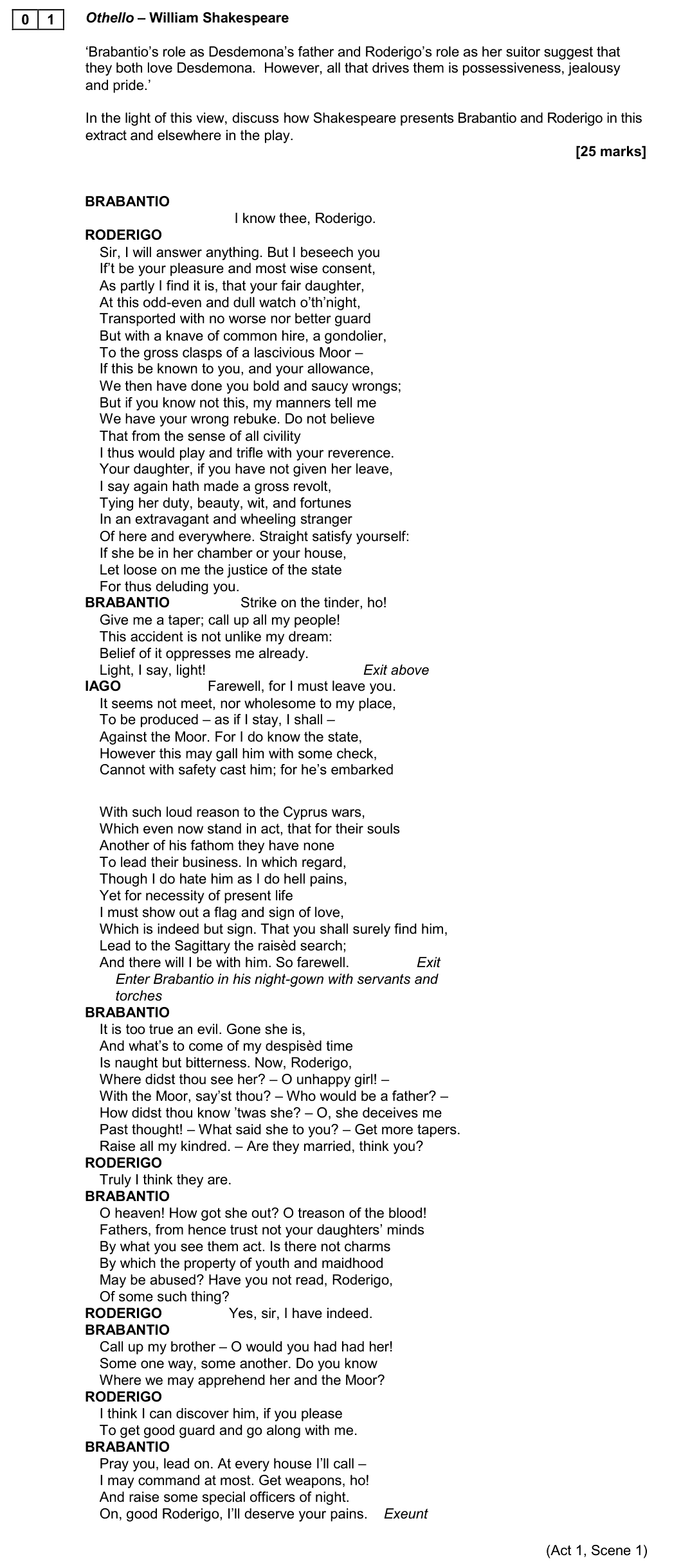
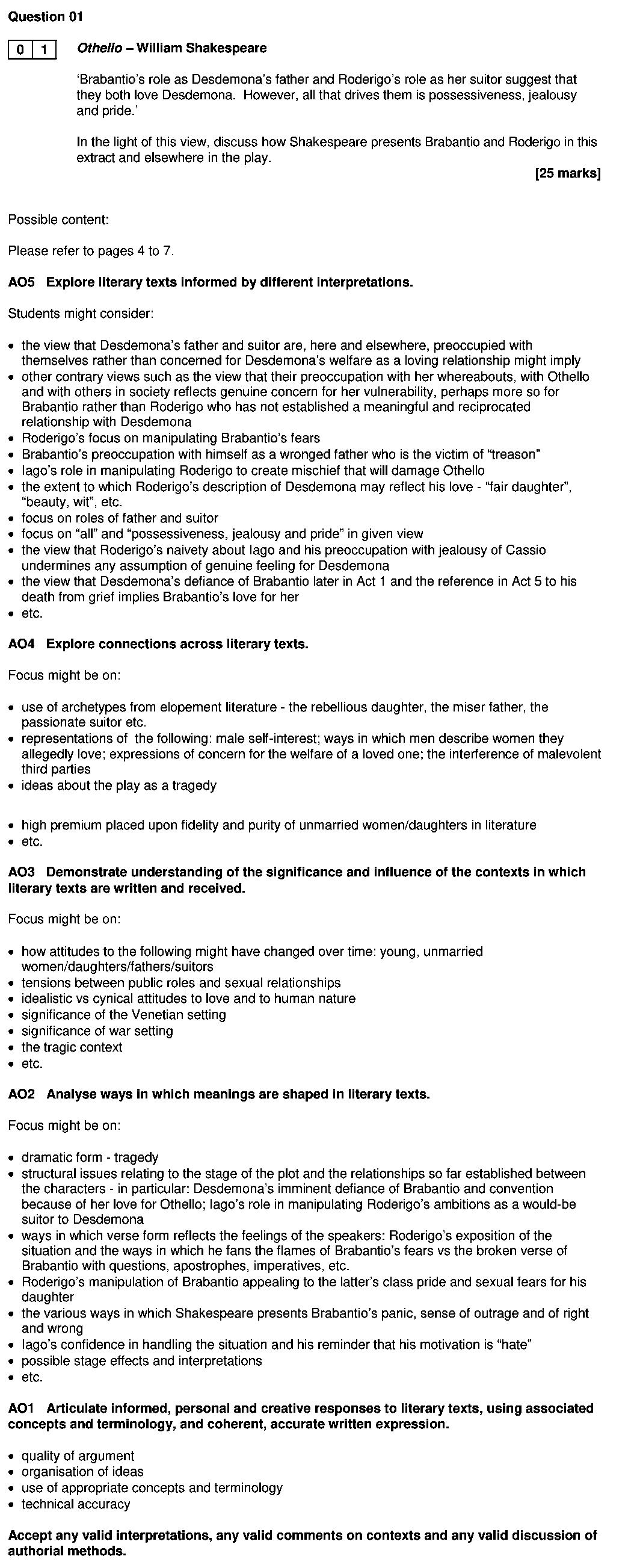
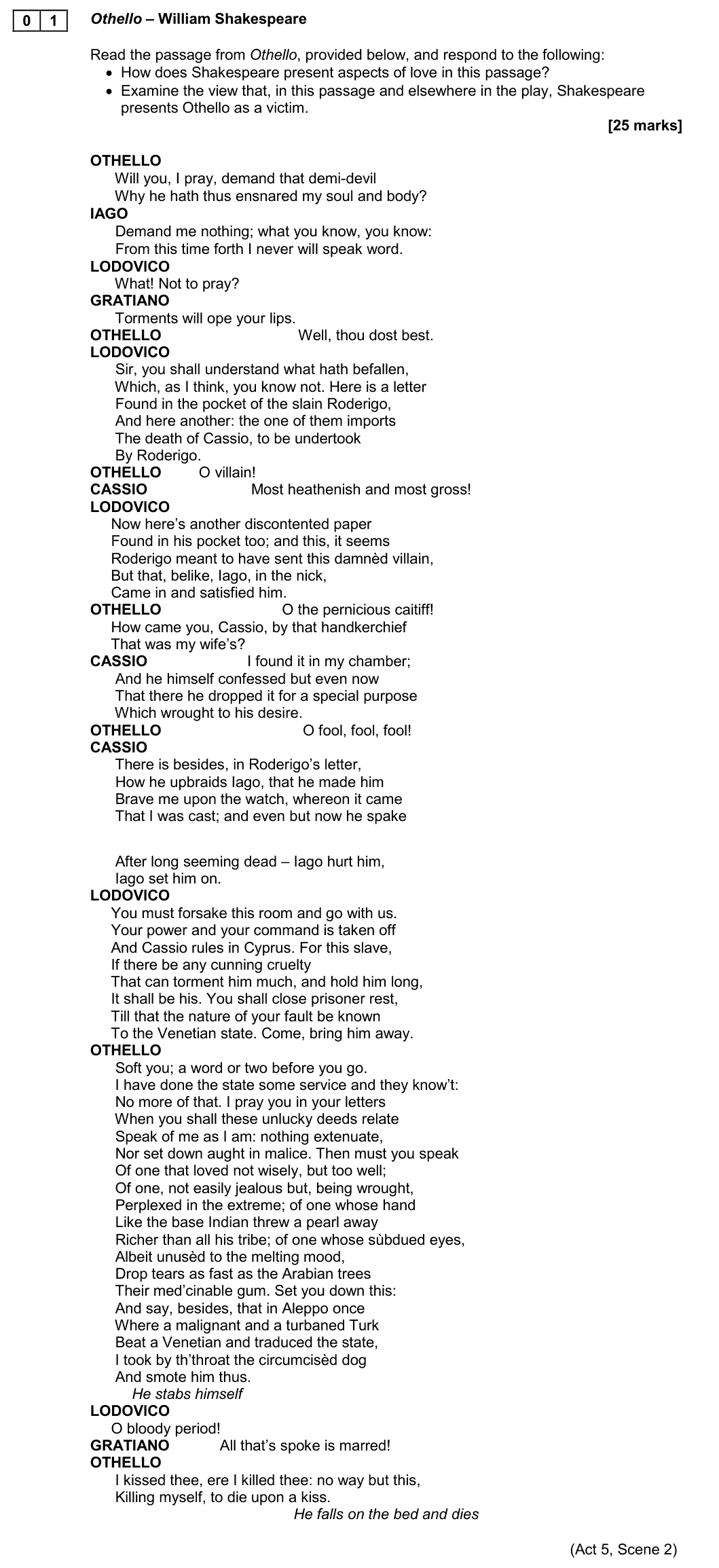
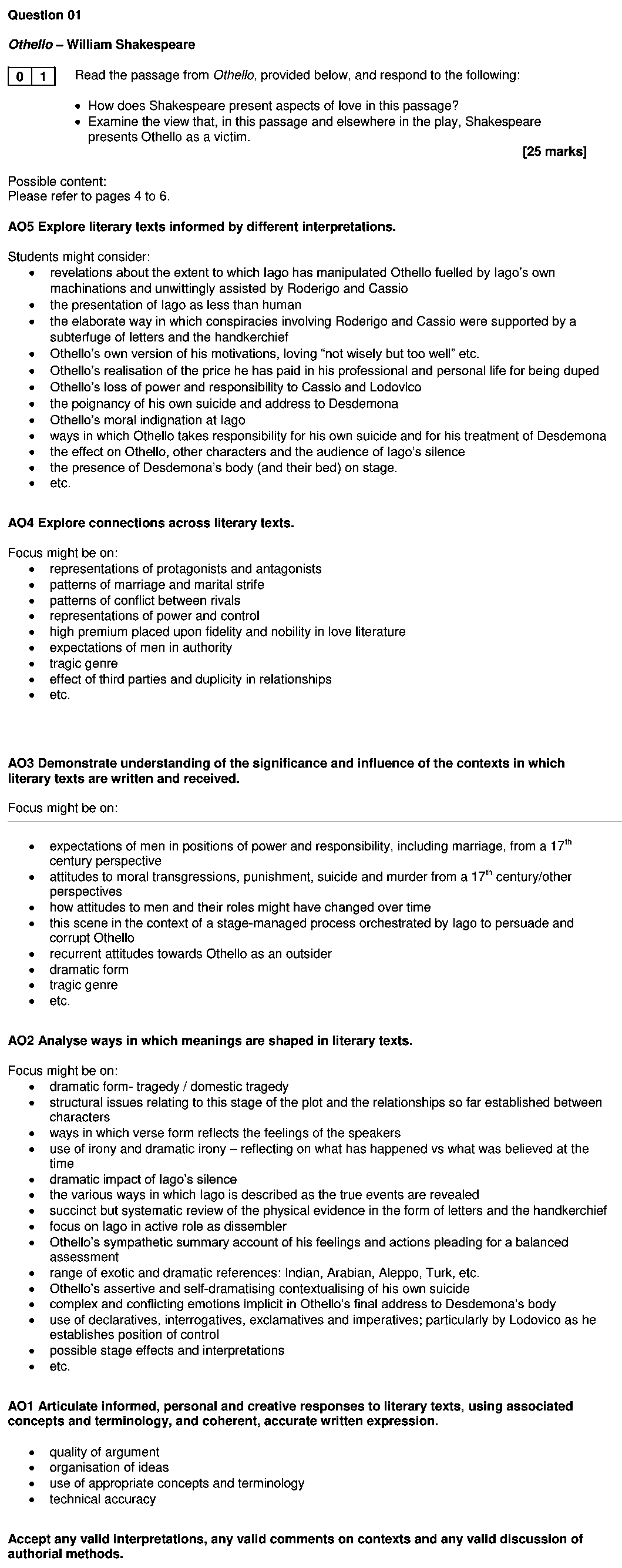
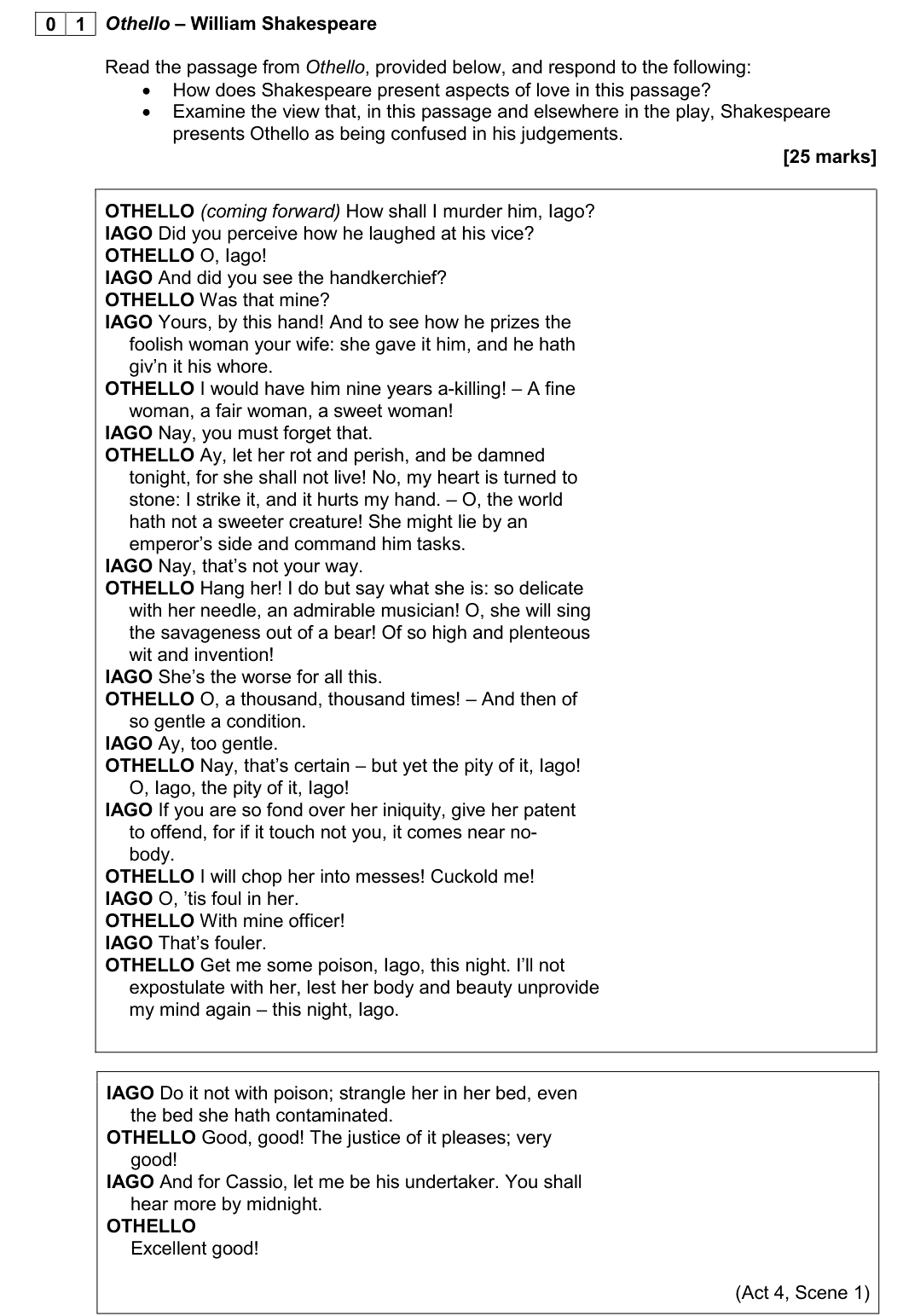
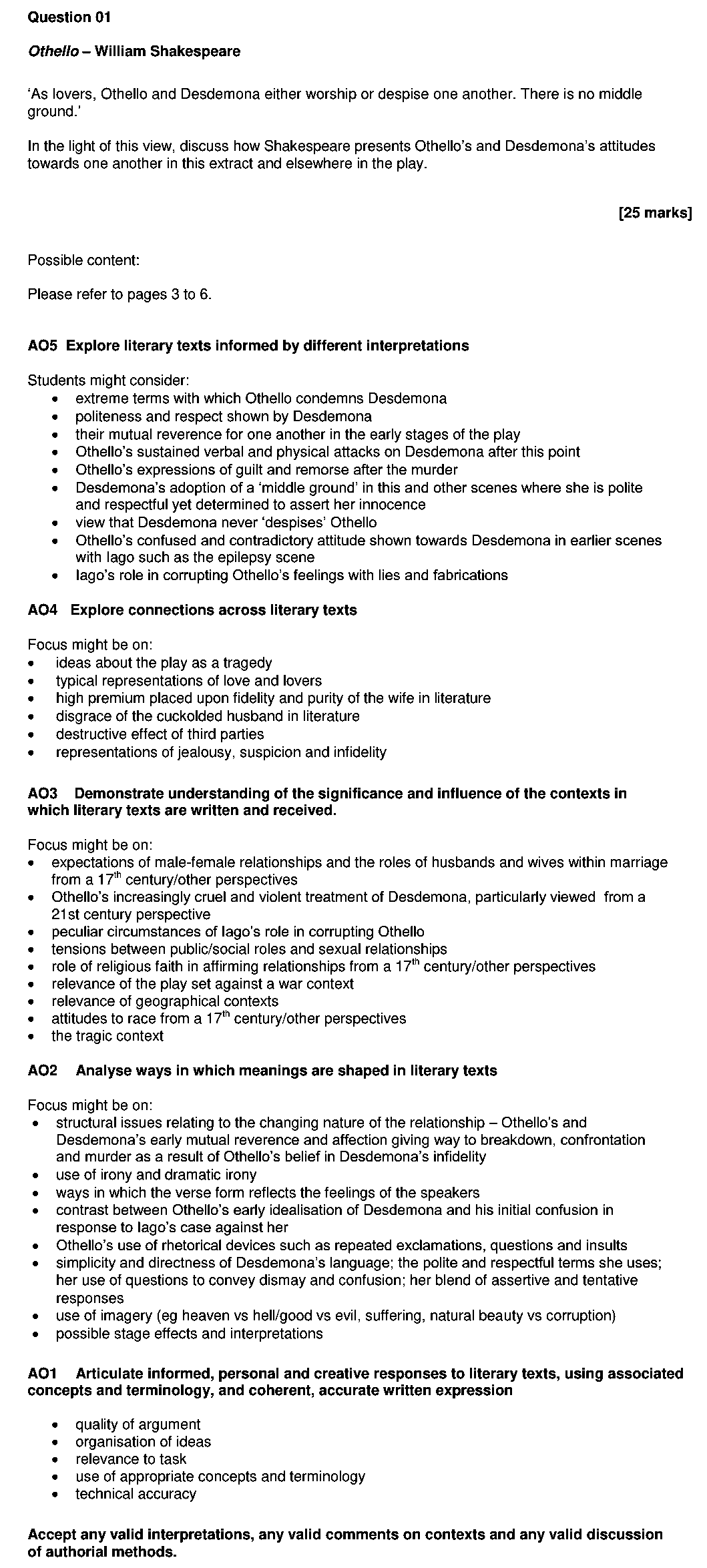
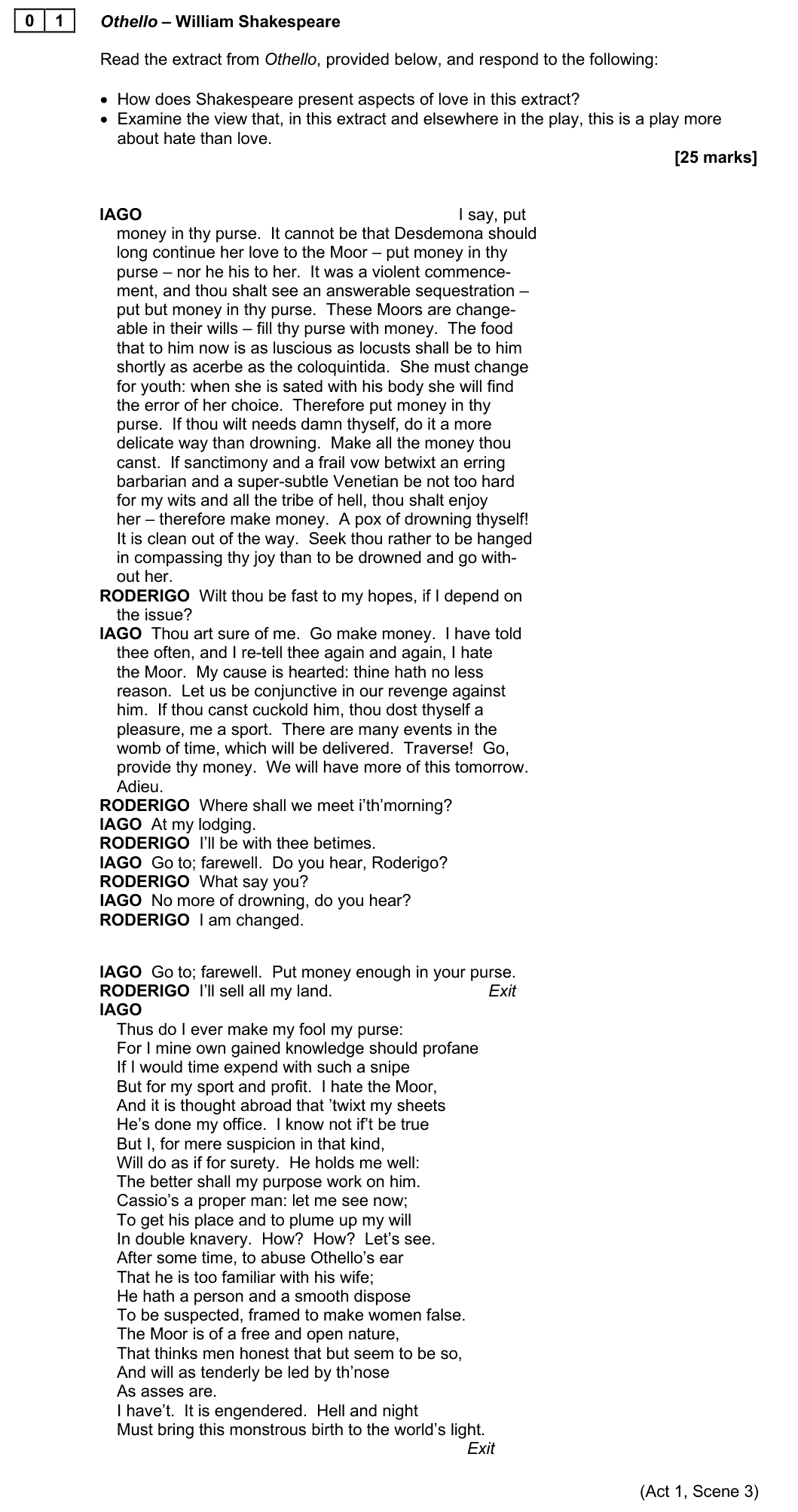
June 2025 · AS Paper 1 · Q1 25 marks Shakespeare extract othello
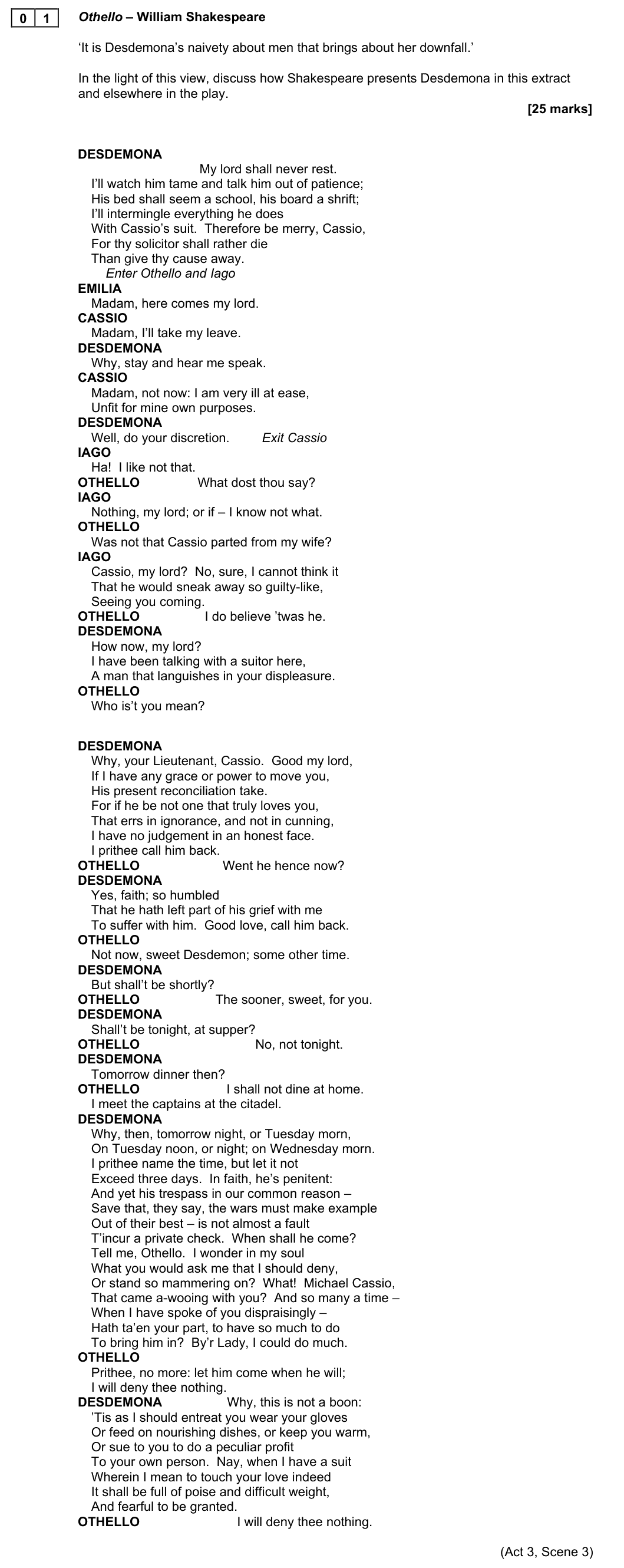
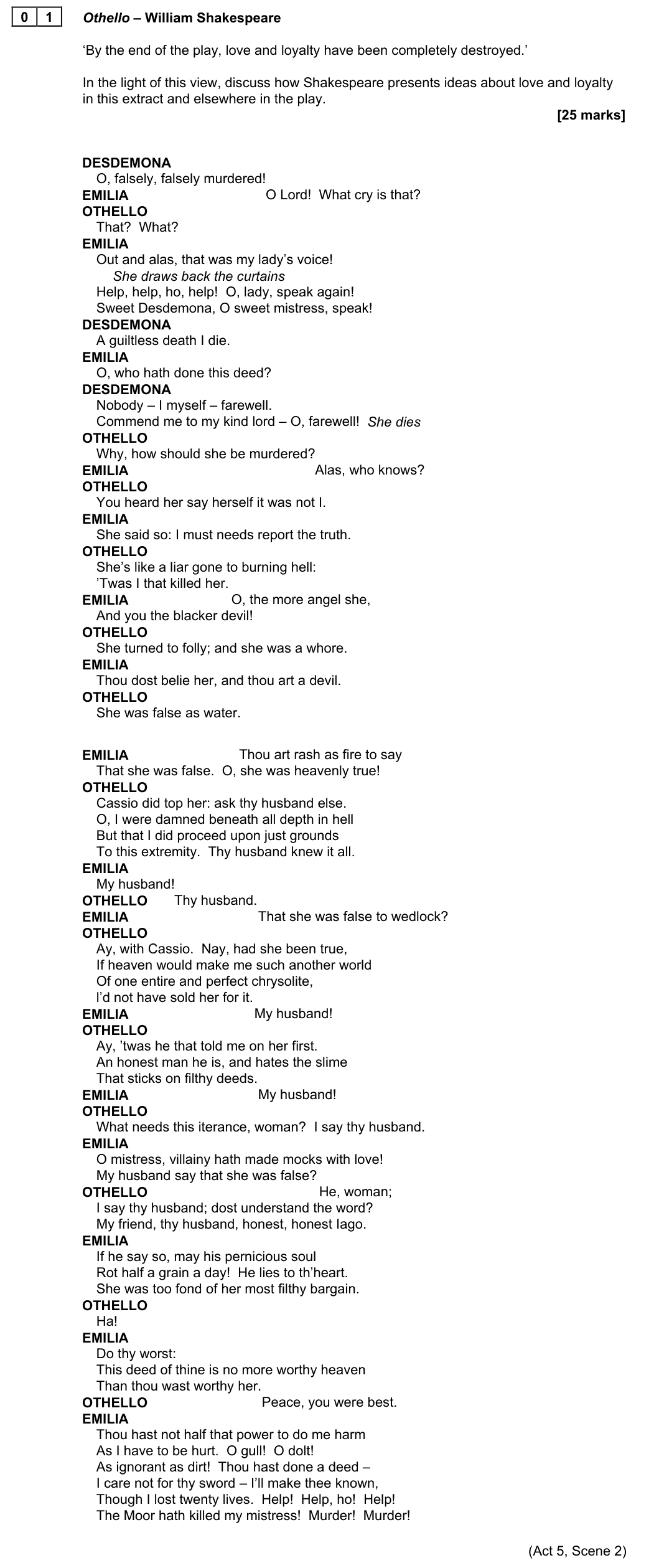
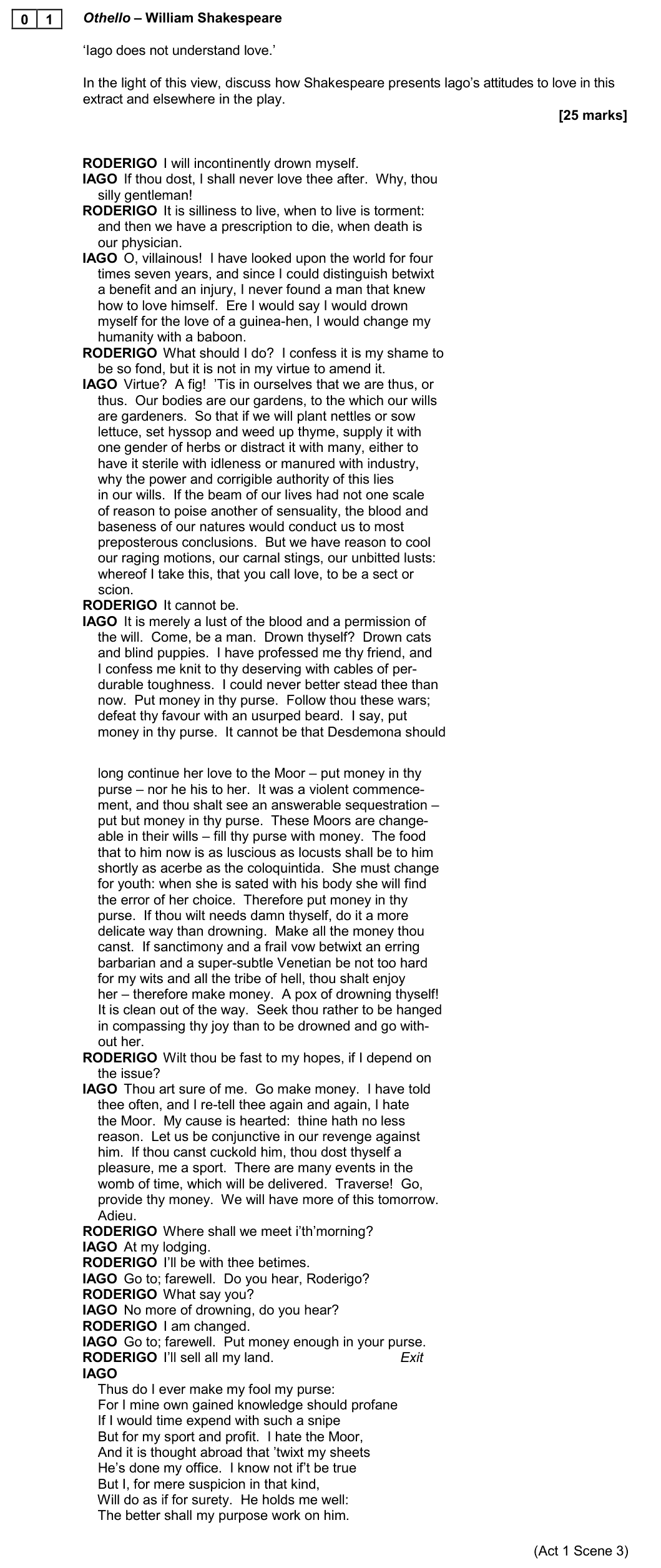
Othello – William Shakespeare
Read the extract from Othello, provided below, and respond to the following:
• How does Shakespeare present aspects of love in this extract?
• Examine the view that, in this extract and elsewhere in the play, this is a play more
about hate than love.
[25 marks]
IAGO
I say, put
money in thy purse. It cannot be that Desdemona should
long continue her love to the Moor – put money in thy
purse – nor he his to her. It was a violent commence-
ment, and thou shalt see an answerable sequestration –
put but money in thy purse. These Moors are change-
able in their wills – fill thy purse with money. The food
that to him now is as luscious as locusts shall be to him
shortly as acerbe as the coloquintida. She must change
for youth: when she is sated with his body she will find
the error of her choice. Therefore put money in thy
purse. If thou wilt needs damn thyself, do it a more
delicate way than drowning. Make all the money thou
canst. If sanctimony and a frail vow betwixt an erring
barbarian and a super-subtle Venetian be not too hard
for my wits and all the tribe of hell, thou shalt enjoy
her – therefore make money. A pox of drowning thyself!
It is clean out of the way. Seek thou rather to be hanged
in compassing thy joy than to be drowned and go with-
out her.
RODERIGO Wilt thou be fast to my hopes, if I depend on
the issue?
IAGO Thou art sure of me. Go make money. I have told
thee often, and I re-tell thee again and again, I hate
the Moor. My cause is hearted: thine hath no less
reason. Let us be conjunctive in our revenge against
him. If thou canst cuckold him, thou dost thyself a
pleasure, me a sport. There are many events in the
womb of time, which will be delivered. Traverse! Go,
provide thy money. We will have more of this tomorrow.
Adieu.
RODERIGO Where shall we meet i’th’morning?
IAGO At my lodging.
RODERIGO I’ll be with thee betimes.
IAGO Go to; farewell. Do you hear, Roderigo?
RODERIGO What say you?
IAGO No more of drowning, do you hear?
RODERIGO I am changed.
IAGO Go to; farewell. Put money enough in your purse.
RODERIGO I’ll sell all my land.
Exit
IAGO
Thus do I ever make my fool my purse:
For I mine own gained knowledge should profane
If I would time expend with such a snipe
But for my sport and profit. I hate the Moor,
And it is thought abroad that ’twixt my sheets
He’s done my office. I know not if’t be true
But I, for mere suspicion in that kind,
Will do as if for surety. He holds me well:
The better shall my purpose work on him.
Cassio’s a proper man: let me see now;
To get his place and to plume up my will
In double knavery. How? How? Let’s see.
After some time, to abuse Othello’s ear
That he is too familiar with his wife;
He hath a person and a smooth dispose
To be suspected, framed to make women false.
The Moor is of a free and open nature,
That thinks men honest that but seem to be so,
And will as tenderly be led by th’nose
As asses are.
I have’t. It is engendered. Hell and night
Must bring this monstrous birth to the world’s light.
Exit
(Act 1, Scene 3)
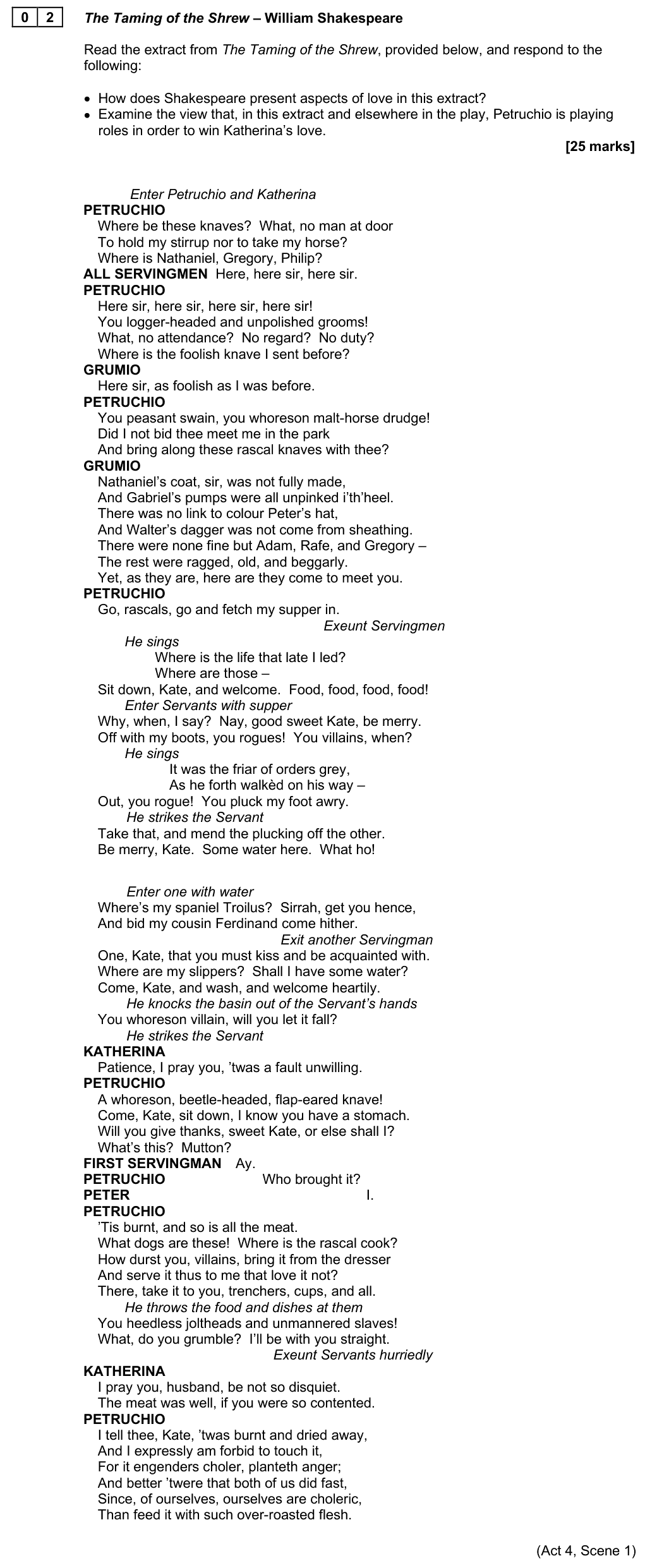
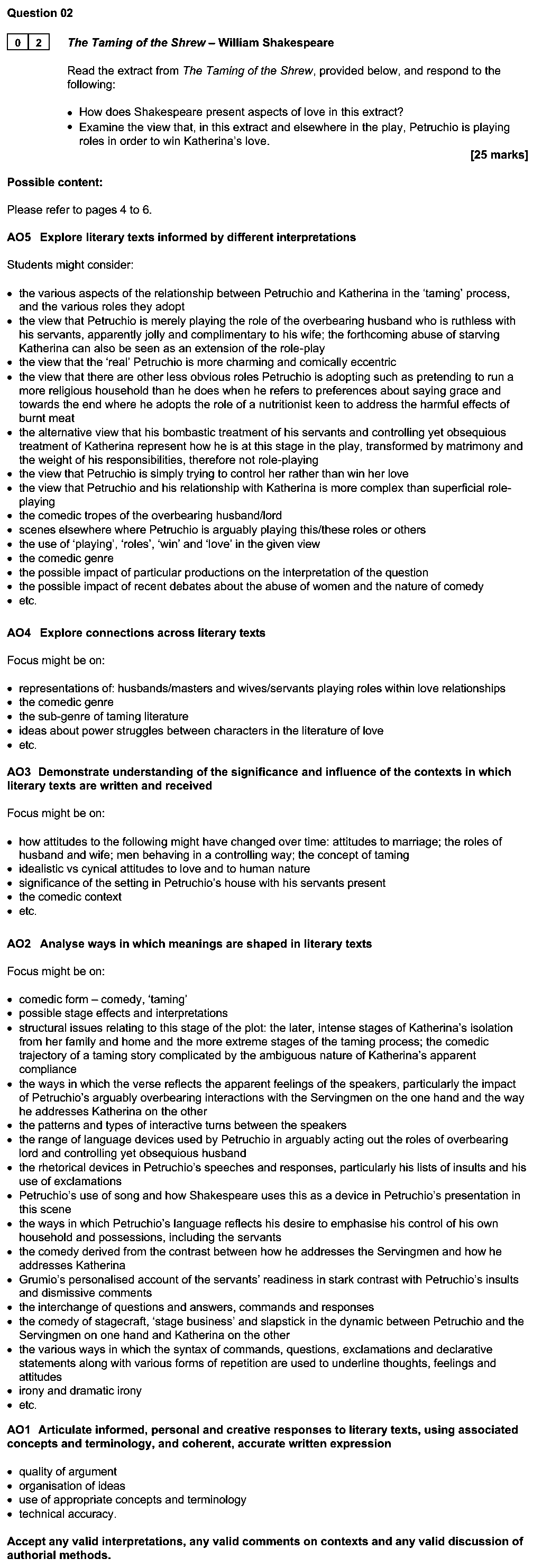
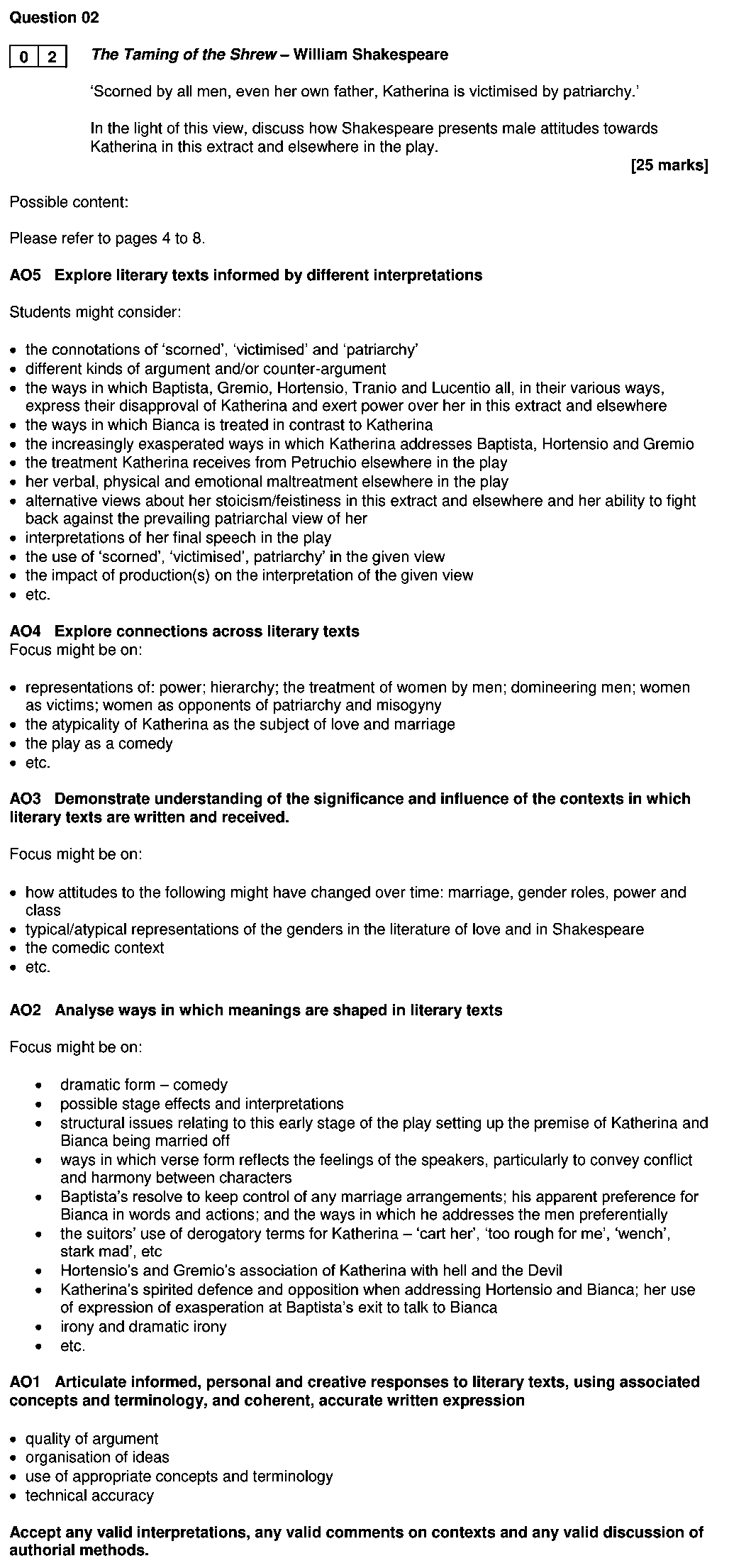
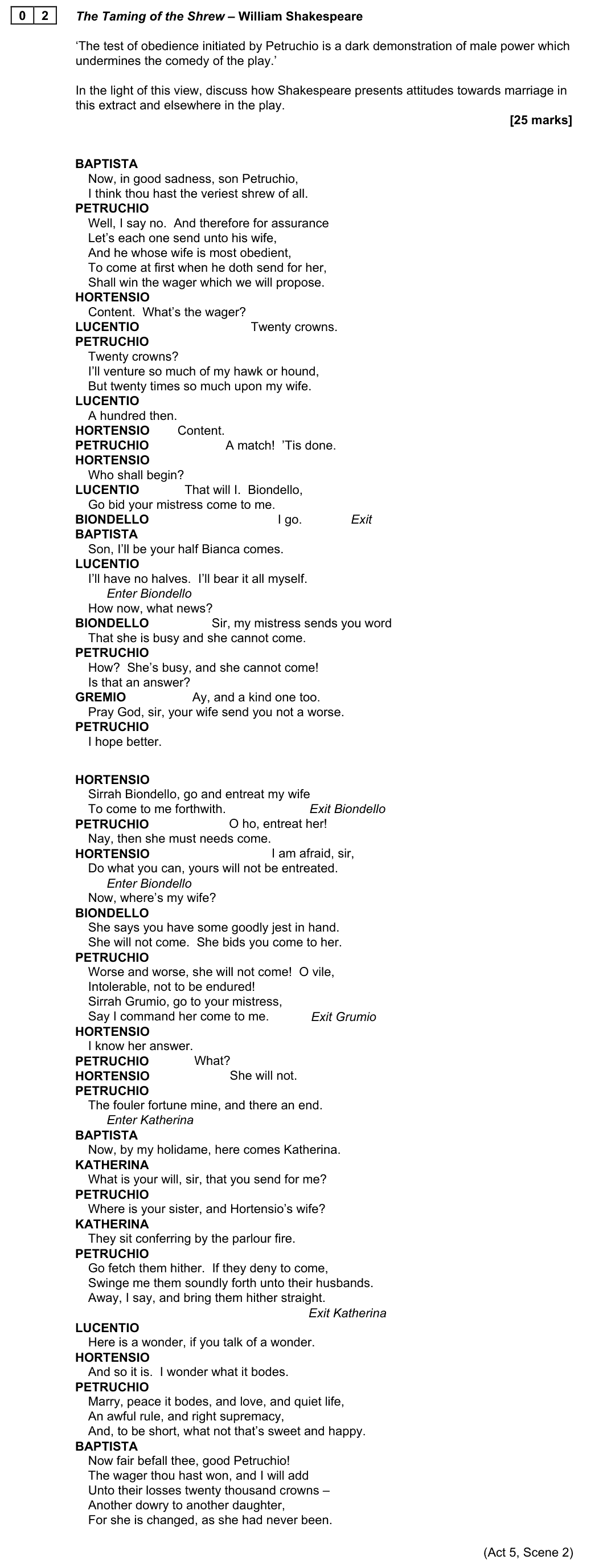
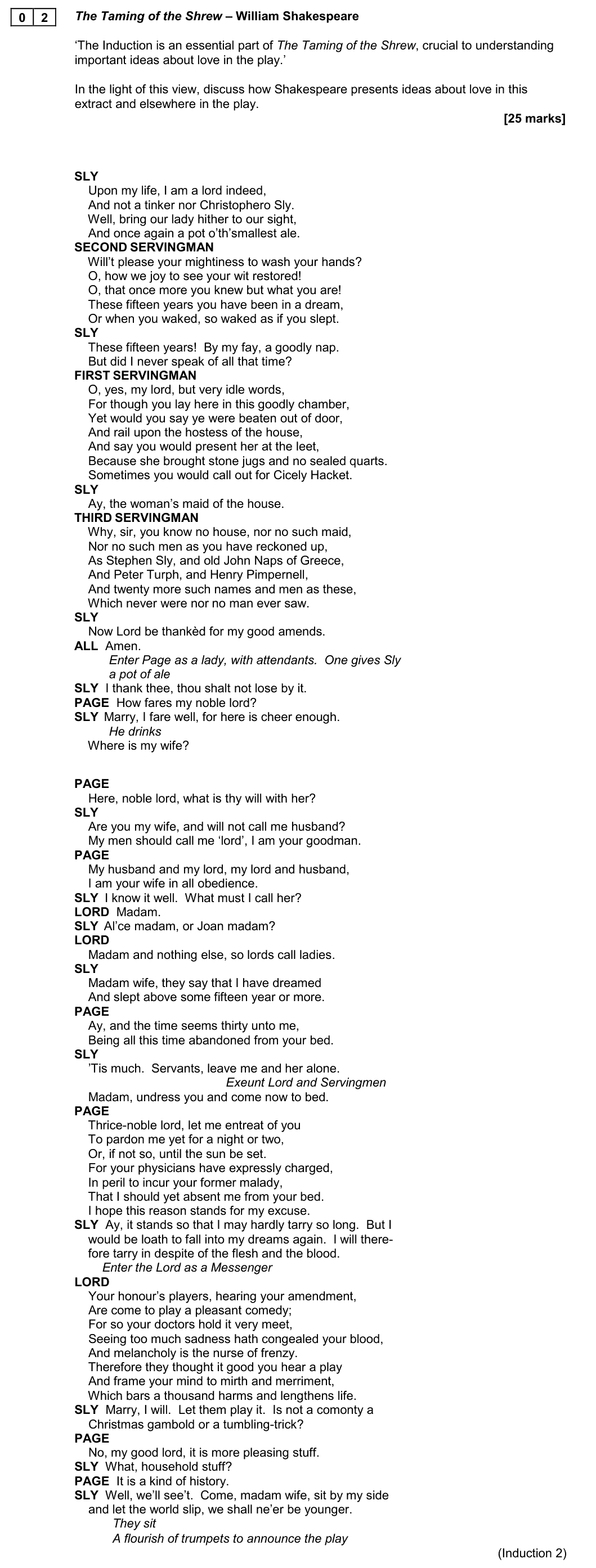
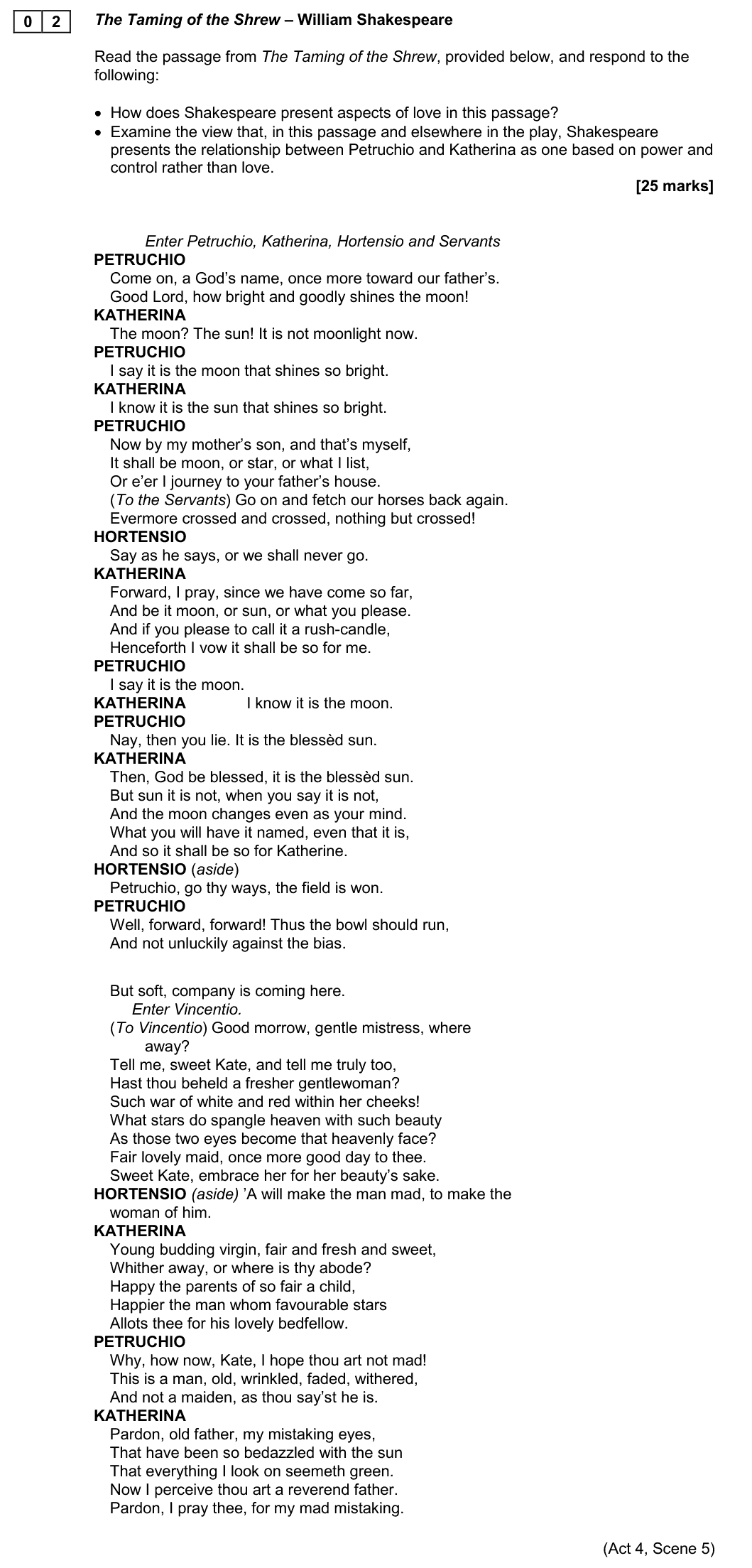
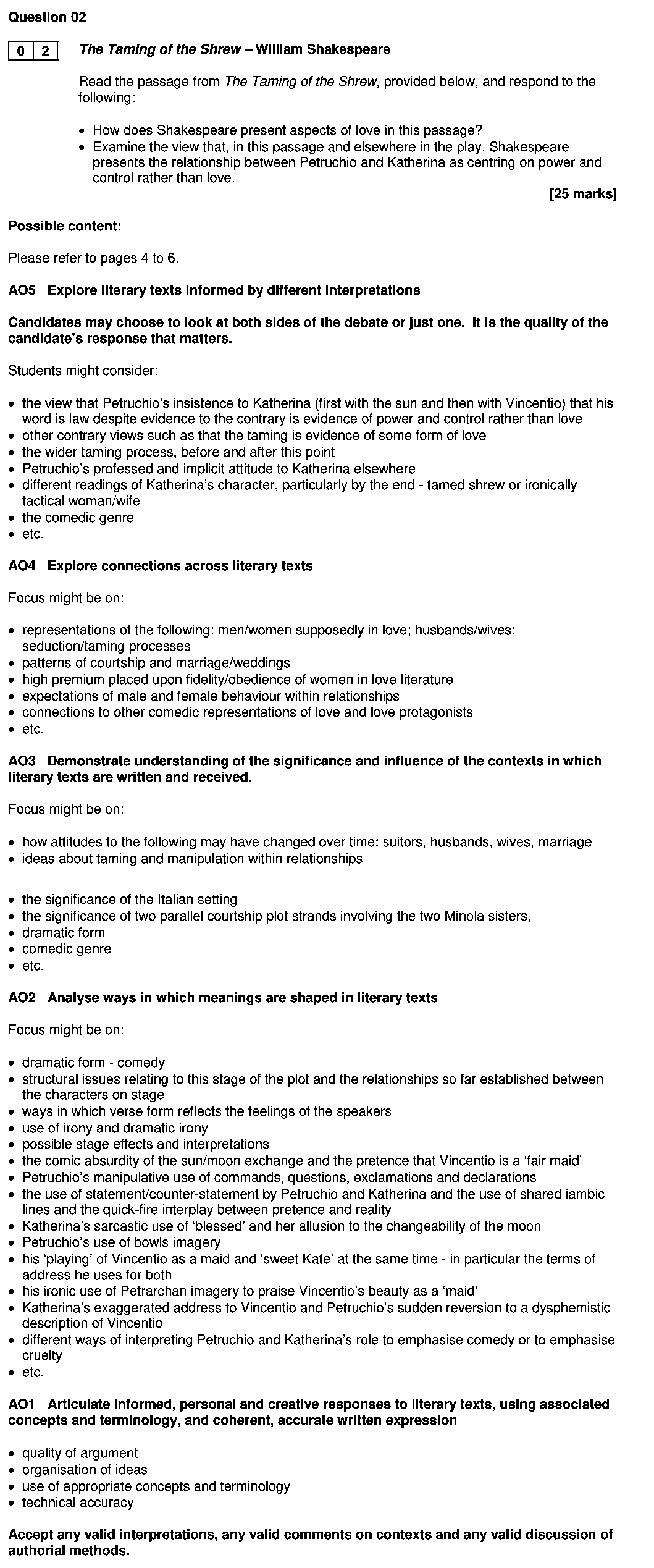
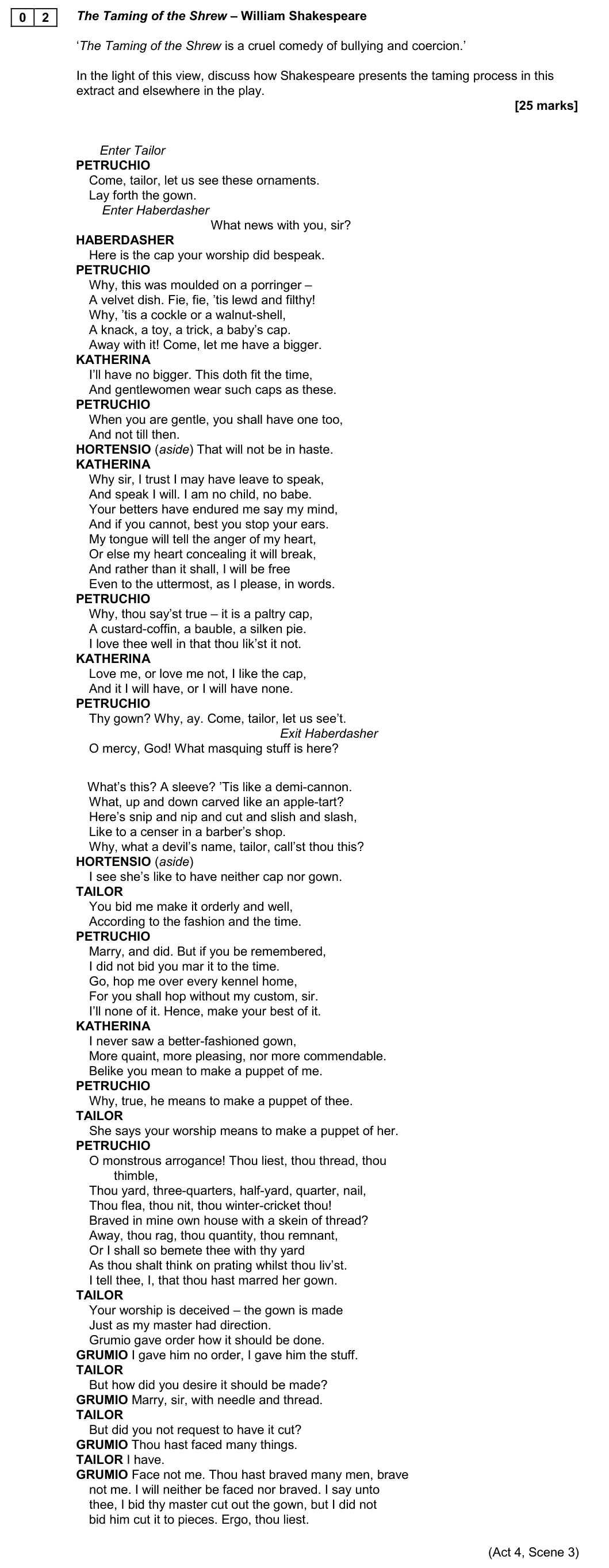
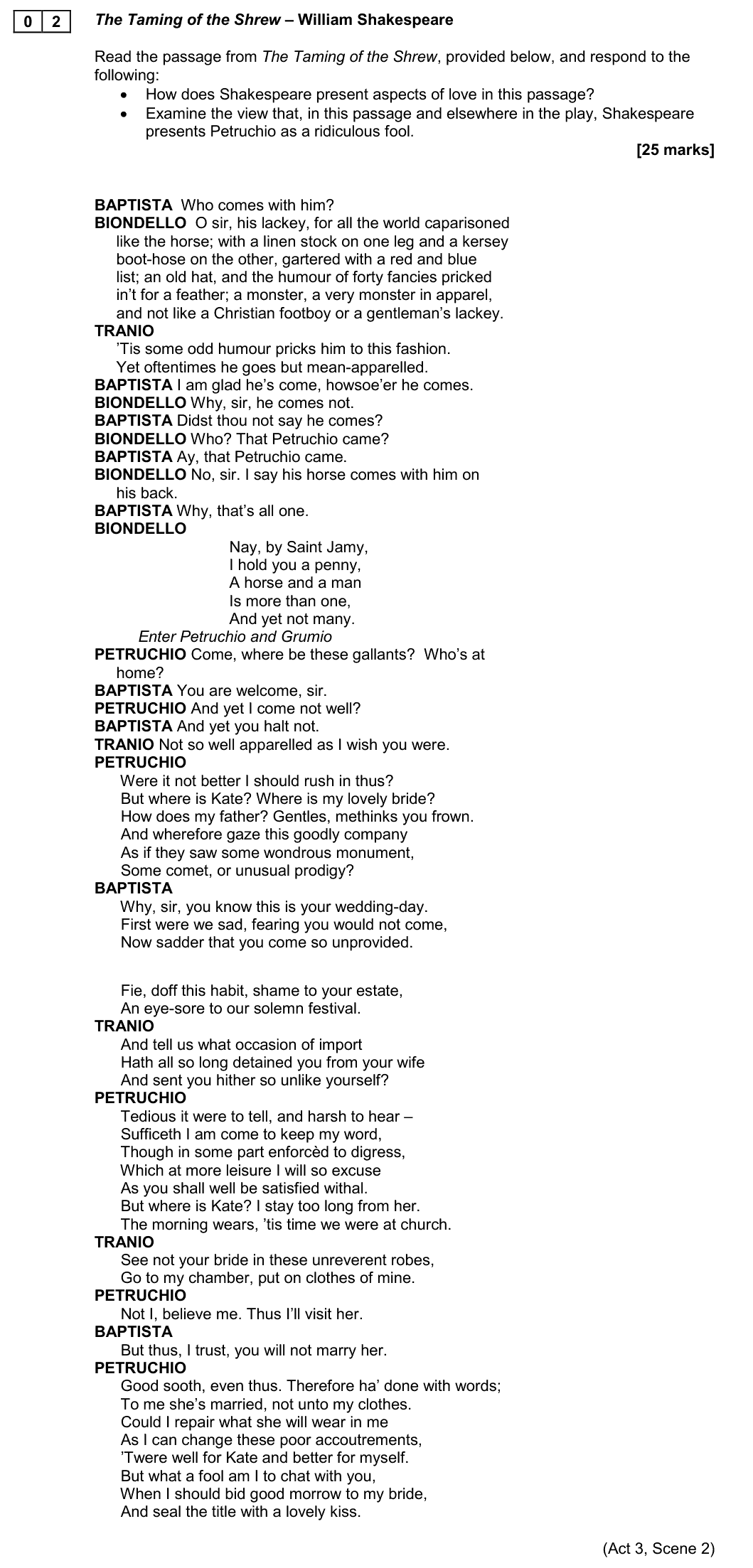
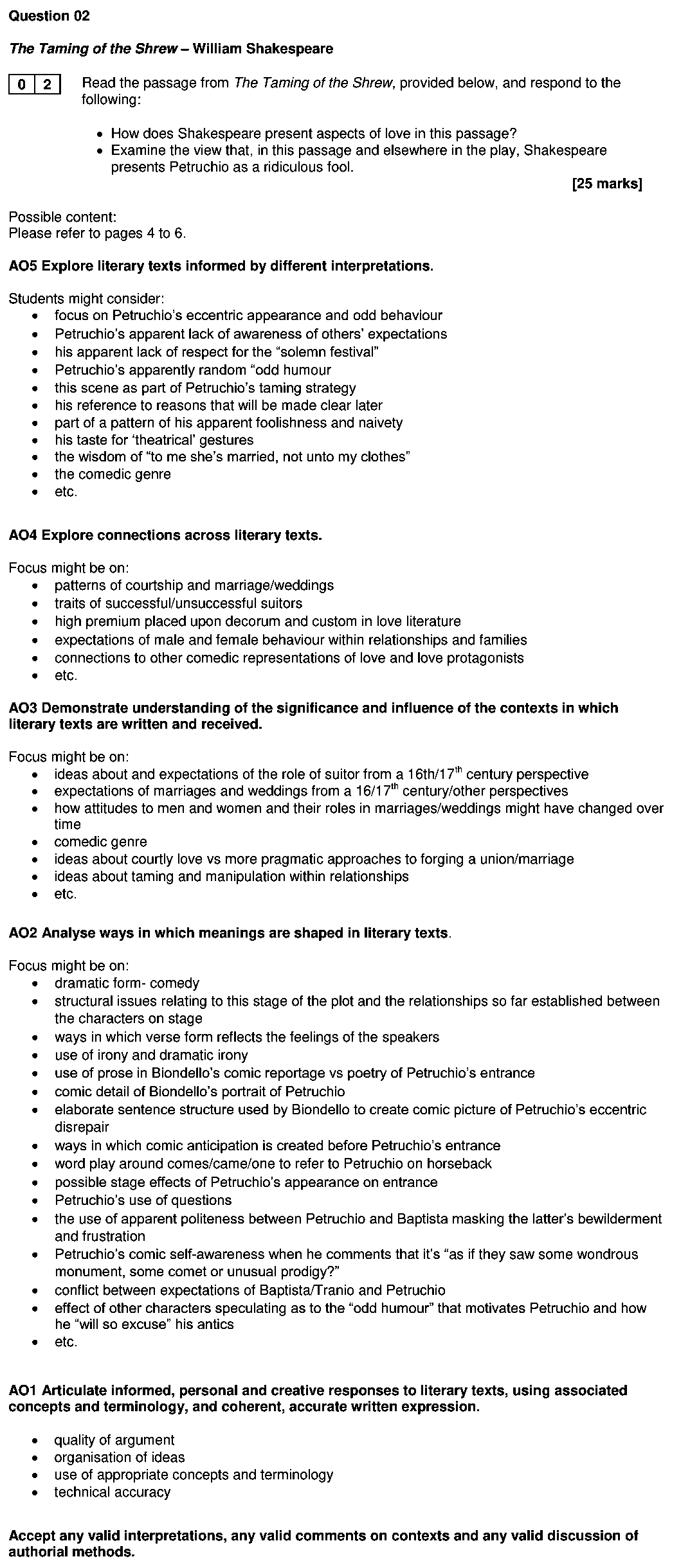
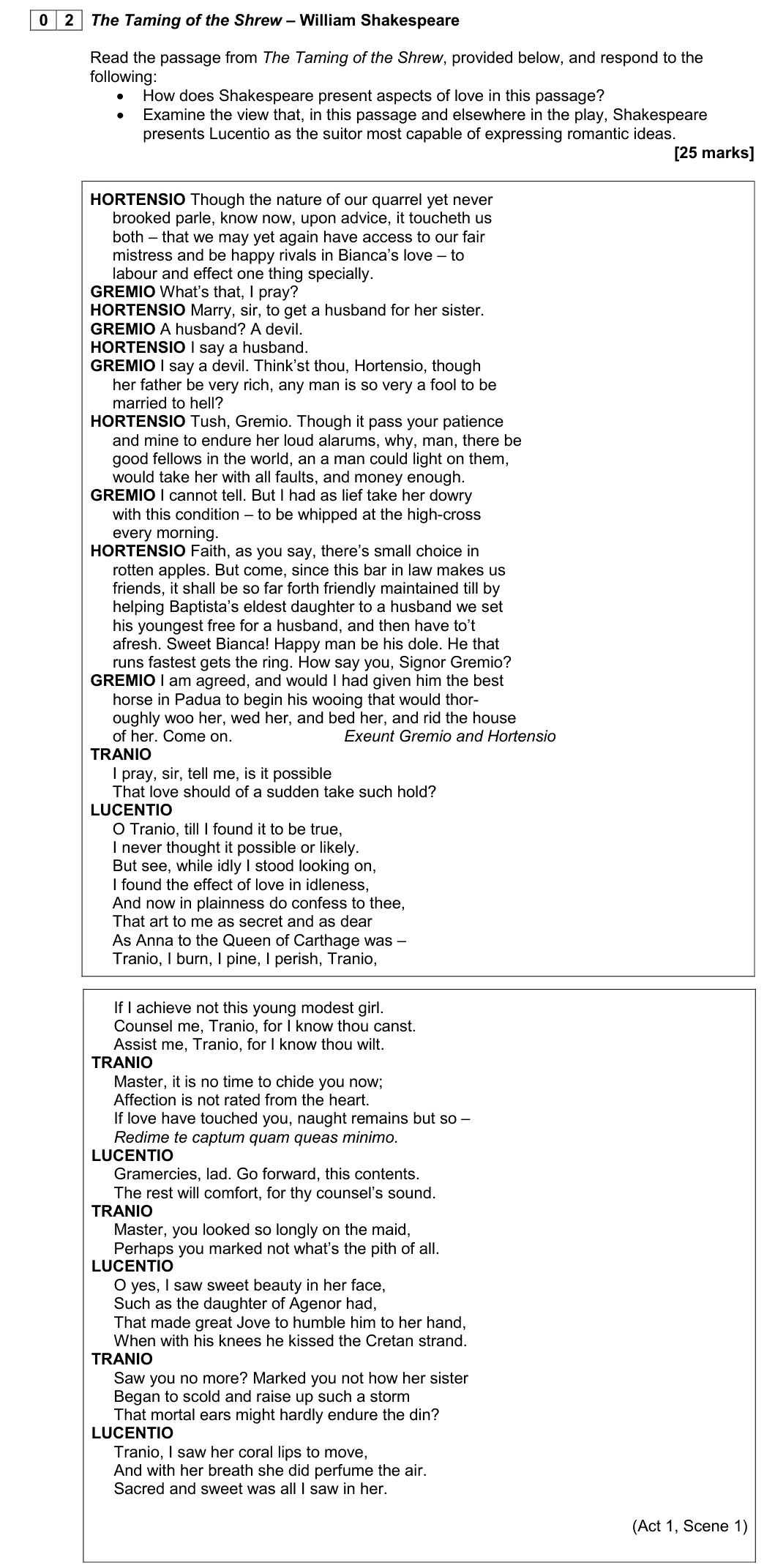
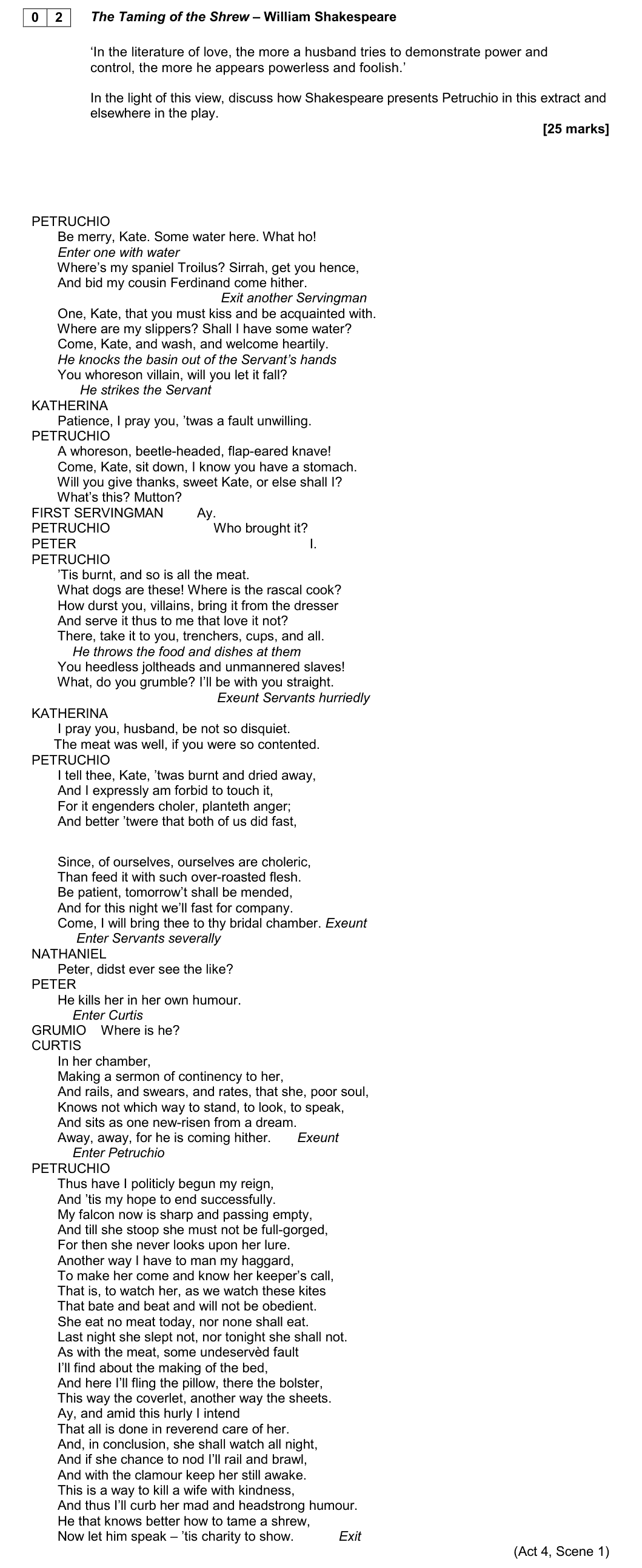
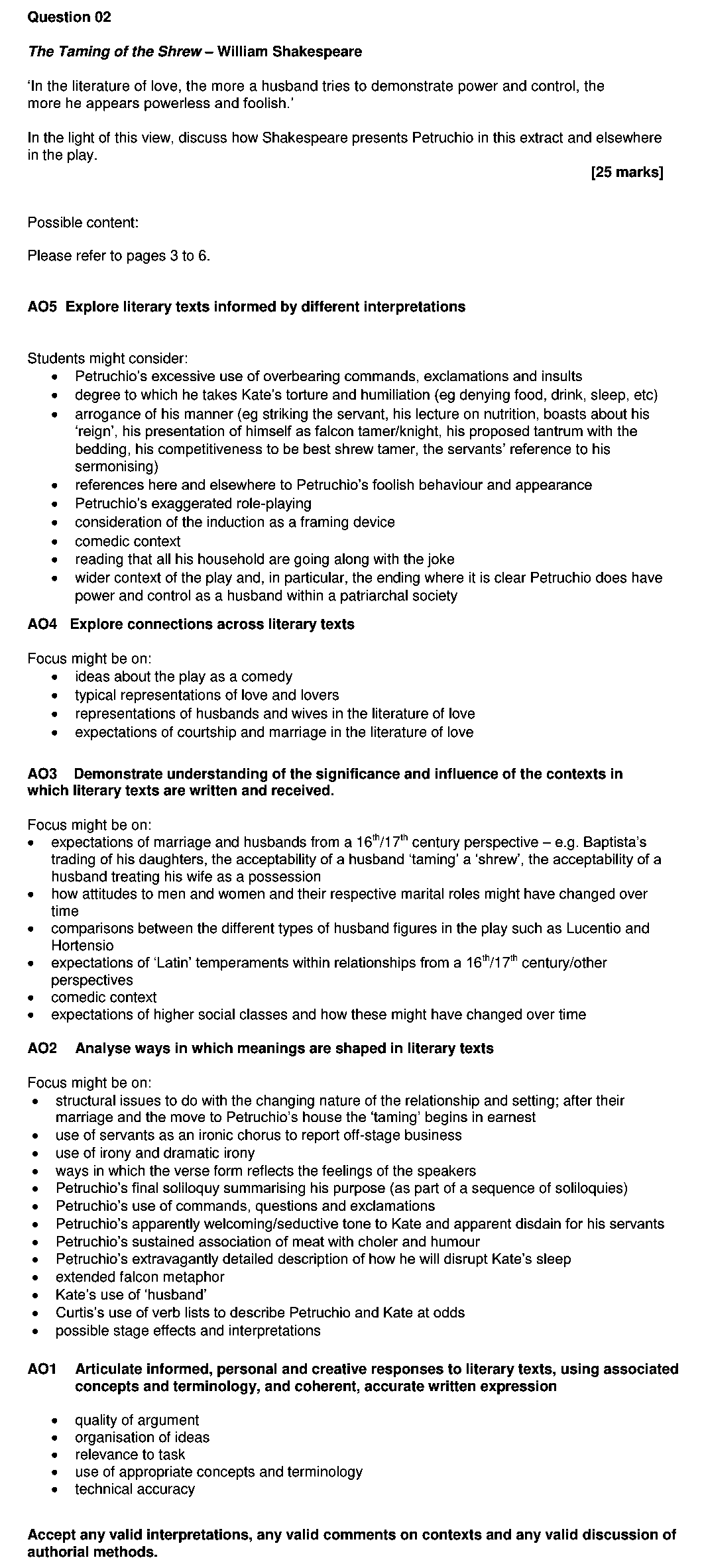
June 2025 · AS Paper 1 · Q2 25 marks Shakespeare extract taming of the shrew
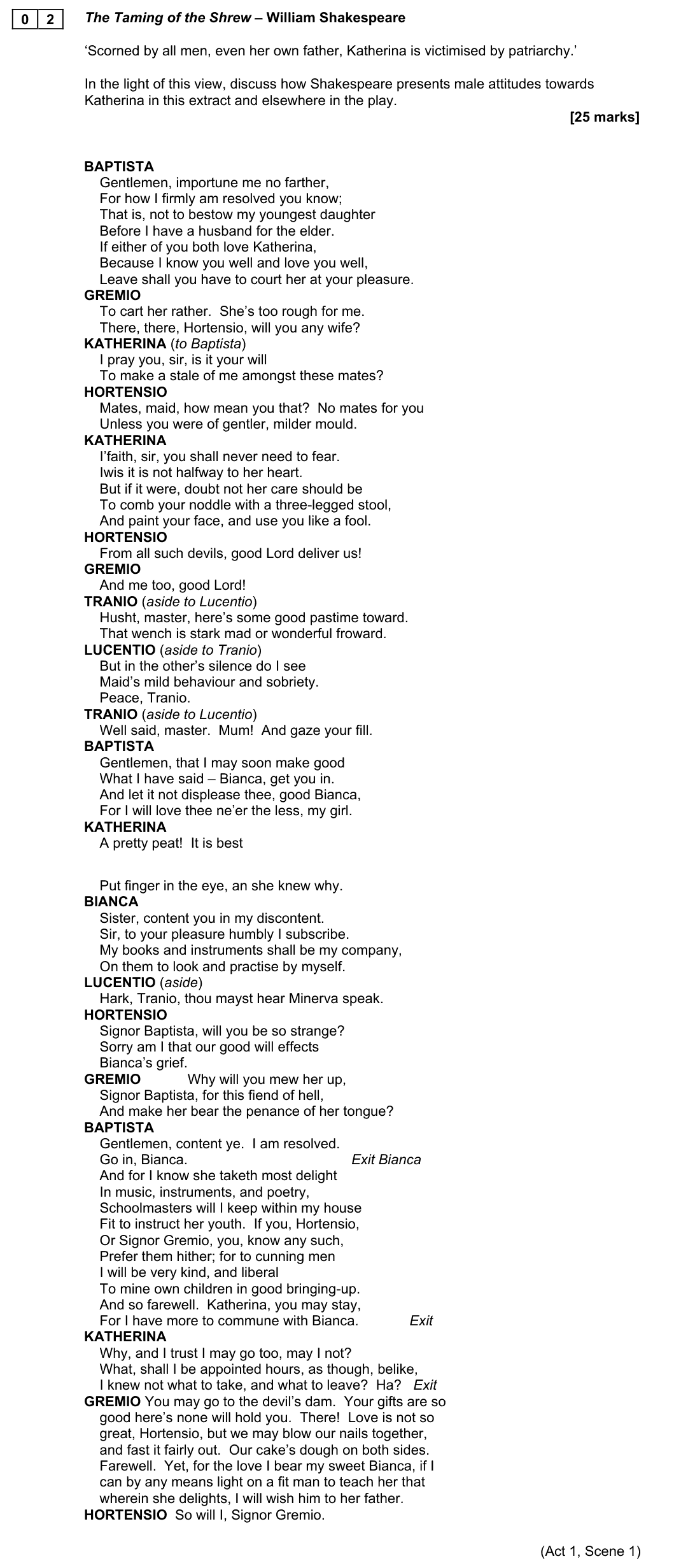
The Taming of the Shrew – William Shakespeare
Read the extract from The Taming of the Shrew, provided below, and respond to the
following:
• How does Shakespeare present aspects of love in this extract?
• Examine the view that, in this extract and elsewhere in the play, Petruchio is playing
roles in order to win Katherina’s love.
[25 marks]
Enter Petruchio and Katherina
PETRUCHIO
Where be these knaves? What, no man at door
To hold my stirrup nor to take my horse?
Where is Nathaniel, Gregory, Philip?
ALL SERVINGMEN Here, here sir, here sir.
PETRUCHIO
Here sir, here sir, here sir, here sir!
You logger-headed and unpolished grooms!
What, no attendance? No regard? No duty?
Where is the foolish knave I sent before?
GRUMIO
Here sir, as foolish as I was before.
PETRUCHIO
You peasant swain, you whoreson malt-horse drudge!
Did I not bid thee meet me in the park
And bring along these rascal knaves with thee?
GRUMIO
Nathaniel’s coat, sir, was not fully made,
And Gabriel’s pumps were all unpinked i’th’heel.
There was no link to colour Peter’s hat,
And Walter’s dagger was not come from sheathing.
There were none fine but Adam, Rafe, and Gregory –
The rest were ragged, old, and beggarly.
Yet, as they are, here are they come to meet you.
PETRUCHIO
Go, rascals, go and fetch my supper in.
Exeunt Servingmen
He sings
Where is the life that late I led?
Where are those –
Sit down, Kate, and welcome. Food, food, food, food!
Enter Servants with supper
Why, when, I say? Nay, good sweet Kate, be merry.
Off with my boots, you rogues! You villains, when?
He sings
It was the friar of orders grey,
As he forth walkèd on his way –
Out, you rogue! You pluck my foot awry.
He strikes the Servant
Take that, and mend the plucking off the other.
Be merry, Kate. Some water here. What ho!
Enter one with water
Where’s my spaniel Troilus? Sirrah, get you hence,
And bid my cousin Ferdinand come hither.
Exit another Servingman
One, Kate, that you must kiss and be acquainted with.
Where are my slippers? Shall I have some water?
Come, Kate, and wash, and welcome heartily.
He knocks the basin out of the Servant’s hands
You whoreson villain, will you let it fall?
He strikes the Servant
KATHERINA
Patience, I pray you, ’twas a fault unwilling.
PETRUCHIO
A whoreson, beetle-headed, flap-eared knave!
Come, Kate, sit down, I know you have a stomach.
Will you give thanks, sweet Kate, or else shall I?
What’s this? Mutton?
FIRST SERVINGMAN Ay.
PETRUCHIO
Who brought it?
PETER
I.
PETRUCHIO
’Tis burnt, and so is all the meat.
What dogs are these! Where is the rascal cook?
How durst you, villains, bring it from the dresser
And serve it thus to me that love it not?
There, take it to you, trenchers, cups, and all.
He throws the food and dishes at them
You heedless joltheads and unmannered slaves!
What, do you grumble? I’ll be with you straight.
Exeunt Servants hurriedly
KATHERINA
I pray you, husband, be not so disquiet.
The meat was well, if you were so contented.
PETRUCHIO
I tell thee, Kate, ’twas burnt and dried away,
And I expressly am forbid to touch it,
For it engenders choler, planteth anger;
And better ’twere that both of us did fast,
Since, of ourselves, ourselves are choleric,
Than feed it with such over-roasted flesh.
(Act 4, Scene 1)
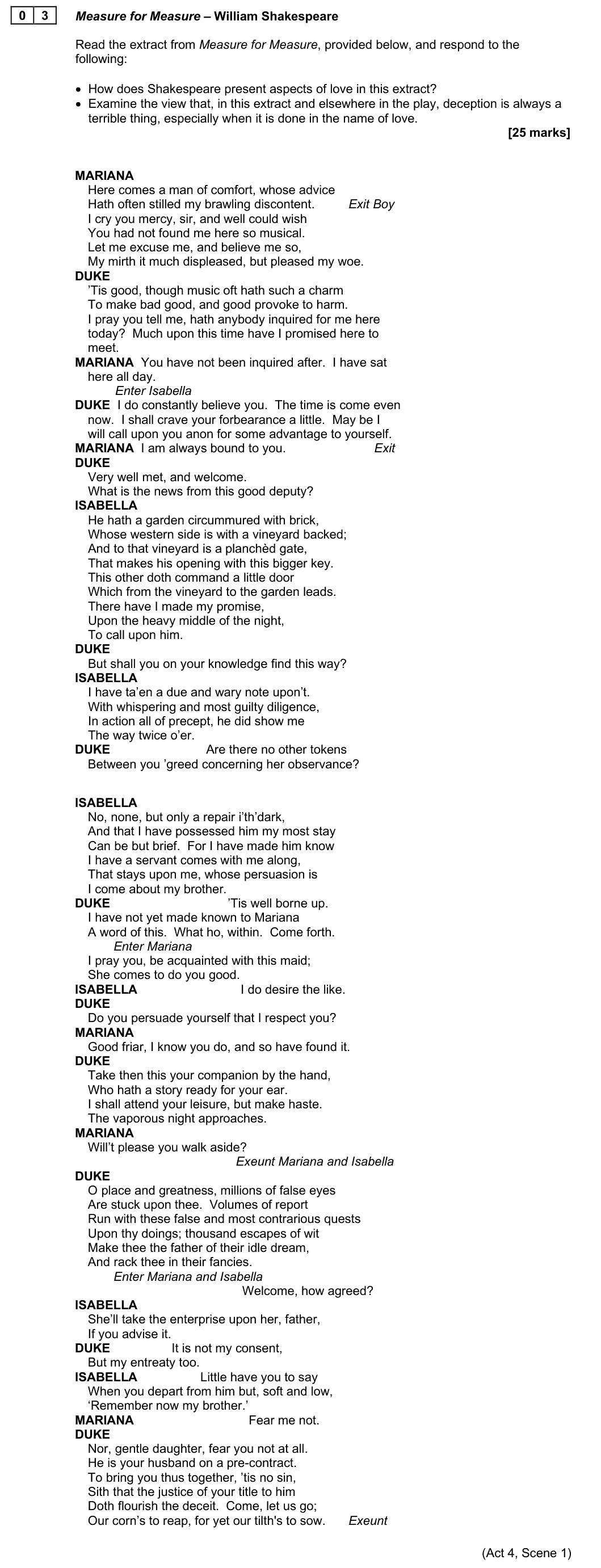
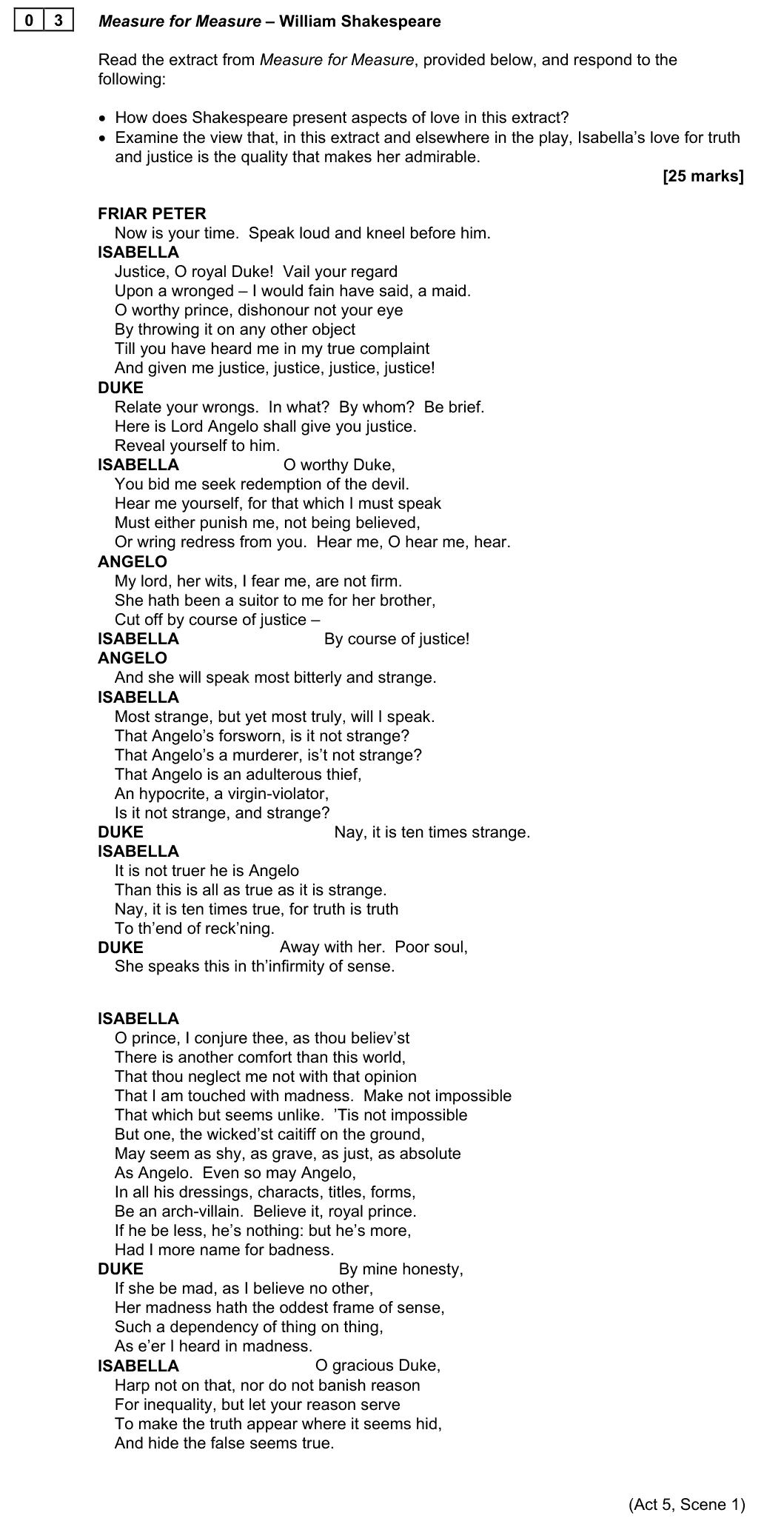
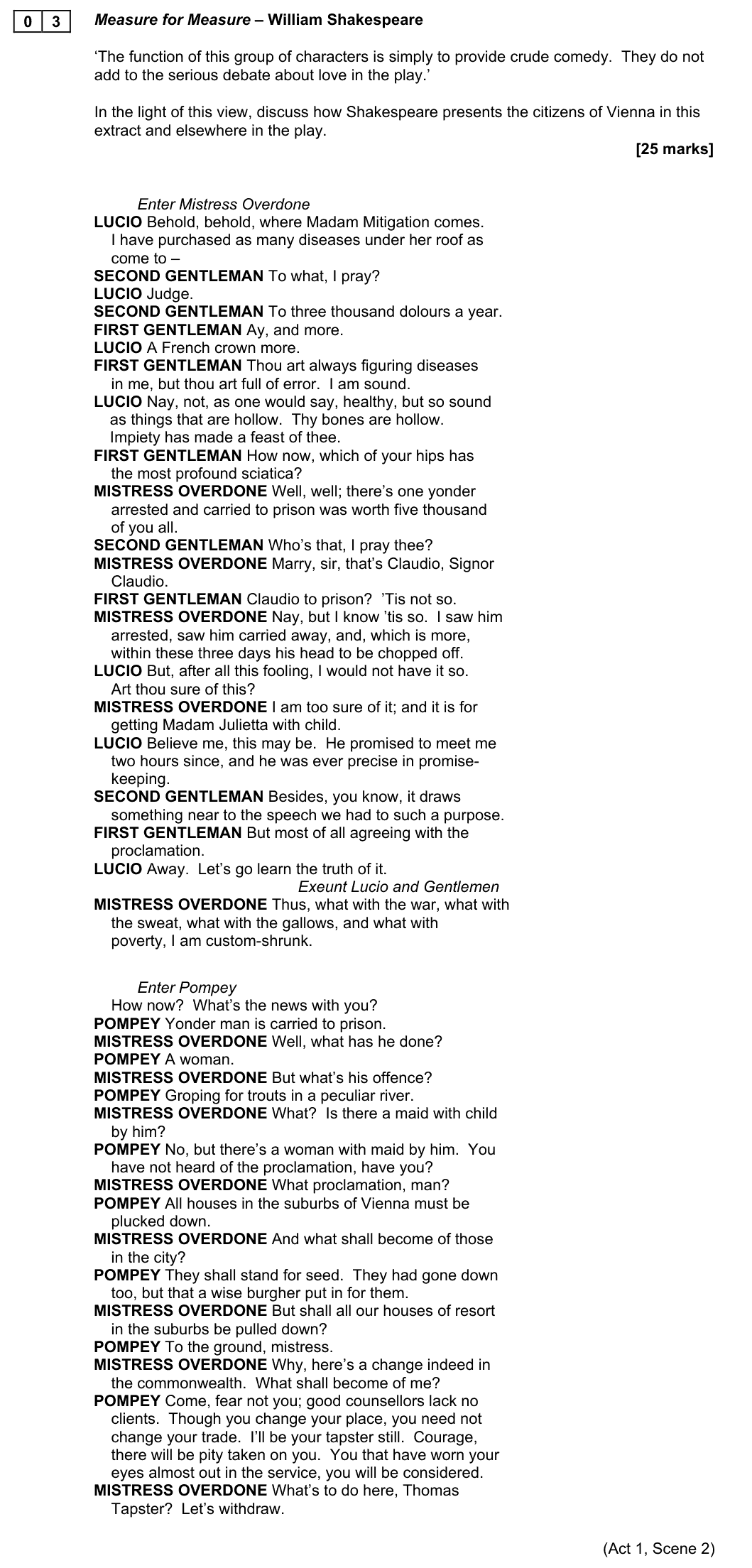
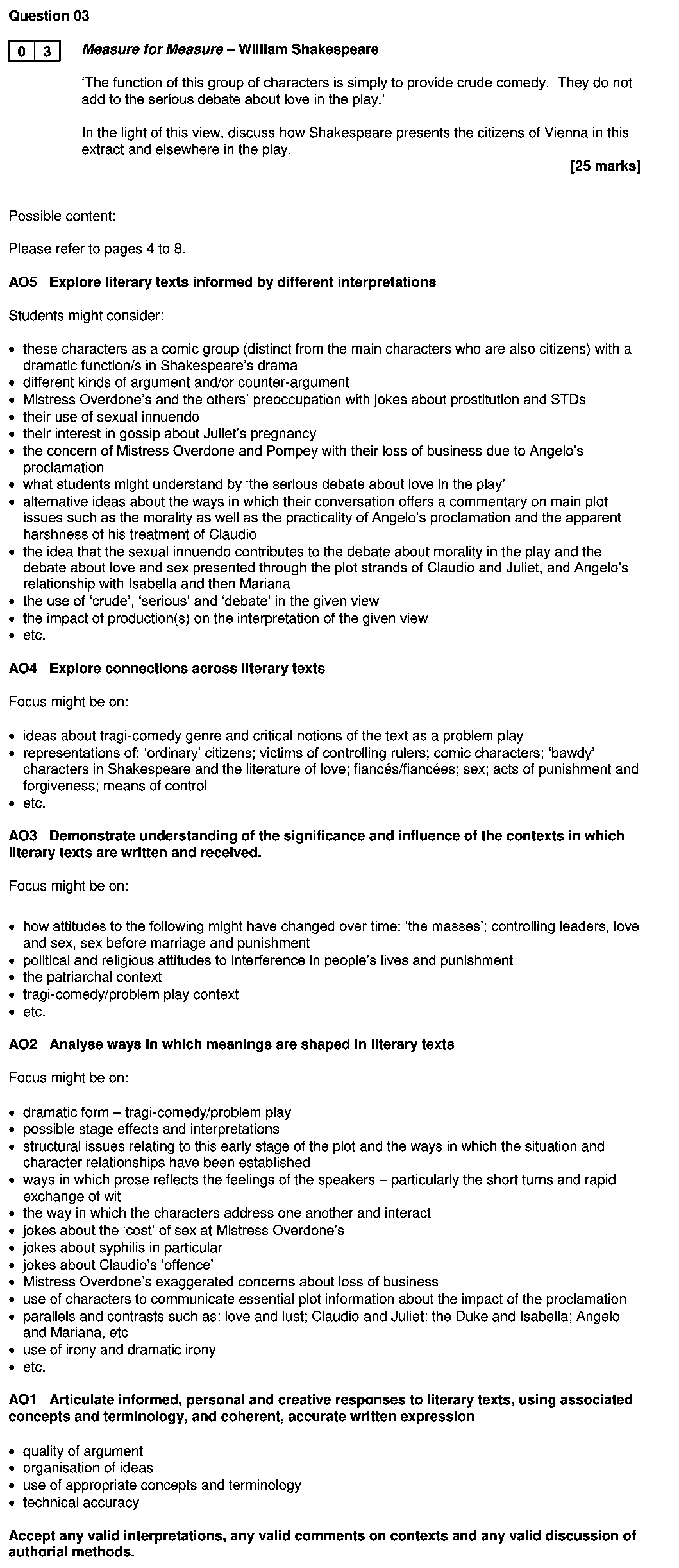
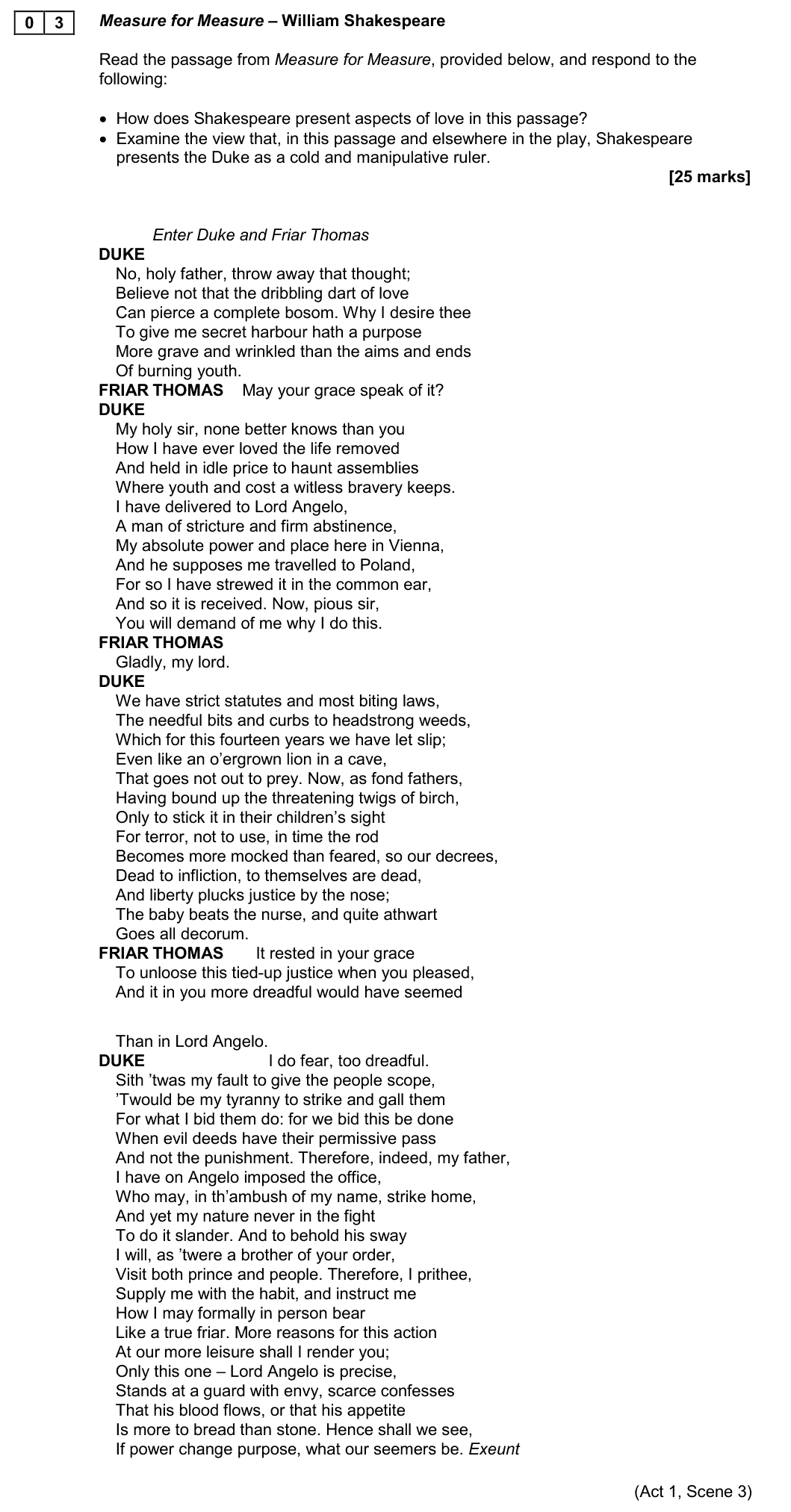
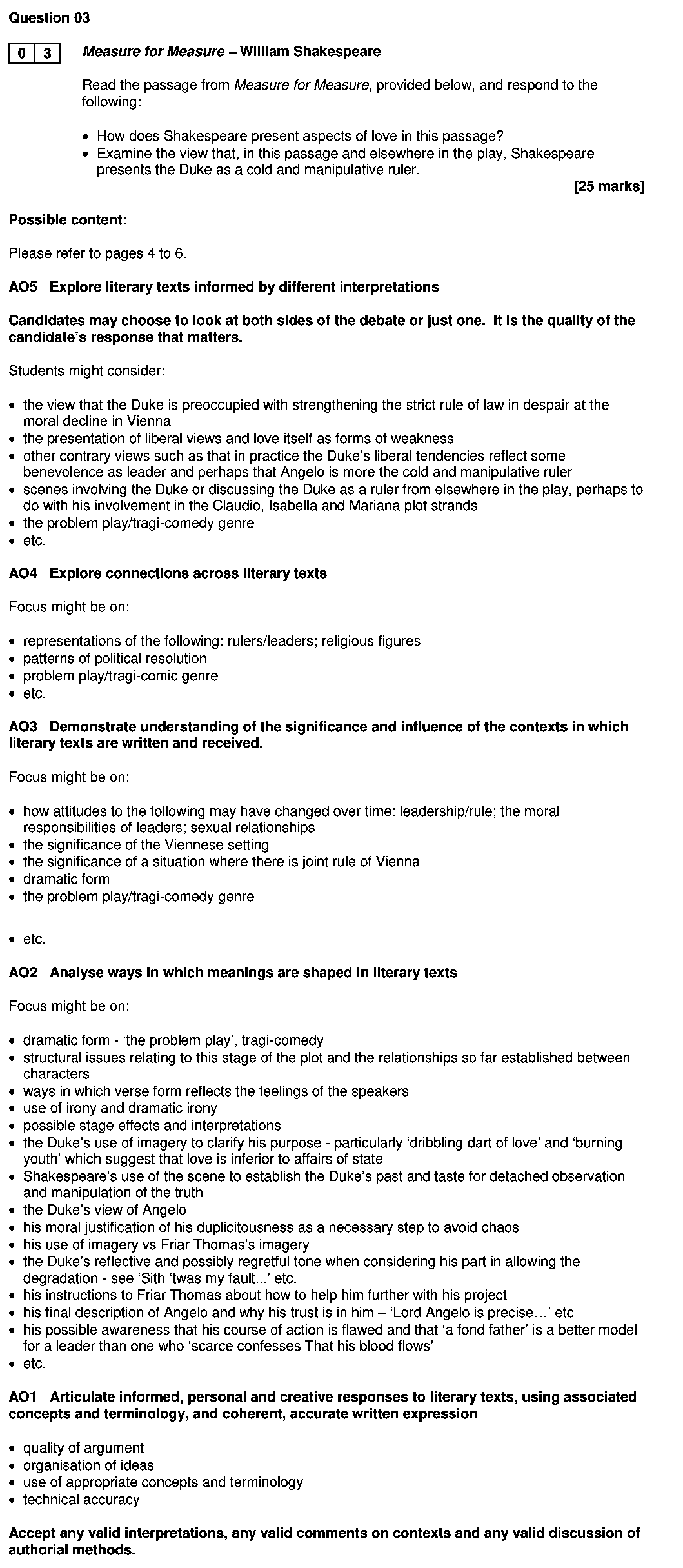
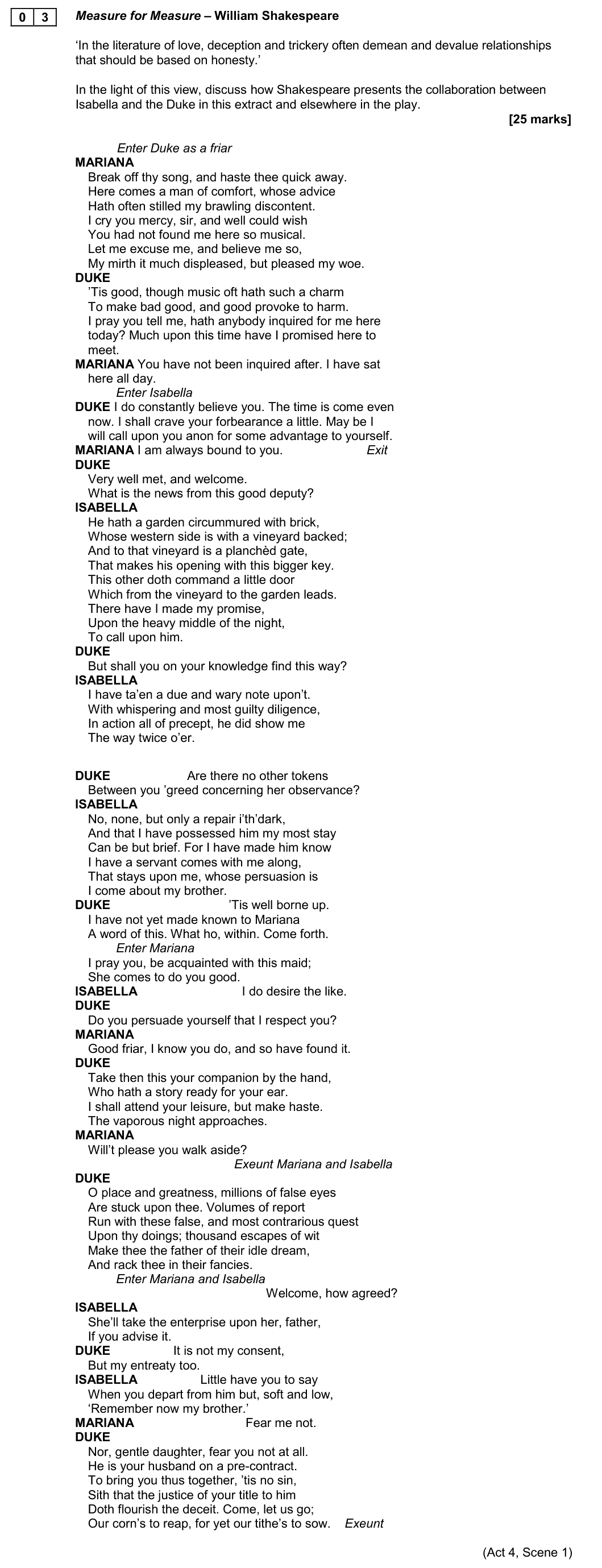
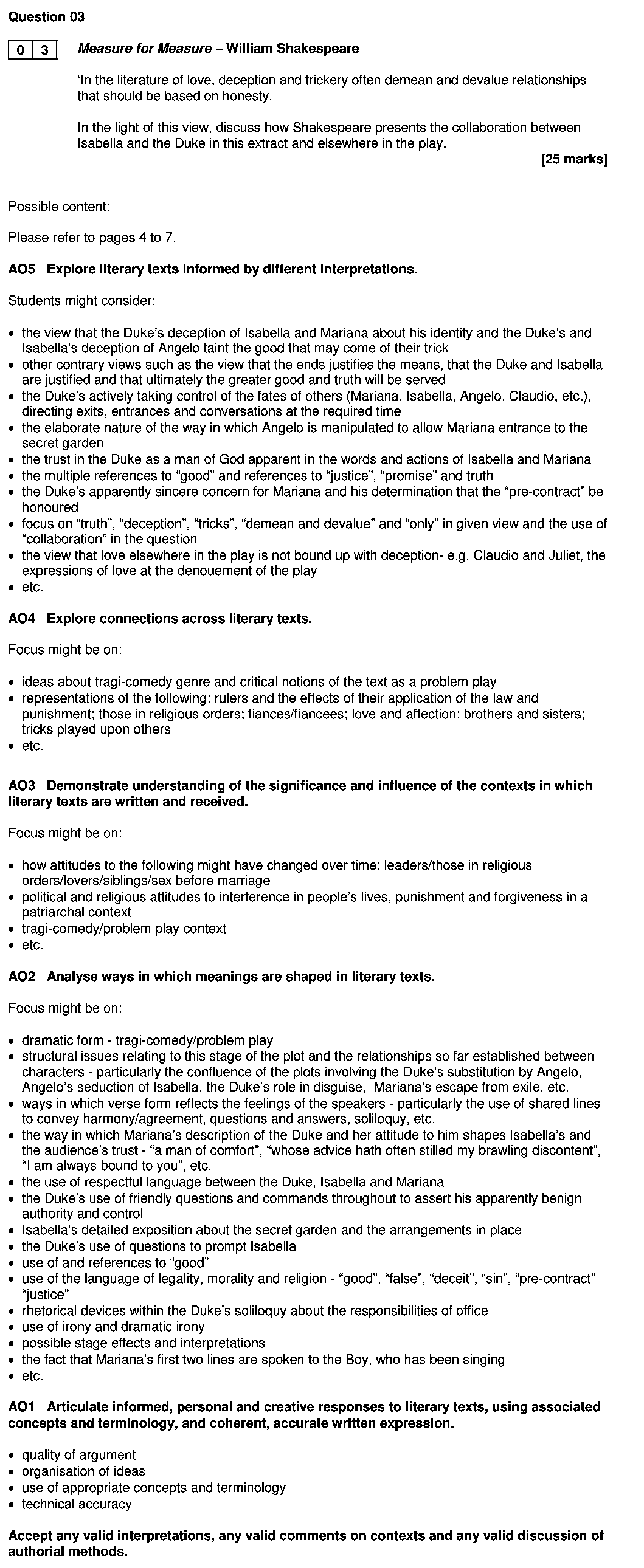
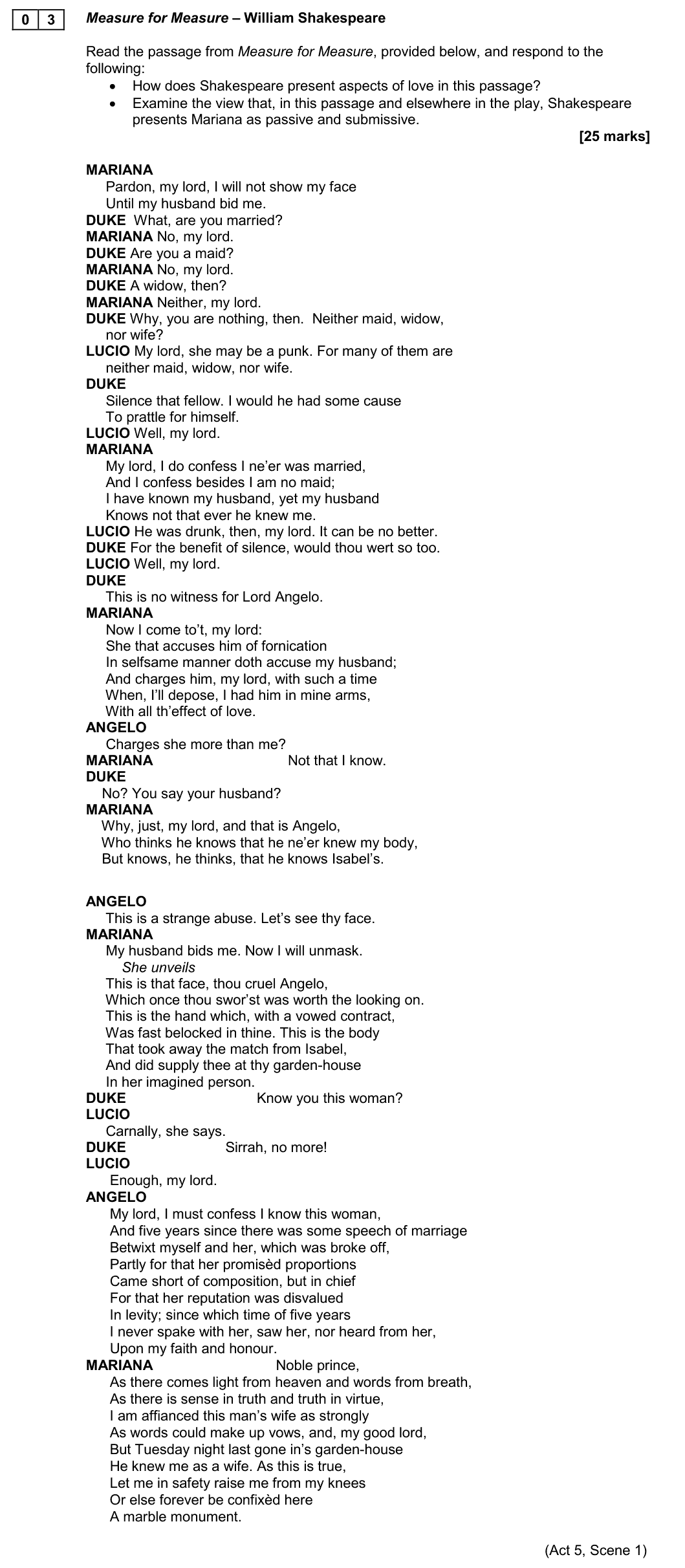
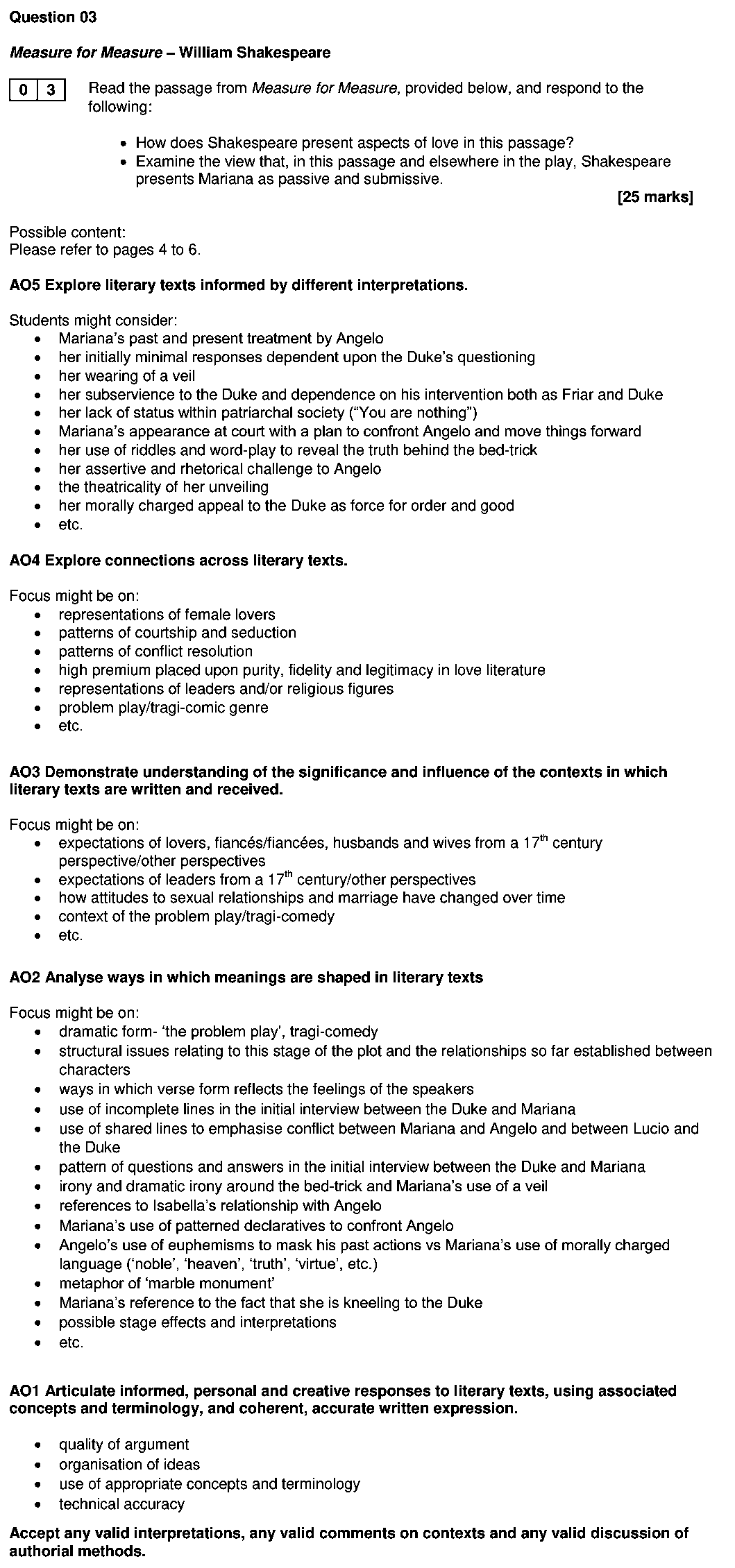
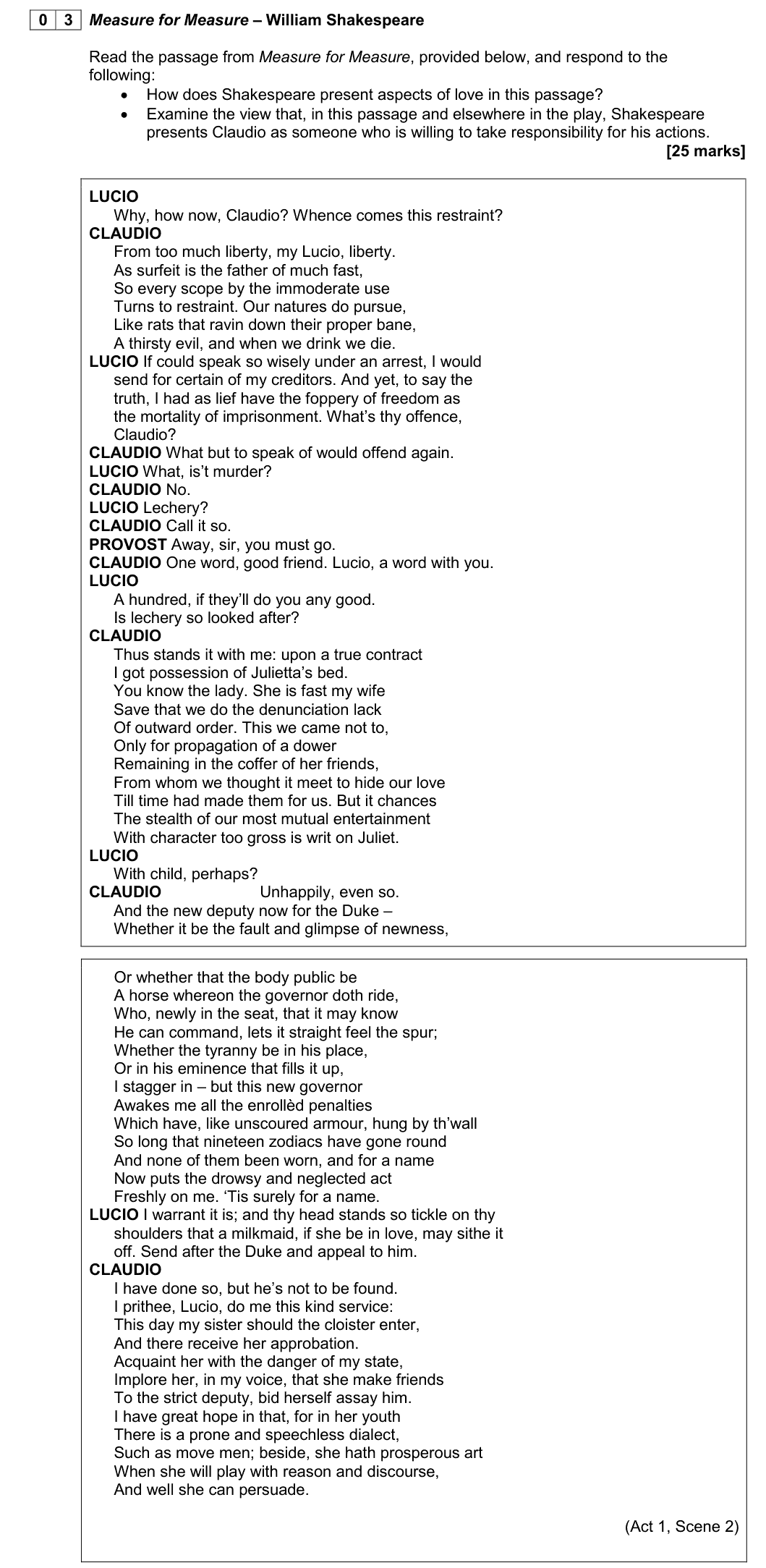
June 2025 · AS Paper 1 · Q3 25 marks Shakespeare extract measure for measure
Measure for Measure – William Shakespeare
Read the extract from Measure for Measure, provided below, and respond to the
following:
• How does Shakespeare present aspects of love in this extract?
• Examine the view that, in this extract and elsewhere in the play, deception is always a
terrible thing, especially when it is done in the name of love.
[25 marks]
MARIANA
Here comes a man of comfort, whose advice
Hath often stilled my brawling discontent.
Exit Boy
I cry you mercy, sir, and well could wish
You had not found me here so musical.
Let me excuse me, and believe me so,
My mirth it much displeased, but pleased my woe.
DUKE
’Tis good, though music oft hath such a charm
To make bad good, and good provoke to harm.
I pray you tell me, hath anybody inquired for me here
today? Much upon this time have I promised here to
meet.
MARIANA You have not been inquired after. I have sat
here all day.
Enter Isabella
DUKE I do constantly believe you. The time is come even
now. I shall crave your forbearance a little. May be I
will call upon you anon for some advantage to yourself.
MARIANA I am always bound to you.
Exit
DUKE
Very well met, and welcome.
What is the news from this good deputy?
ISABELLA
He hath a garden circummured with brick,
Whose western side is with a vineyard backed;
And to that vineyard is a planchèd gate,
That makes his opening with this bigger key.
This other doth command a little door
Which from the vineyard to the garden leads.
There have I made my promise,
Upon the heavy middle of the night,
To call upon him.
DUKE
But shall you on your knowledge find this way?
ISABELLA
I have ta’en a due and wary note upon’t.
With whispering and most guilty diligence,
In action all of precept, he did show me
The way twice o’er.
DUKE
Are there no other tokens
Between you ’greed concerning her observance?
ISABELLA
No, none, but only a repair i’th’dark,
And that I have possessed him my most stay
Can be but brief. For I have made him know
I have a servant comes with me along,
That stays upon me, whose persuasion is
I come about my brother.
DUKE
’Tis well borne up.
I have not yet made known to Mariana
A word of this. What ho, within. Come forth.
Enter Mariana
I pray you, be acquainted with this maid;
She comes to do you good.
ISABELLA
I do desire the like.
DUKE
Do you persuade yourself that I respect you?
MARIANA
Good friar, I know you do, and so have found it.
DUKE
Take then this your companion by the hand,
Who hath a story ready for your ear.
I shall attend your leisure, but make haste.
The vaporous night approaches.
MARIANA
Will’t please you walk aside?
Exeunt Mariana and Isabella
DUKE
O place and greatness, millions of false eyes
Are stuck upon thee. Volumes of report
Run with these false and most contrarious quests
Upon thy doings; thousand escapes of wit
Make thee the father of their idle dream,
And rack thee in their fancies.
Enter Mariana and Isabella
Welcome, how agreed?
ISABELLA
She’ll take the enterprise upon her, father,
If you advise it.
DUKE
It is not my consent,
But my entreaty too.
ISABELLA
Little have you to say
When you depart from him but, soft and low,
‘Remember now my brother.’
MARIANA
Fear me not.
DUKE
Nor, gentle daughter, fear you not at all.
He is your husband on a pre-contract.
To bring you thus together, ’tis no sin,
Sith that the justice of your title to him
Doth flourish the deceit. Come, let us go;
Our corn’s to reap, for yet our tilth's to sow.
Exeunt
(Act 4, Scene 1)
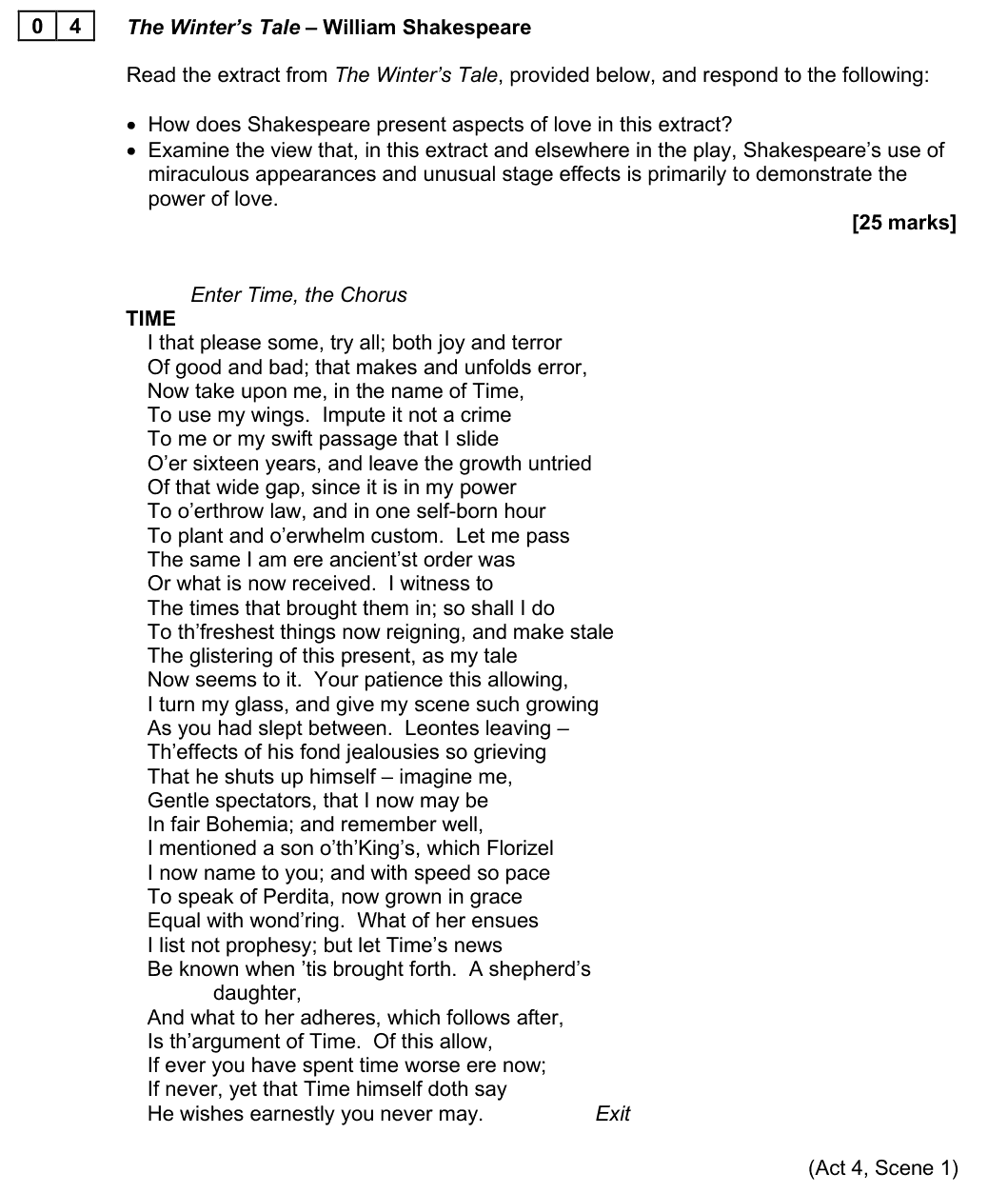
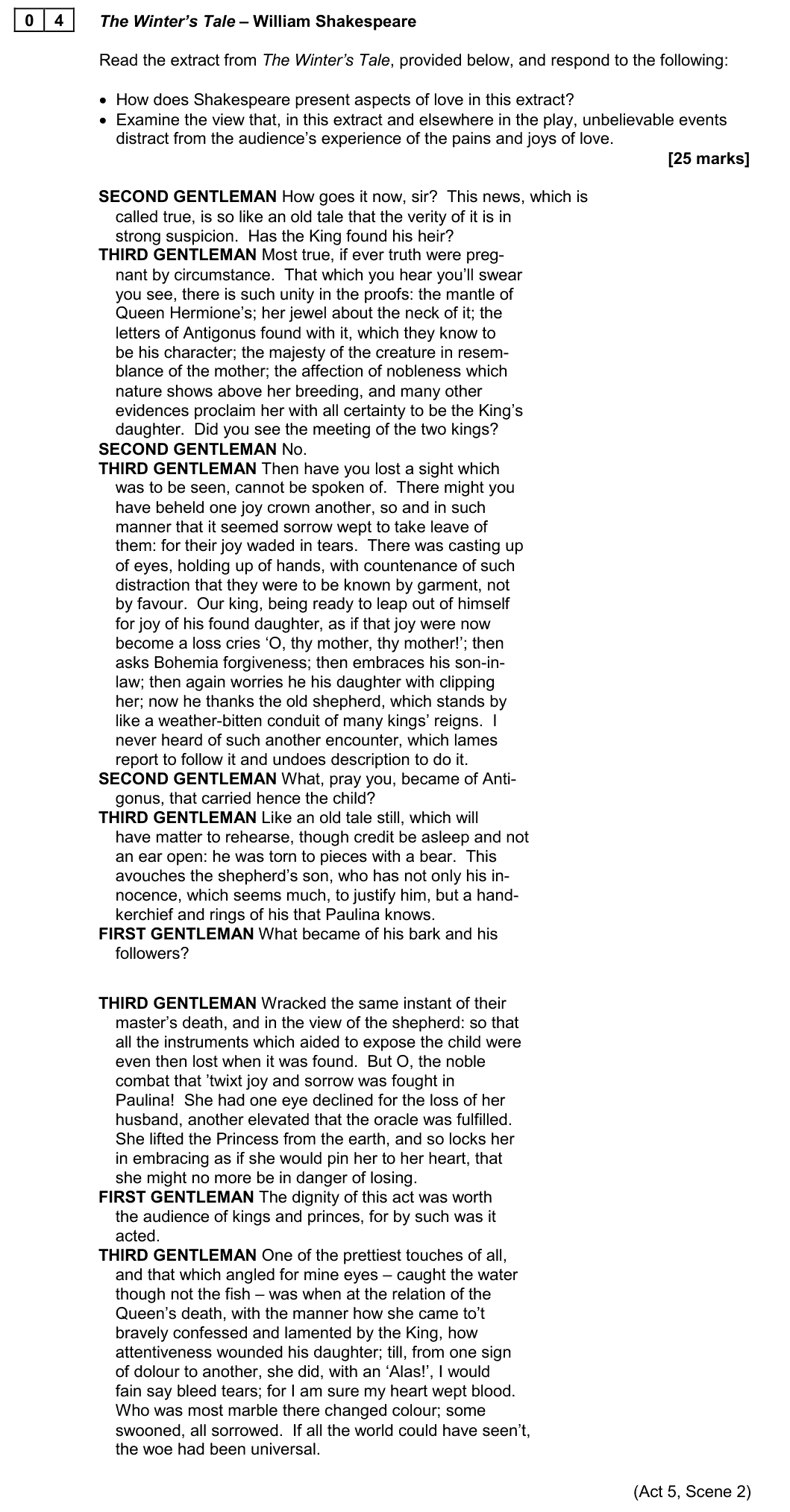
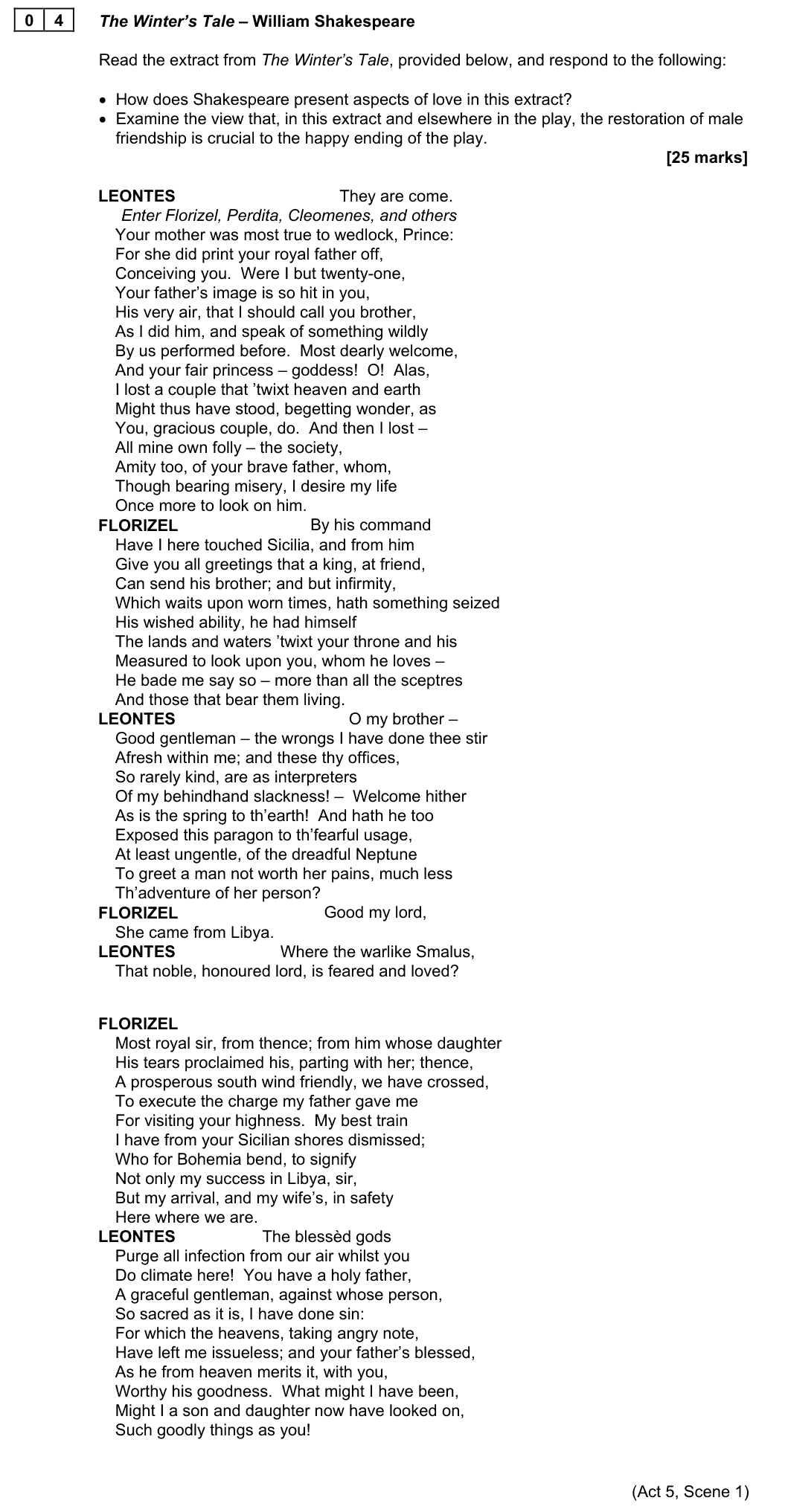
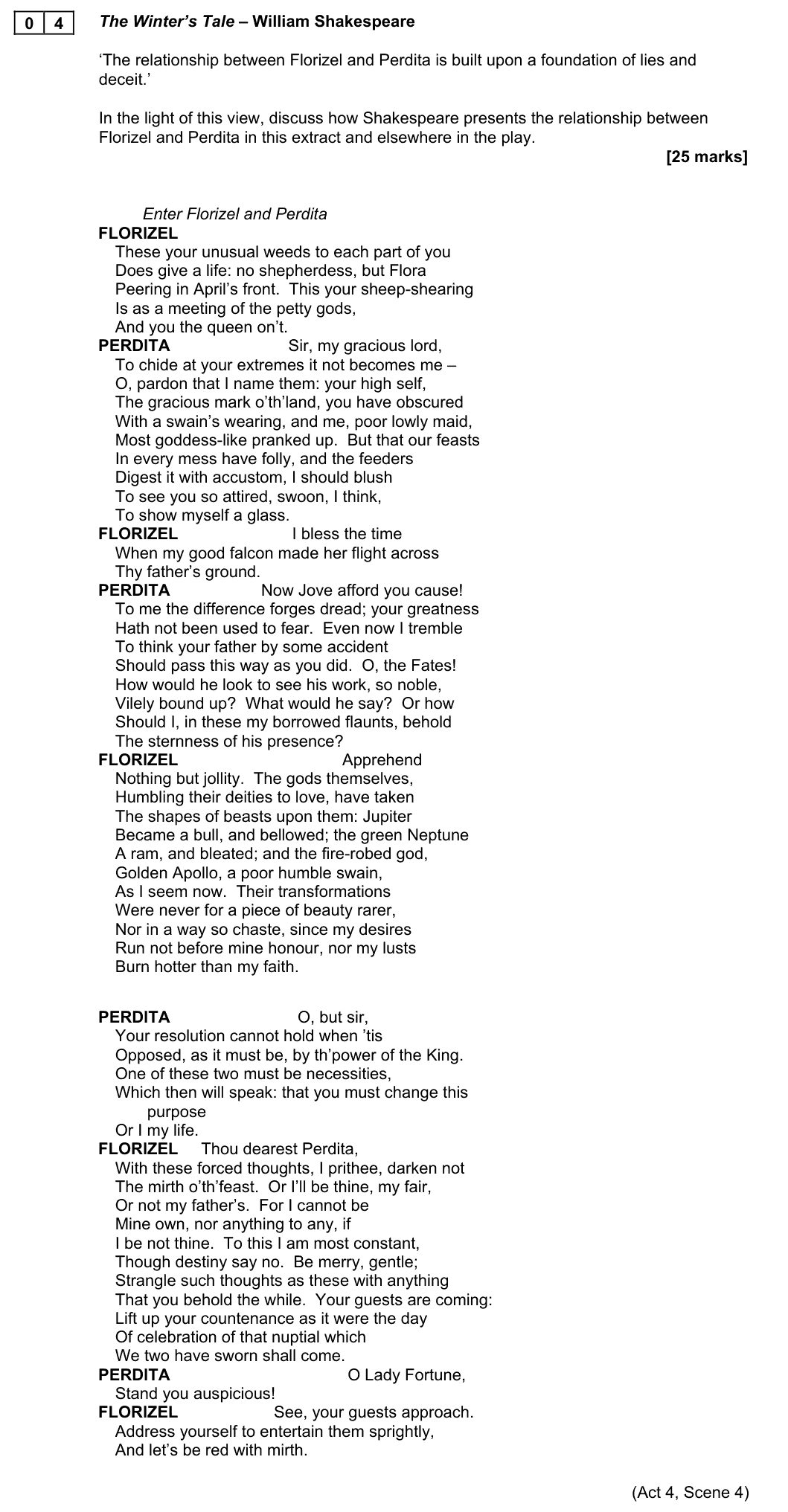
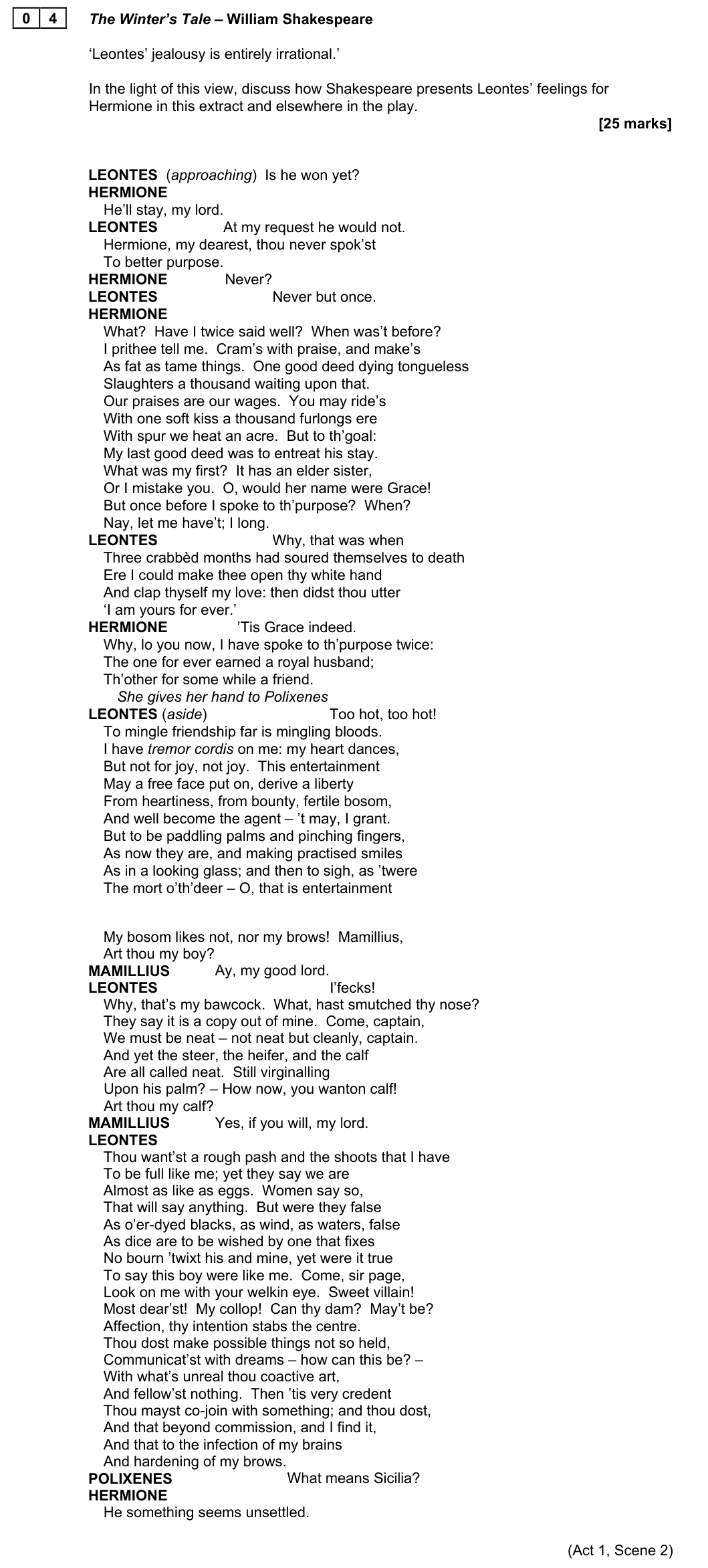
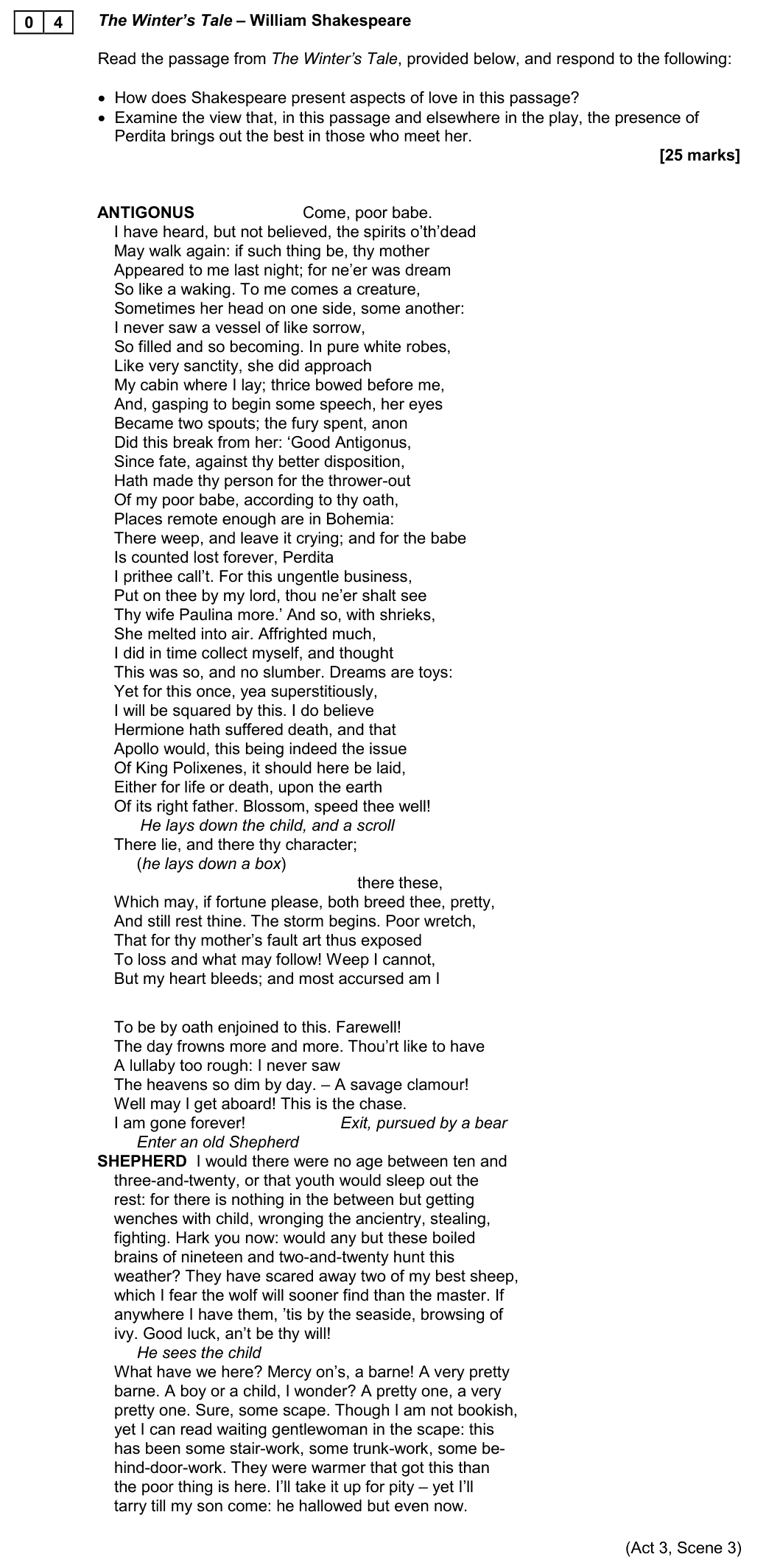
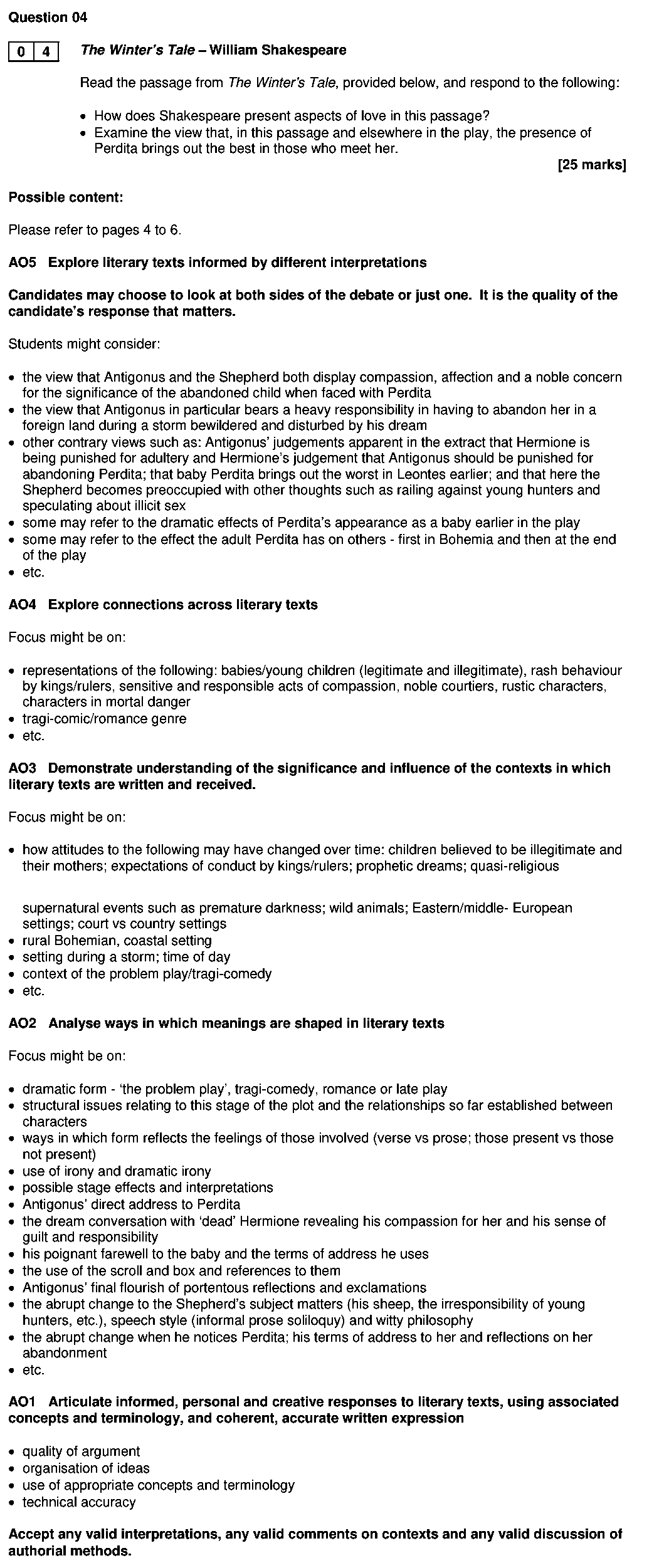
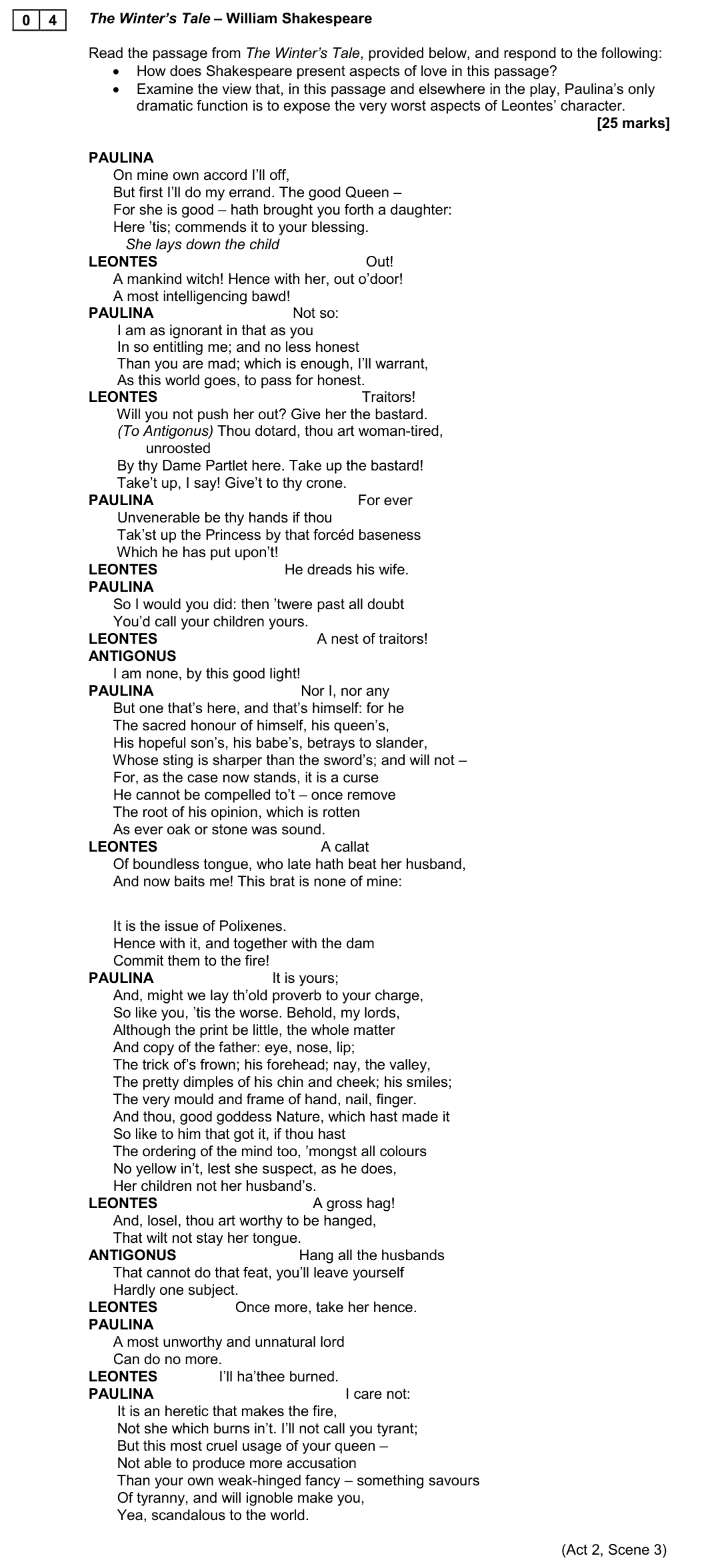
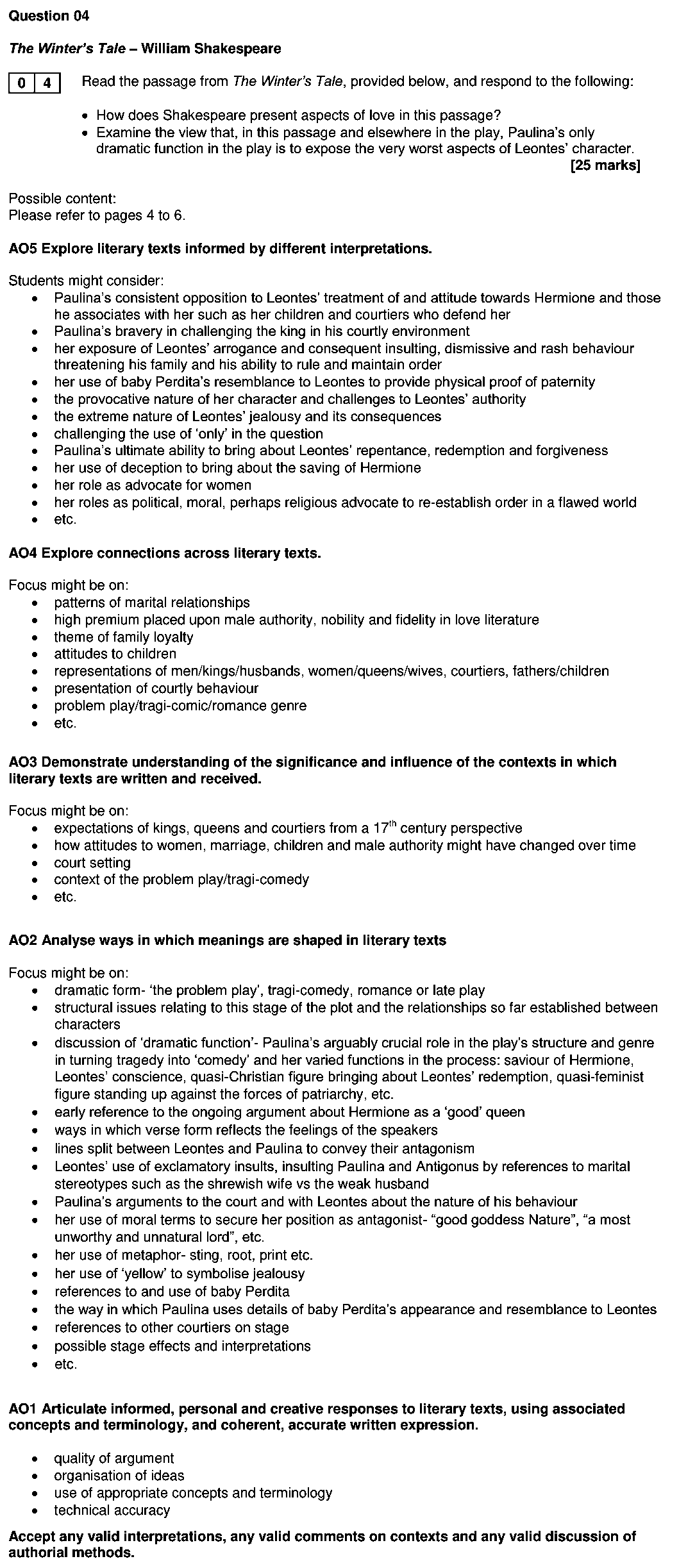
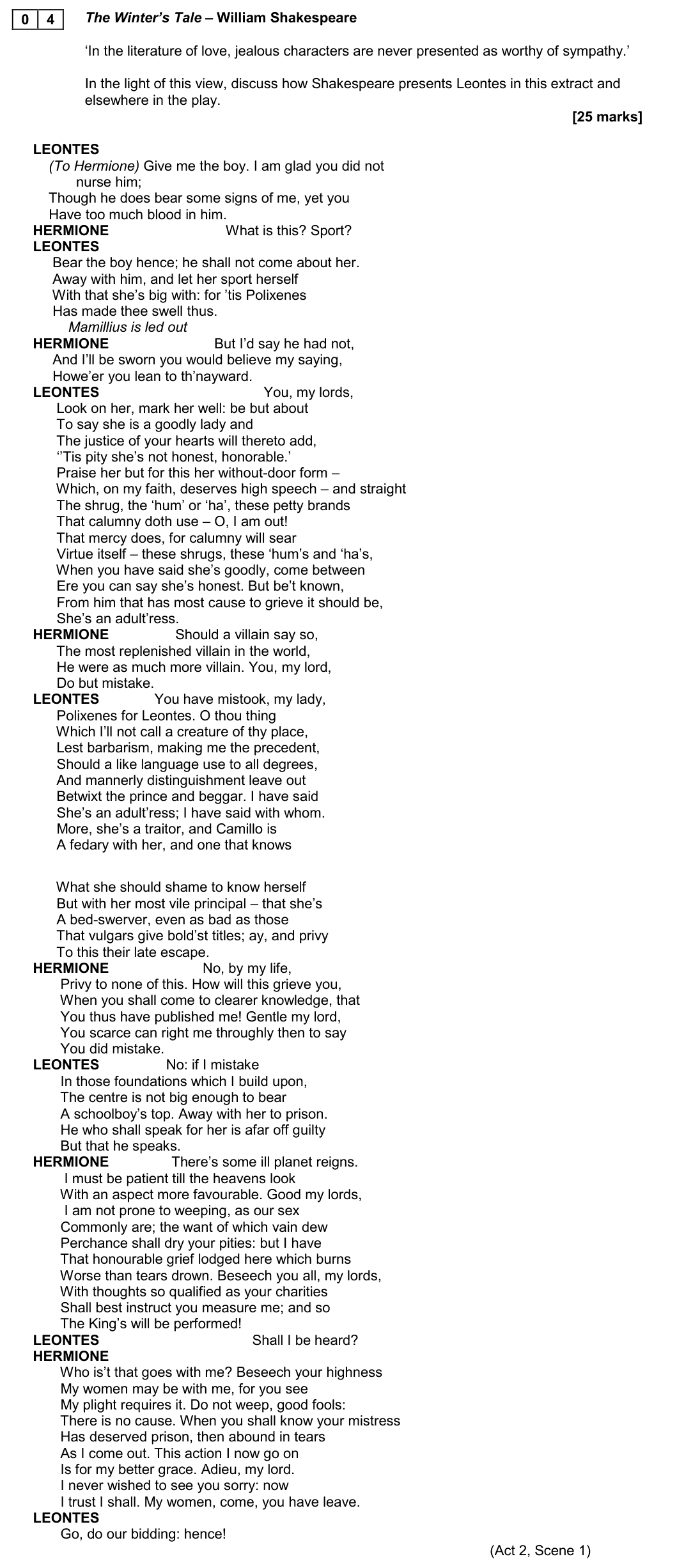
June 2025 · AS Paper 1 · Q4 25 marks Shakespeare extract the winters tale
The Winter’s Tale – William Shakespeare
Read the extract from The Winter’s Tale, provided below, and respond to the following:
• How does Shakespeare present aspects of love in this extract?
• Examine the view that, in this extract and elsewhere in the play, Shakespeare’s use of
miraculous appearances and unusual stage effects is primarily to demonstrate the
power of love.
[25 marks]
Enter Time, the Chorus
TIME
I that please some, try all; both joy and terror
Of good and bad; that makes and unfolds error,
Now take upon me, in the name of Time,
To use my wings. Impute it not a crime
To me or my swift passage that I slide
O’er sixteen years, and leave the growth untried
Of that wide gap, since it is in my power
To o’erthrow law, and in one self-born hour
To plant and o’erwhelm custom. Let me pass
The same I am ere ancient’st order was
Or what is now received. I witness to
The times that brought them in; so shall I do
To th’freshest things now reigning, and make stale
The glistering of this present, as my tale
Now seems to it. Your patience this allowing,
I turn my glass, and give my scene such growing
As you had slept between. Leontes leaving –
Th’effects of his fond jealousies so grieving
That he shuts up himself – imagine me,
Gentle spectators, that I now may be
In fair Bohemia; and remember well,
I mentioned a son o’th’King’s, which Florizel
I now name to you; and with speed so pace
To speak of Perdita, now grown in grace
Equal with wond’ring. What of her ensues
I list not prophesy; but let Time’s news
Be known when ’tis brought forth. A shepherd’s
daughter,
And what to her adheres, which follows after,
Is th’argument of Time. Of this allow,
If ever you have spent time worse ere now;
If never, yet that Time himself doth say
He wishes earnestly you never may.
Exit
(Act 4, Scene 1)
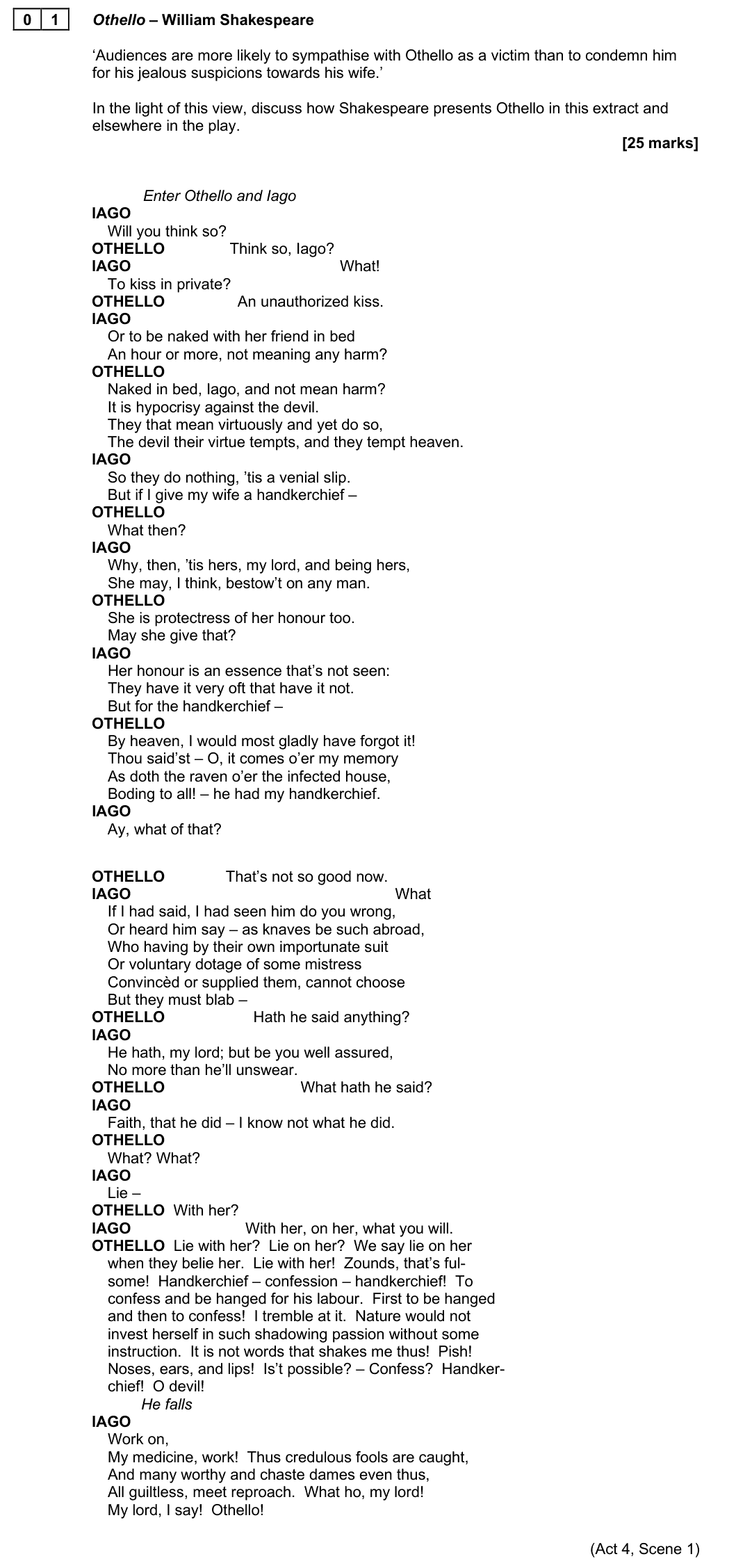
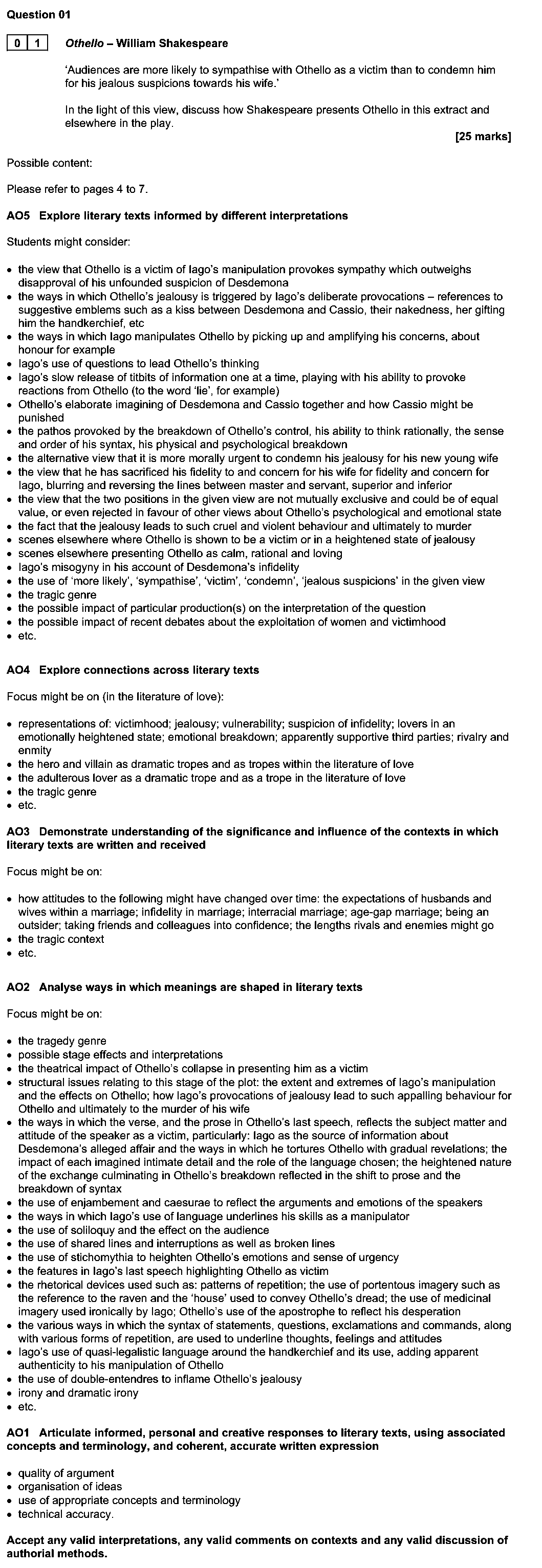
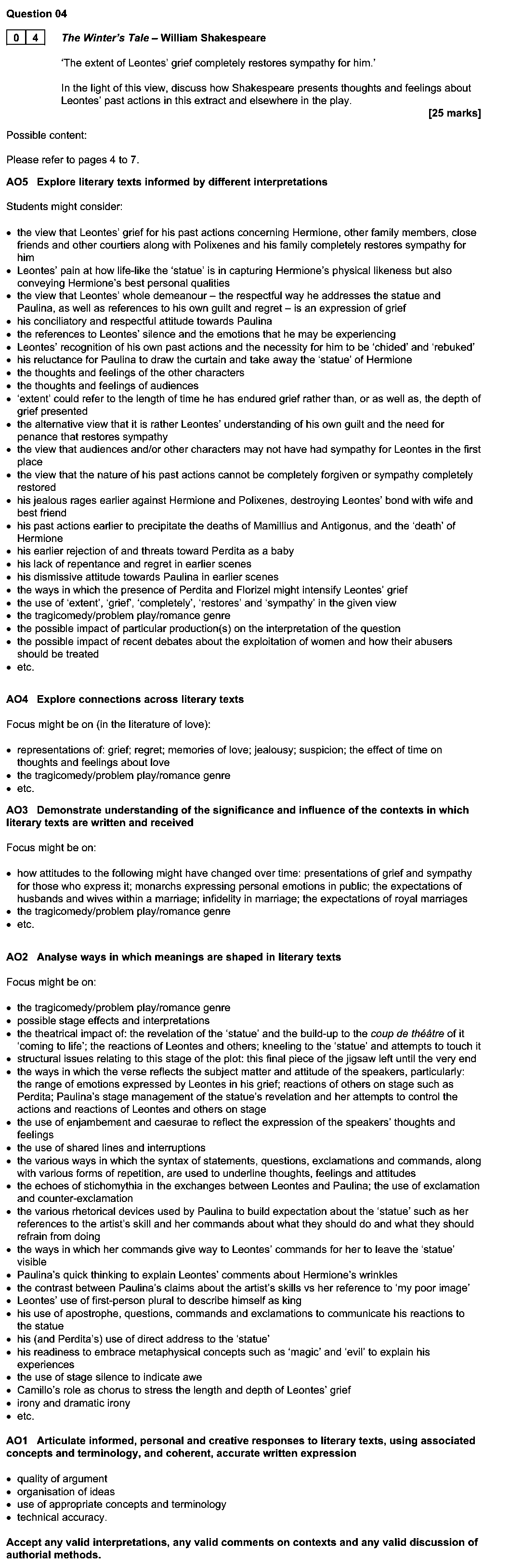
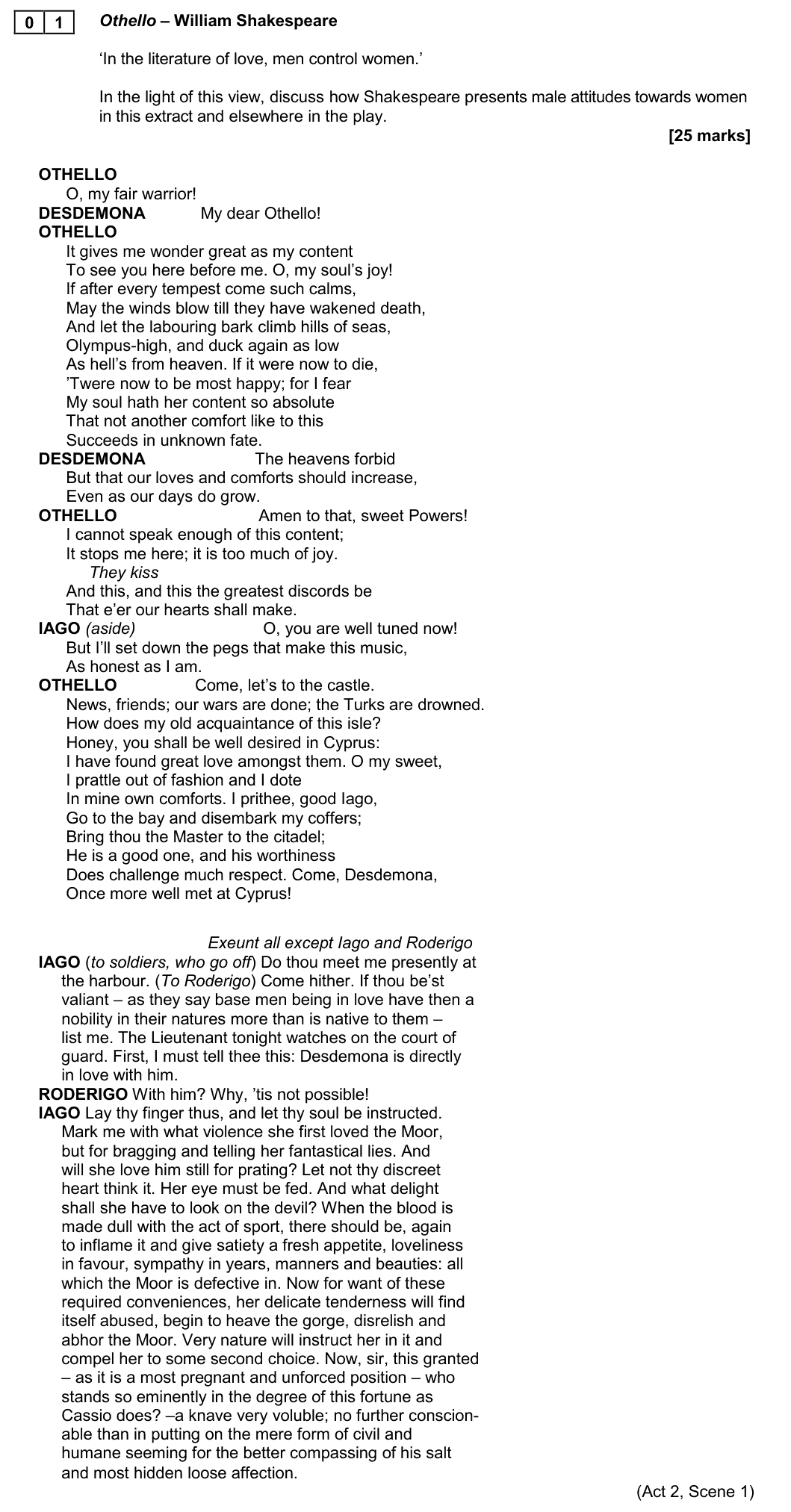
June 2025 · Paper 1 · Q1 25 marks Shakespeare extract othello
Othello – William Shakespeare
‘Audiences are more likely to sympathise with Othello as a victim than to condemn him
for his jealous suspicions towards his wife.’
In the light of this view, discuss how Shakespeare presents Othello in this extract and
elsewhere in the play.
[25 marks]
Enter Othello and Iago
IAGO
Will you think so?
OTHELLO
Think so, Iago?
IAGO
What!
To kiss in private?
OTHELLO
An unauthorized kiss.
IAGO
Or to be naked with her friend in bed
An hour or more, not meaning any harm?
OTHELLO
Naked in bed, Iago, and not mean harm?
It is hypocrisy against the devil.
They that mean virtuously and yet do so,
The devil their virtue tempts, and they tempt heaven.
IAGO
So they do nothing, ’tis a venial slip.
But if I give my wife a handkerchief –
OTHELLO
What then?
IAGO
Why, then, ’tis hers, my lord, and being hers,
She may, I think, bestow’t on any man.
OTHELLO
She is protectress of her honour too.
May she give that?
IAGO
Her honour is an essence that’s not seen:
They have it very oft that have it not.
But for the handkerchief –
OTHELLO
By heaven, I would most gladly have forgot it!
Thou said’st – O, it comes o’er my memory
As doth the raven o’er the infected house,
Boding to all! – he had my handkerchief.
IAGO
Ay, what of that?
OTHELLO
That’s not so good now.
IAGO
What
If I had said, I had seen him do you wrong,
Or heard him say – as knaves be such abroad,
Who having by their own importunate suit
Or voluntary dotage of some mistress
Convincèd or supplied them, cannot choose
But they must blab –
OTHELLO
Hath he said anything?
IAGO
He hath, my lord; but be you well assured,
No more than he’ll unswear.
OTHELLO
What hath he said?
IAGO
Faith, that he did – I know not what he did.
OTHELLO
What? What?
IAGO
Lie –
OTHELLO With her?
IAGO
With her, on her, what you will.
OTHELLO Lie with her? Lie on her? We say lie on her
when they belie her. Lie with her! Zounds, that’s ful-
some! Handkerchief – confession – handkerchief! To
confess and be hanged for his labour. First to be hanged
and then to confess! I tremble at it. Nature would not
invest herself in such shadowing passion without some
instruction. It is not words that shakes me thus! Pish!
Noses, ears, and lips! Is’t possible? – Confess? Handker-
chief! O devil!
He falls
IAGO
Work on,
My medicine, work! Thus credulous fools are caught,
And many worthy and chaste dames even thus,
All guiltless, meet reproach. What ho, my lord!
My lord, I say! Othello!
(Act 4, Scene 1)
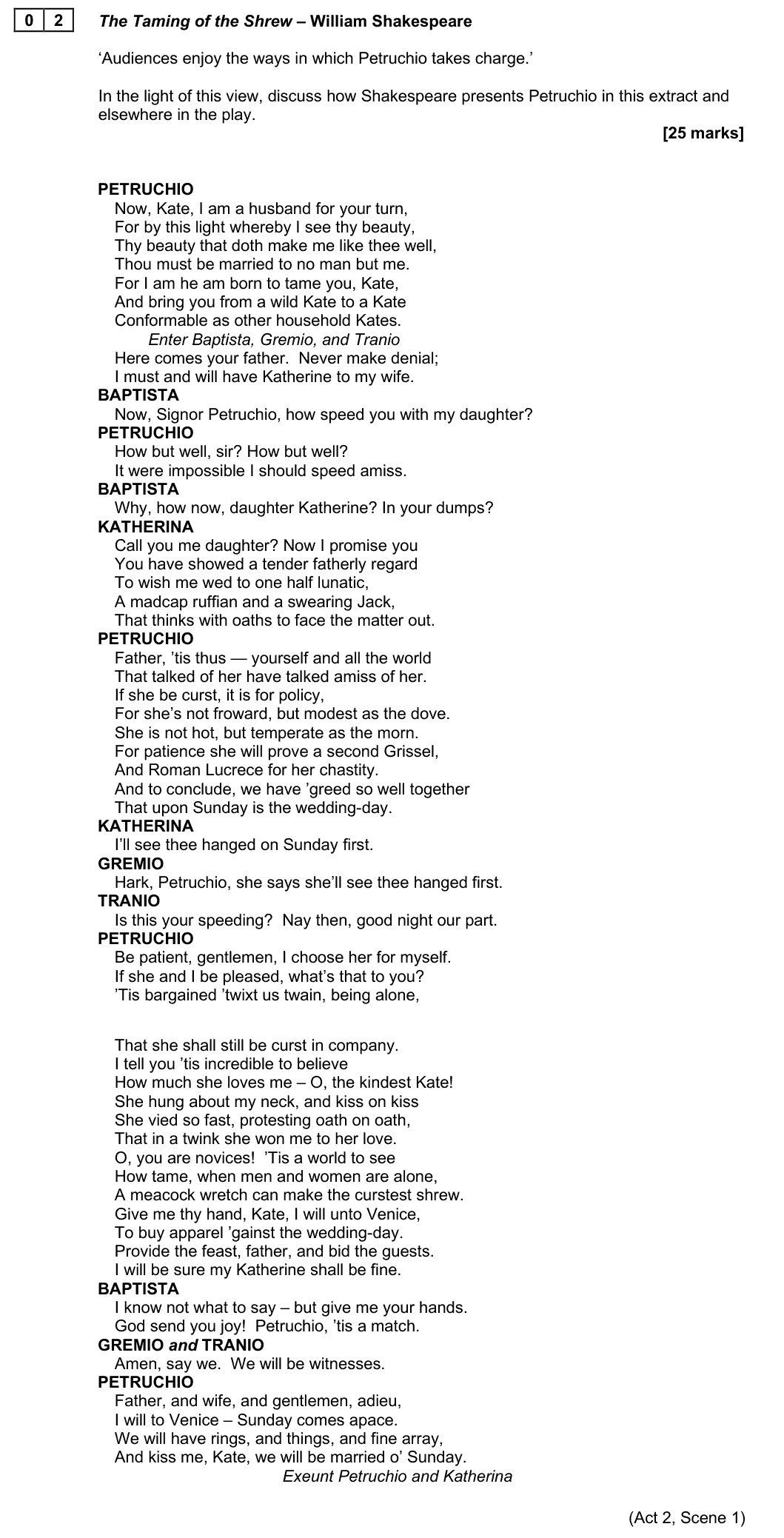
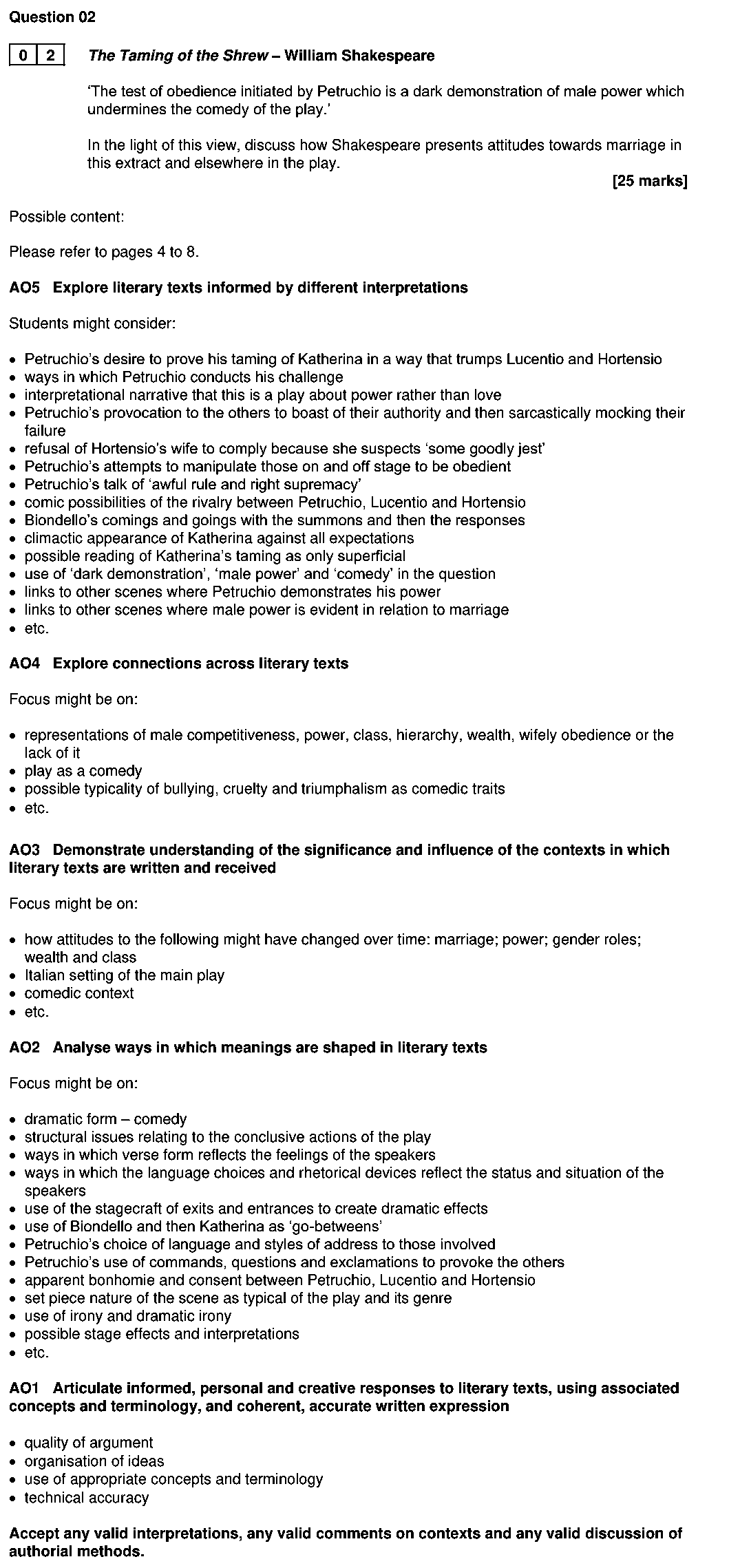
June 2025 · Paper 1 · Q2 25 marks Shakespeare extract taming of the shrew
The Taming of the Shrew – William Shakespeare
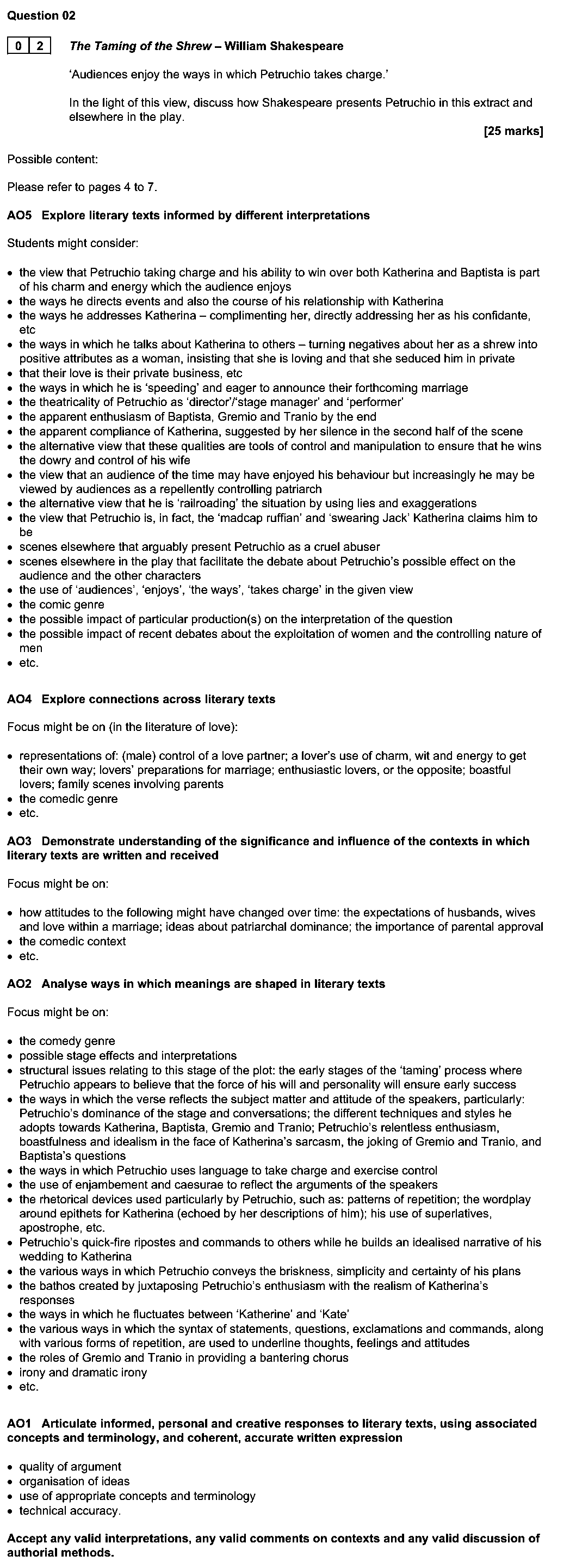
‘Audiences enjoy the ways in which Petruchio takes charge.’
In the light of this view, discuss how Shakespeare presents Petruchio in this extract and
elsewhere in the play.
[25 marks]
PETRUCHIO
Now, Kate, I am a husband for your turn,
For by this light whereby I see thy beauty,
Thy beauty that doth make me like thee well,
Thou must be married to no man but me.
For I am he am born to tame you, Kate,
And bring you from a wild Kate to a Kate
Conformable as other household Kates.
Enter Baptista, Gremio, and Tranio
Here comes your father. Never make denial;
I must and will have Katherine to my wife.
BAPTISTA
Now, Signor Petruchio, how speed you with my daughter?
PETRUCHIO
How but well, sir? How but well?
It were impossible I should speed amiss.
BAPTISTA
Why, how now, daughter Katherine? In your dumps?
KATHERINA
Call you me daughter? Now I promise you
You have showed a tender fatherly regard
To wish me wed to one half lunatic,
A madcap ruffian and a swearing Jack,
That thinks with oaths to face the matter out.
PETRUCHIO
Father, ’tis thus — yourself and all the world
That talked of her have talked amiss of her.
If she be curst, it is for policy,
For she’s not froward, but modest as the dove.
She is not hot, but temperate as the morn.
For patience she will prove a second Grissel,
And Roman Lucrece for her chastity.
And to conclude, we have ’greed so well together
That upon Sunday is the wedding-day.
KATHERINA
I’ll see thee hanged on Sunday first.
GREMIO
Hark, Petruchio, she says she’ll see thee hanged first.
TRANIO
Is this your speeding? Nay then, good night our part.
PETRUCHIO
Be patient, gentlemen, I choose her for myself.
If she and I be pleased, what’s that to you?
’Tis bargained ’twixt us twain, being alone,
That she shall still be curst in company.
I tell you ’tis incredible to believe
How much she loves me – O, the kindest Kate!
She hung about my neck, and kiss on kiss
She vied so fast, protesting oath on oath,
That in a twink she won me to her love.
O, you are novices! ’Tis a world to see
How tame, when men and women are alone,
A meacock wretch can make the curstest shrew.
Give me thy hand, Kate, I will unto Venice,
To buy apparel ’gainst the wedding-day.
Provide the feast, father, and bid the guests.
I will be sure my Katherine shall be fine.
BAPTISTA
I know not what to say – but give me your hands.
God send you joy! Petruchio, ’tis a match.
GREMIO and TRANIO
Amen, say we. We will be witnesses.
PETRUCHIO
Father, and wife, and gentlemen, adieu,
I will to Venice – Sunday comes apace.
We will have rings, and things, and fine array,
And kiss me, Kate, we will be married o’ Sunday.
Exeunt Petruchio and Katherina
(Act 2, Scene 1)
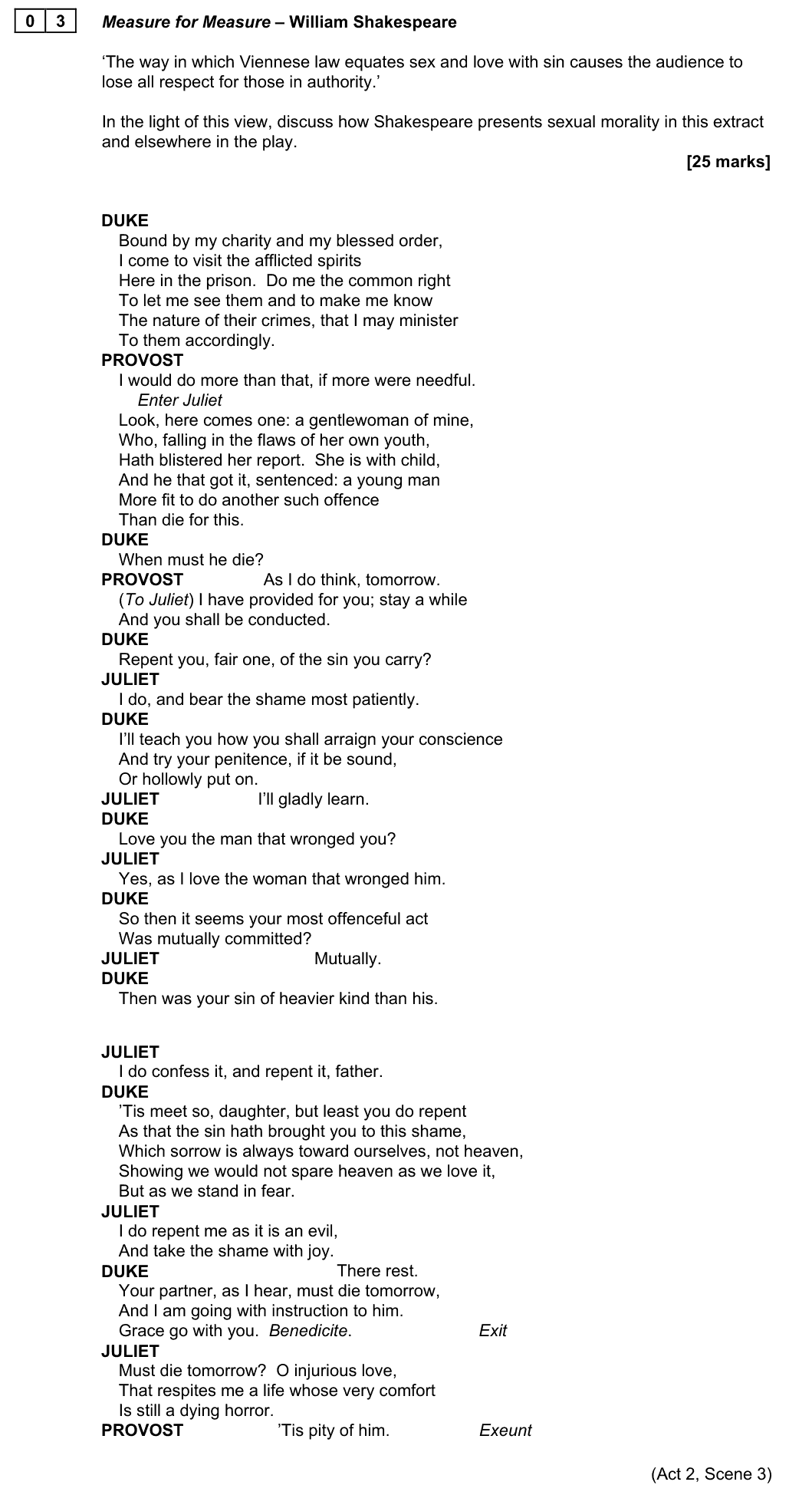
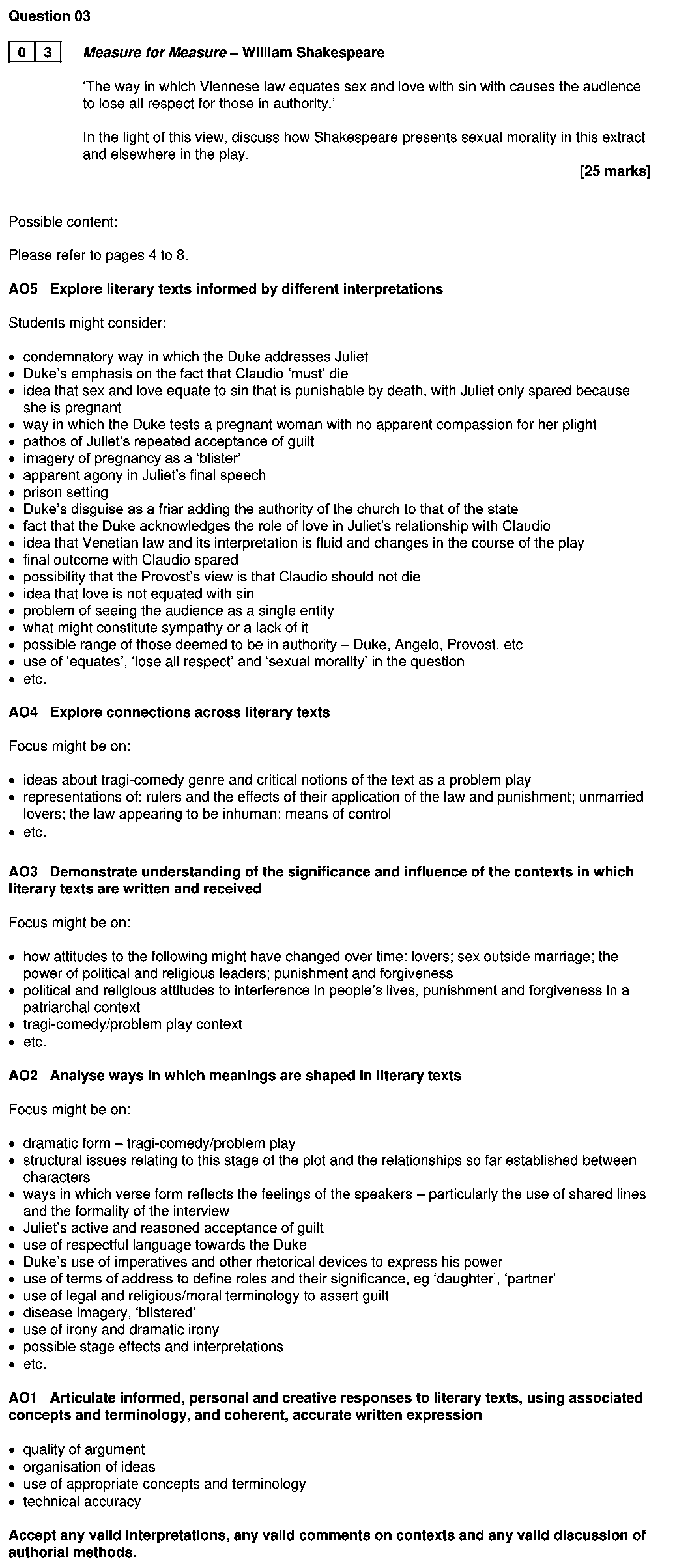
June 2025 · Paper 1 · Q3 25 marks Shakespeare extract measure for measure
Measure for Measure – William Shakespeare
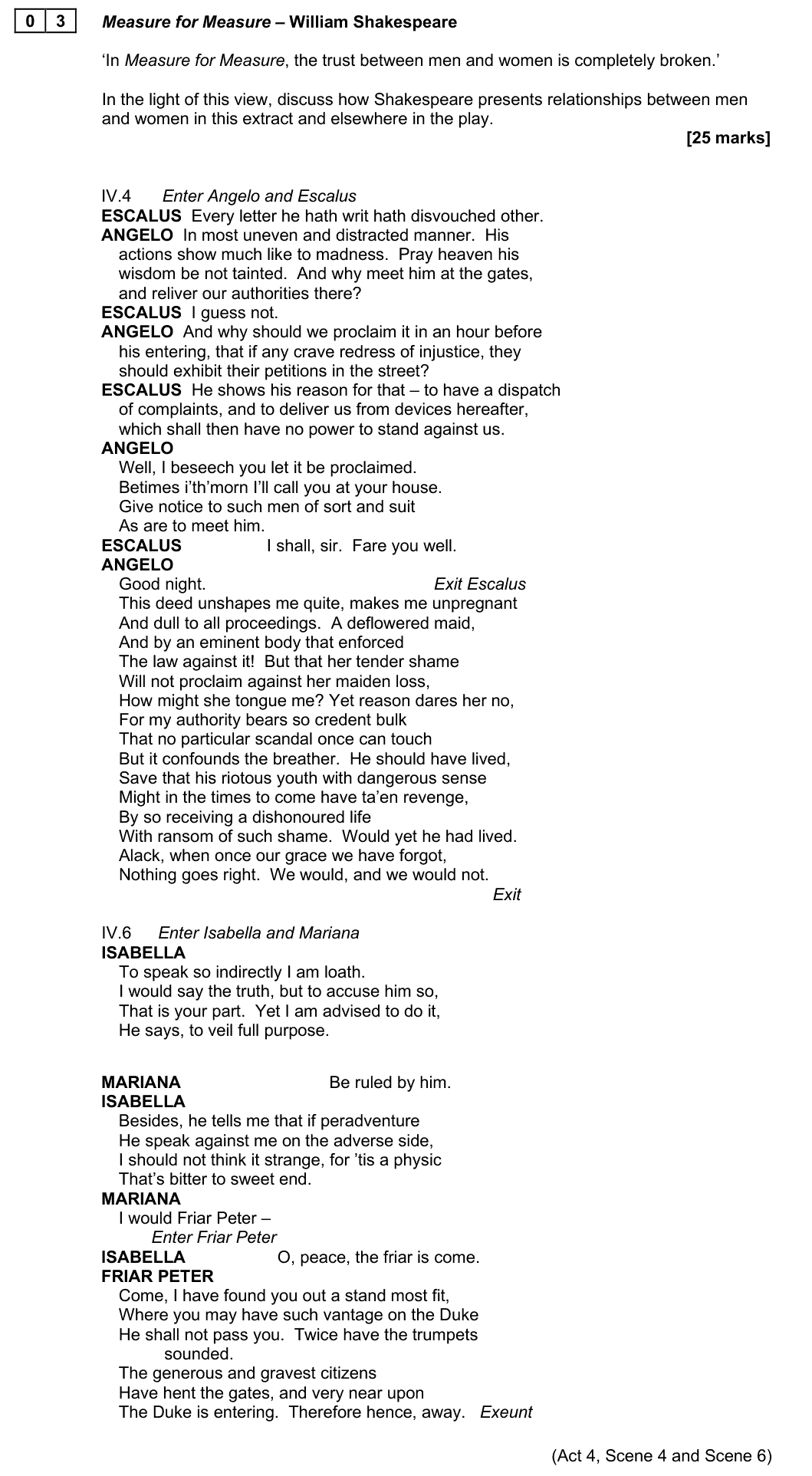
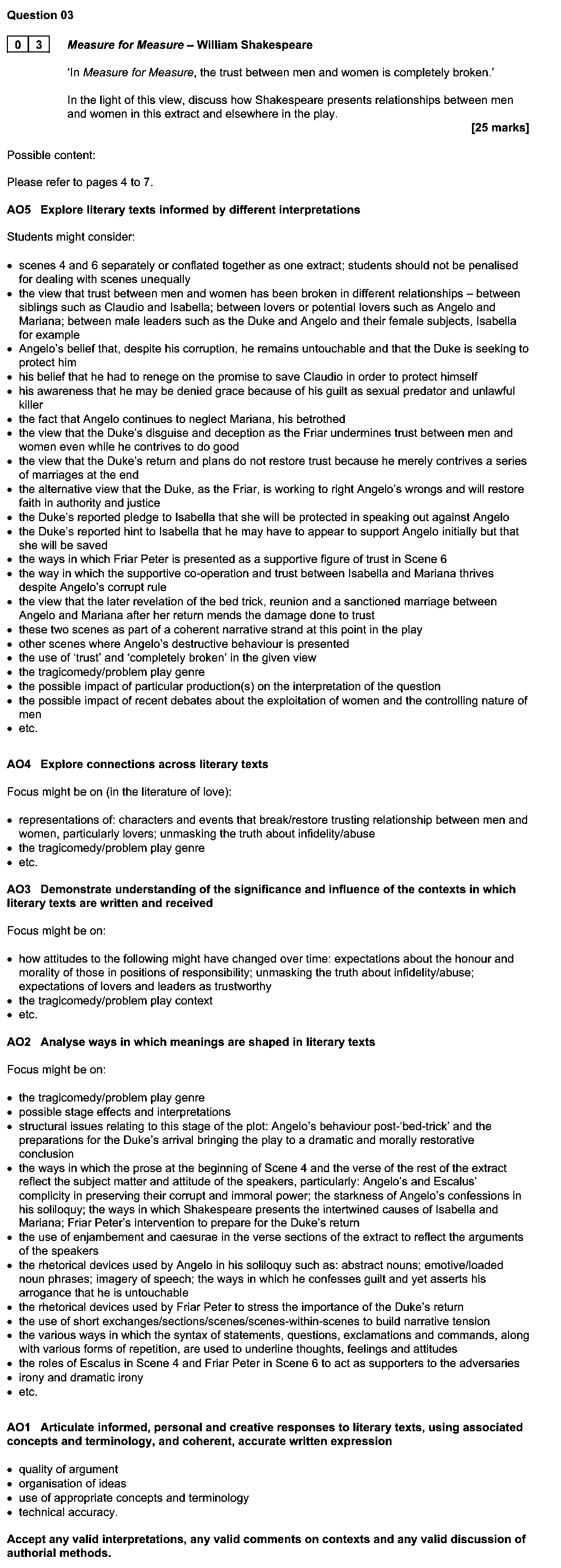
‘In Measure for Measure, the trust between men and women is completely broken.’
In the light of this view, discuss how Shakespeare presents relationships between men
and women in this extract and elsewhere in the play.
[25 marks]
IV.4
Enter Angelo and Escalus
ESCALUS Every letter he hath writ hath disvouched other.
ANGELO In most uneven and distracted manner. His
actions show much like to madness. Pray heaven his
wisdom be not tainted. And why meet him at the gates,
and reliver our authorities there?
ESCALUS I guess not.
ANGELO And why should we proclaim it in an hour before
his entering, that if any crave redress of injustice, they
should exhibit their petitions in the street?
ESCALUS He shows his reason for that – to have a dispatch
of complaints, and to deliver us from devices hereafter,
which shall then have no power to stand against us.
ANGELO
Well, I beseech you let it be proclaimed.
Betimes i’th’morn I’ll call you at your house.
Give notice to such men of sort and suit
As are to meet him.
ESCALUS
I shall, sir. Fare you well.
ANGELO
Good night.
Exit Escalus
This deed unshapes me quite, makes me unpregnant
And dull to all proceedings. A deflowered maid,
And by an eminent body that enforced
The law against it! But that her tender shame
Will not proclaim against her maiden loss,
How might she tongue me? Yet reason dares her no,
For my authority bears so credent bulk
That no particular scandal once can touch
But it confounds the breather. He should have lived,
Save that his riotous youth with dangerous sense
Might in the times to come have ta’en revenge,
By so receiving a dishonoured life
With ransom of such shame. Would yet he had lived.
Alack, when once our grace we have forgot,
Nothing goes right. We would, and we would not.
Exit
IV.6
Enter Isabella and Mariana
ISABELLA
To speak so indirectly I am loath.
I would say the truth, but to accuse him so,
That is your part. Yet I am advised to do it,
He says, to veil full purpose.
MARIANA
Be ruled by him.
ISABELLA
Besides, he tells me that if peradventure
He speak against me on the adverse side,
I should not think it strange, for ’tis a physic
That’s bitter to sweet end.
MARIANA
I would Friar Peter –
Enter Friar Peter
ISABELLA
O, peace, the friar is come.
FRIAR PETER
Come, I have found you out a stand most fit,
Where you may have such vantage on the Duke
He shall not pass you. Twice have the trumpets
sounded.
The generous and gravest citizens
Have hent the gates, and very near upon
The Duke is entering. Therefore hence, away. Exeunt
(Act 4, Scene 4 and Scene 6)
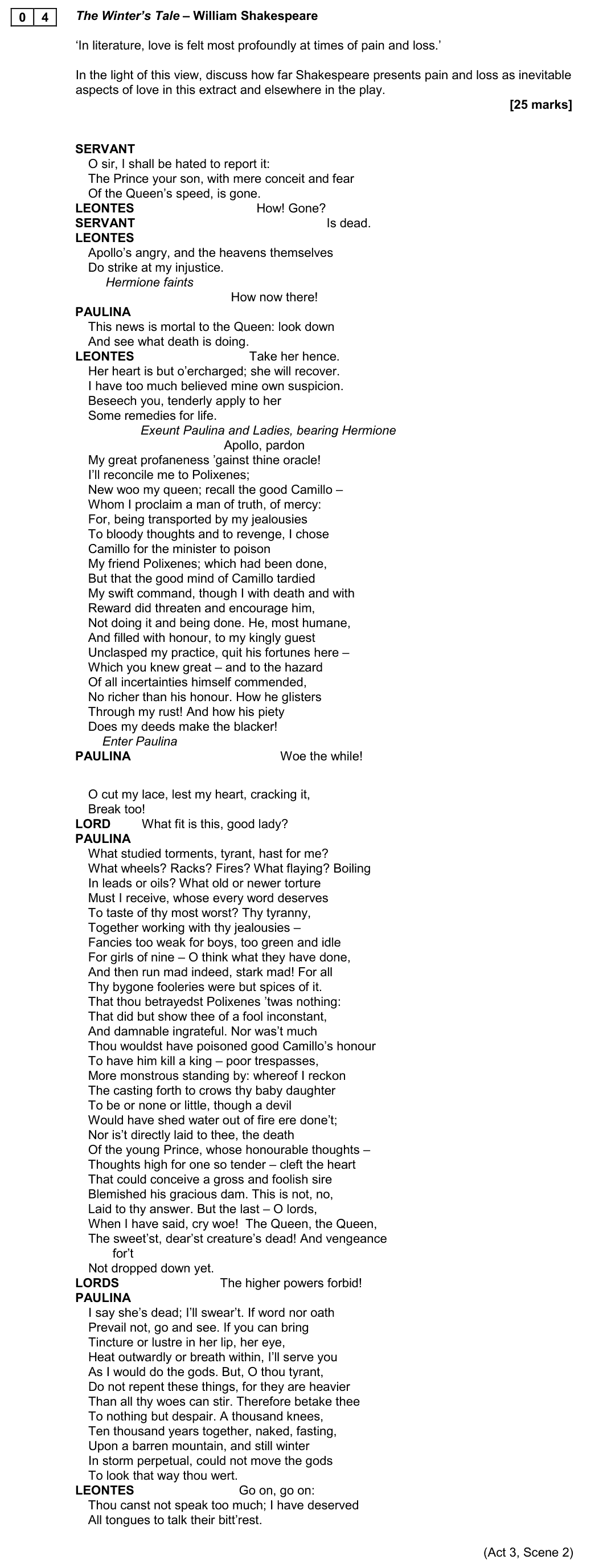
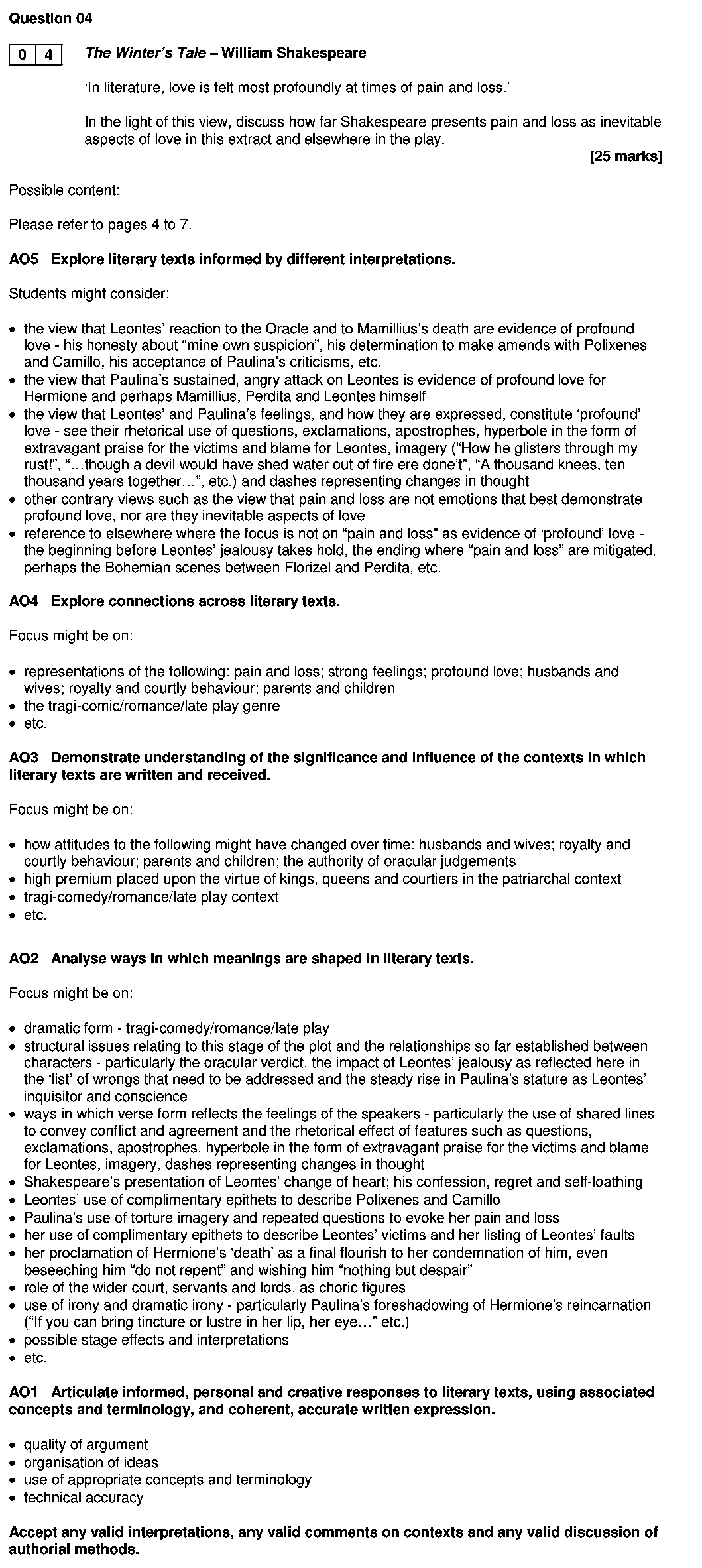
June 2025 · Paper 1 · Q4 25 marks Shakespeare extract the winters tale
The Winter’s Tale – William Shakespeare
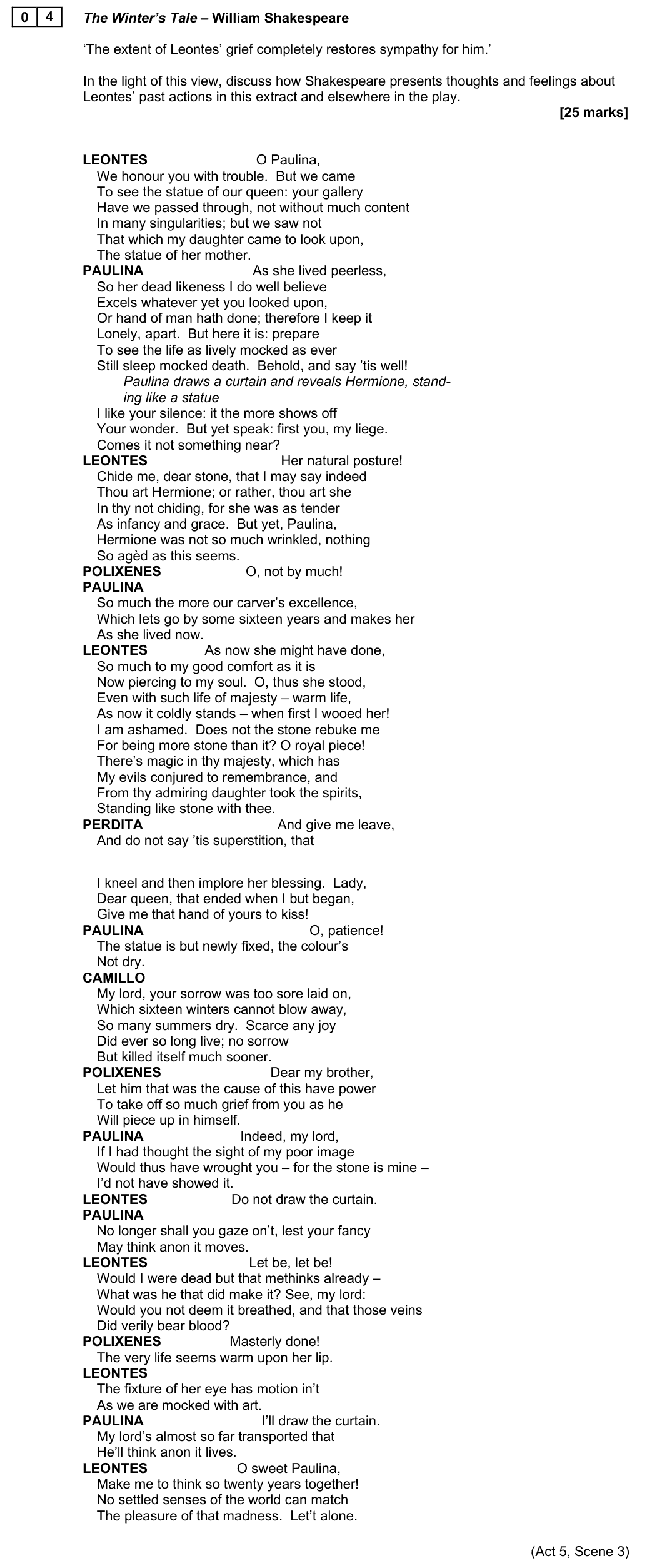
‘The extent of Leontes’ grief completely restores sympathy for him.’
In the light of this view, discuss how Shakespeare presents thoughts and feelings about
Leontes’ past actions in this extract and elsewhere in the play.
[25 marks]
LEONTES
O Paulina,
We honour you with trouble. But we came
To see the statue of our queen: your gallery
Have we passed through, not without much content
In many singularities; but we saw not
That which my daughter came to look upon,
The statue of her mother.
PAULINA
As she lived peerless,
So her dead likeness I do well believe
Excels whatever yet you looked upon,
Or hand of man hath done; therefore I keep it
Lonely, apart. But here it is: prepare
To see the life as lively mocked as ever
Still sleep mocked death. Behold, and say ’tis well!
Paulina draws a curtain and reveals Hermione, stand-
ing like a statue
I like your silence: it the more shows off
Your wonder. But yet speak: first you, my liege.
Comes it not something near?
LEONTES
Her natural posture!
Chide me, dear stone, that I may say indeed
Thou art Hermione; or rather, thou art she
In thy not chiding, for she was as tender
As infancy and grace. But yet, Paulina,
Hermione was not so much wrinkled, nothing
So agèd as this seems.
POLIXENES
O, not by much!
PAULINA
So much the more our carver’s excellence,
Which lets go by some sixteen years and makes her
As she lived now.
LEONTES
As now she might have done,
So much to my good comfort as it is
Now piercing to my soul. O, thus she stood,
Even with such life of majesty – warm life,
As now it coldly stands – when first I wooed her!
I am ashamed. Does not the stone rebuke me
For being more stone than it? O royal piece!
There’s magic in thy majesty, which has
My evils conjured to remembrance, and
From thy admiring daughter took the spirits,
Standing like stone with thee.
PERDITA
And give me leave,
And do not say ’tis superstition, that
I kneel and then implore her blessing. Lady,
Dear queen, that ended when I but began,
Give me that hand of yours to kiss!
PAULINA
O, patience!
The statue is but newly fixed, the colour’s
Not dry.
CAMILLO
My lord, your sorrow was too sore laid on,
Which sixteen winters cannot blow away,
So many summers dry. Scarce any joy
Did ever so long live; no sorrow
But killed itself much sooner.
POLIXENES
Dear my brother,
Let him that was the cause of this have power
To take off so much grief from you as he
Will piece up in himself.
PAULINA
Indeed, my lord,
If I had thought the sight of my poor image
Would thus have wrought you – for the stone is mine –
I’d not have showed it.
LEONTES
Do not draw the curtain.
PAULINA
No longer shall you gaze on’t, lest your fancy
May think anon it moves.
LEONTES
Let be, let be!
Would I were dead but that methinks already –
What was he that did make it? See, my lord:
Would you not deem it breathed, and that those veins
Did verily bear blood?
POLIXENES
Masterly done!
The very life seems warm upon her lip.
LEONTES
The fixture of her eye has motion in’t
As we are mocked with art.
PAULINA
I’ll draw the curtain.
My lord’s almost so far transported that
He’ll think anon it lives.
LEONTES
O sweet Paulina,
Make me to think so twenty years together!
No settled senses of the world can match
The pleasure of that madness. Let’t alone.
(Act 5, Scene 3)
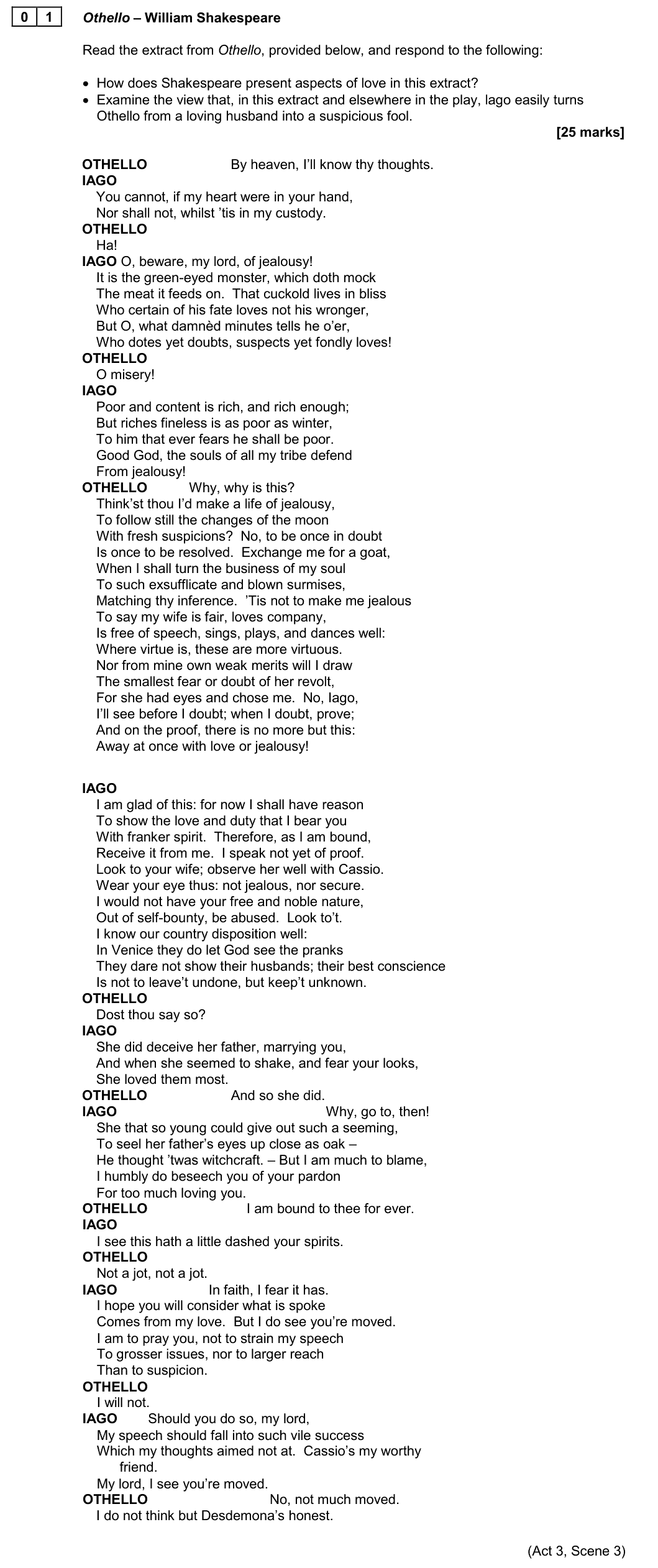
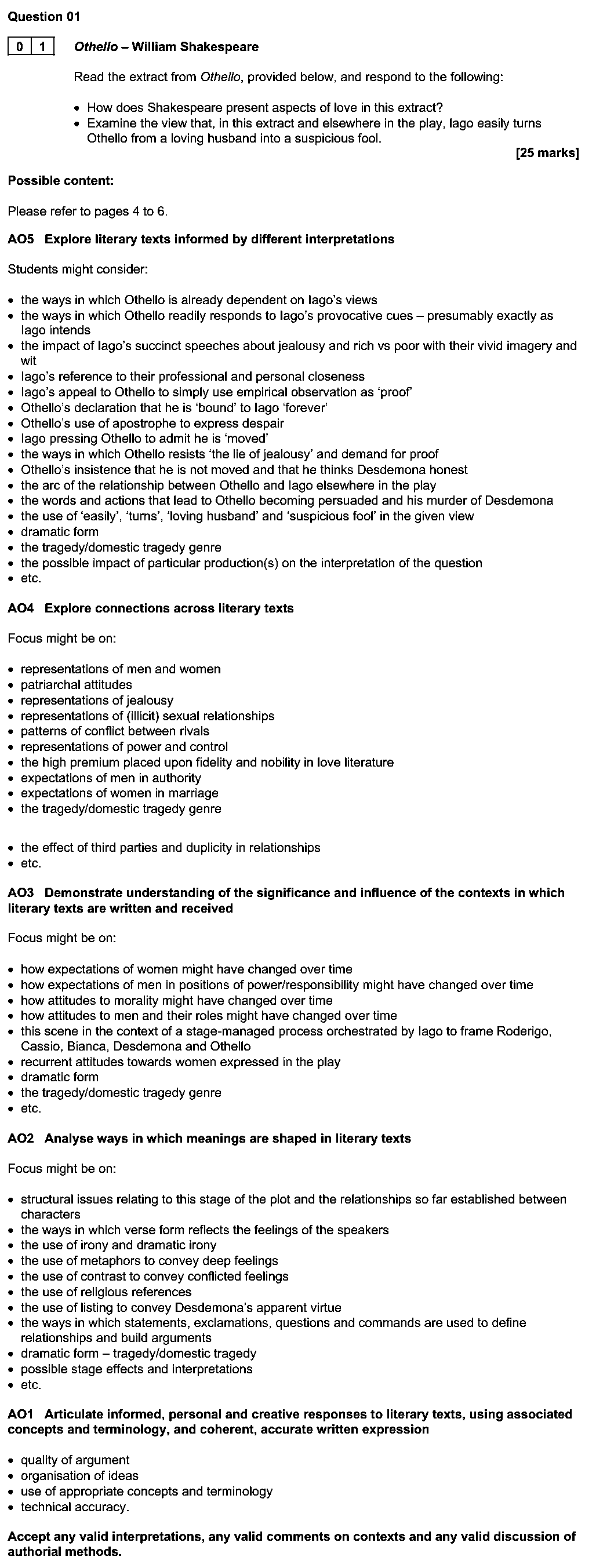
June 2024 · AS Paper 1 · Q1 25 marks Shakespeare extract othello
Othello – William Shakespeare
Read the extract from Othello, provided below, and respond to the following:
• How does Shakespeare present aspects of love in this extract?
• Examine the view that, in this extract and elsewhere in the play, lago easily turns
Othello from a loving husband into a suspicious fool.
[25 marks]
OTHELLO By heaven, I’ll know thy thoughts.
IAGO
You cannot, if my heart were in your hand,
Nor shall not, whilst ’tis in my custody.
OTHELLO
Ha!
IAGO O, beware, my lord, of jealousy!
It is the green-eyed monster, which doth mock
The meat it feeds on. That cuckold lives in bliss
Who certain of his fate loves not his wronger,
But O, what damnèd minutes tells he o’er,
Who dotes yet doubts, suspects yet fondly loves!
OTHELLO
O misery!
IAGO
Poor and content is rich, and rich enough;
But riches fineless is as poor as winter,
To him that ever fears he shall be poor.
Good God, the souls of all my tribe defend
From jealousy!
OTHELLO Why, why is this?
Think’st thou I’d make a life of jealousy,
To follow still the changes of the moon
With fresh suspicions? No, to be once in doubt
Is once to be resolved. Exchange me for a goat,
When I shall turn the business of my soul
To such exsufflicate and blown surmises,
Matching thy inference. ’Tis not to make me jealous
To say my wife is fair, loves company,
Is free of speech, sings, plays, and dances well:
Where virtue is, these are more virtuous.
Nor from mine own weak merits will I draw
The smallest fear or doubt of her revolt,
For she had eyes and chose me. No, Iago,
I’ll see before I doubt; when I doubt, prove;
And on the proof, there is no more but this:
Away at once with love or jealousy!
IAGO
I am glad of this: for now I shall have reason
To show the love and duty that I bear you
With franker spirit. Therefore, as I am bound,
Receive it from me. I speak not yet of proof.
Look to your wife; observe her well with Cassio.
Wear your eye thus: not jealous, nor secure.
I would not have your free and noble nature,
Out of self-bounty, be abused. Look to’t.
I know our country disposition well:
In Venice they do let God see the pranks
They dare not show their husbands; their best conscience
Is not to leave’t undone, but keep’t unknown.
OTHELLO
Dost thou say so?
IAGO
She did deceive her father, marrying you,
And when she seemed to shake, and fear your looks,
She loved them most.
OTHELLO And so she did.
IAGO Why, go to, then!
She that so young could give out such a seeming,
To seel her father’s eyes up close as oak –
He thought ’twas witchcraft. – But I am much to blame,
I humbly do beseech you of your pardon
For too much loving you.
OTHELLO I am bound to thee for ever.
IAGO
I see this hath a little dashed your spirits.
OTHELLO
Not a jot, not a jot.
IAGO In faith, I fear it has.
I hope you will consider what is spoke
Comes from my love. But I do see you’re moved.
I am to pray you, not to strain my speech
To grosser issues, nor to larger reach
Than to suspicion.
OTHELLO
I will not.
IAGO Should you do so, my lord,
My speech should fall into such vile success
Which my thoughts aimed not at. Cassio’s my worthy
friend.
My lord, I see you’re moved.
OTHELLO No, not much moved.
I do not think but Desdemona’s honest.
(Act 3, Scene 3)
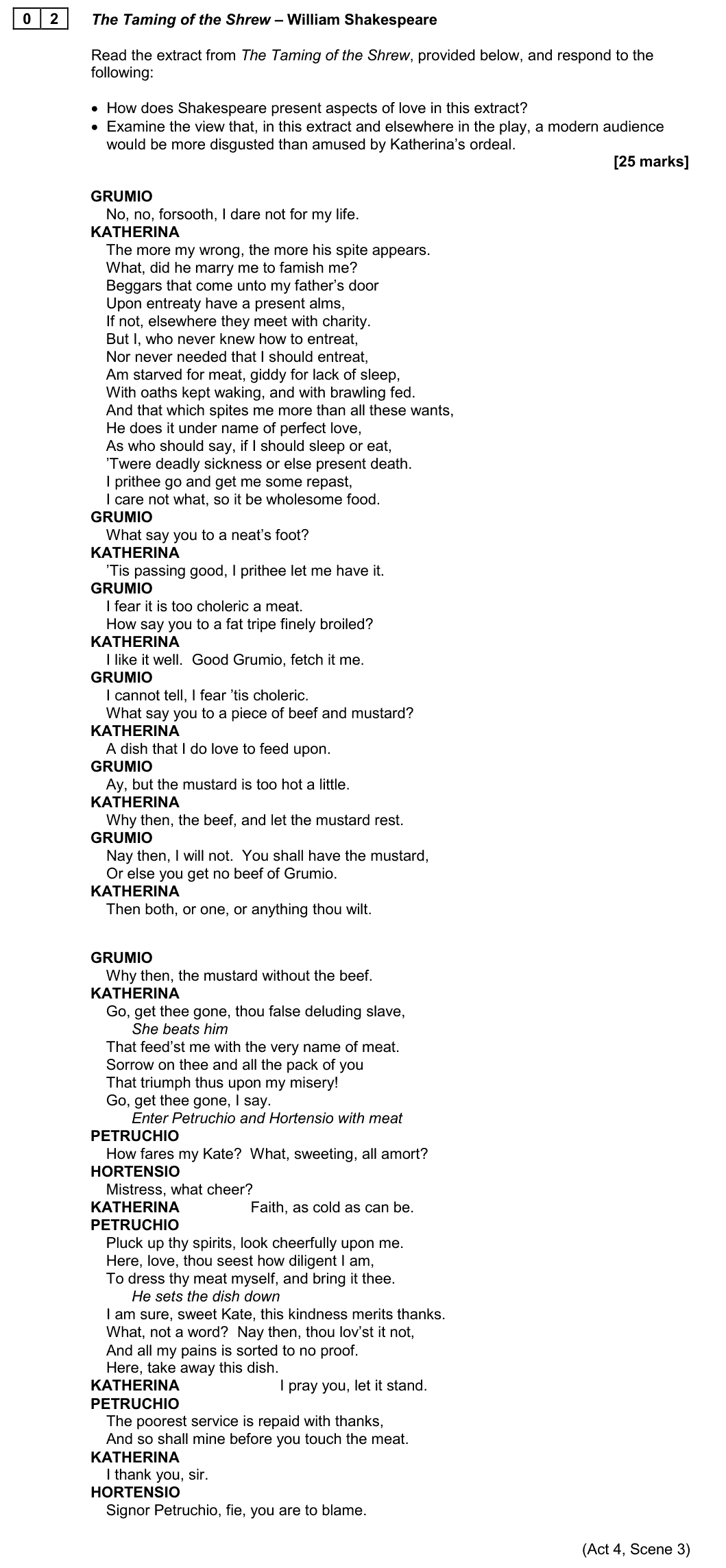
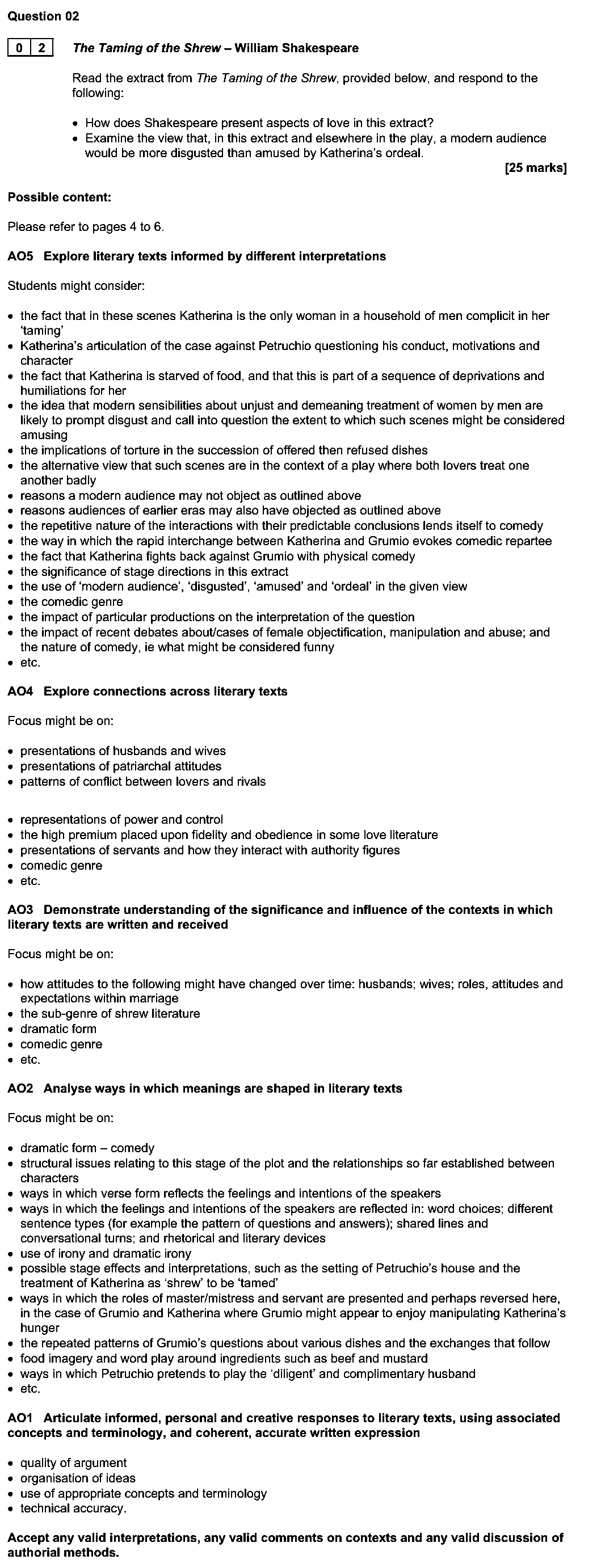
June 2024 · AS Paper 1 · Q2 25 marks Shakespeare extract taming of the shrew
The Taming of the Shrew – William Shakespeare
Read the extract from The Taming of the Shrew, provided below, and respond to the
following:
• How does Shakespeare present aspects of love in this extract?
• Examine the view that, in this extract and elsewhere in the play, a modern audience
would be more disgusted than amused by Katherina’s ordeal.
[25 marks]
GRUMIO
No, no, forsooth, I dare not for my life.
KATHERINA
The more my wrong, the more his spite appears.
What, did he marry me to famish me?
Beggars that come unto my father’s door
Upon entreaty have a present alms,
If not, elsewhere they meet with charity.
But I, who never knew how to entreat,
Nor never needed that I should entreat,
Am starved for meat, giddy for lack of sleep,
With oaths kept waking, and with brawling fed.
And that which spites me more than all these wants,
He does it under name of perfect love,
As who should say, if I should sleep or eat,
’Twere deadly sickness or else present death.
I prithee go and get me some repast,
I care not what, so it be wholesome food.
GRUMIO
What say you to a neat’s foot?
KATHERINA
’Tis passing good, I prithee let me have it.
GRUMIO
I fear it is too choleric a meat.
How say you to a fat tripe finely broiled?
KATHERINA
I like it well. Good Grumio, fetch it me.
GRUMIO
I cannot tell, I fear ’tis choleric.
What say you to a piece of beef and mustard?
KATHERINA
A dish that I do love to feed upon.
GRUMIO
Ay, but the mustard is too hot a little.
KATHERINA
Why then, the beef, and let the mustard rest.
GRUMIO
Nay then, I will not. You shall have the mustard,
Or else you get no beef of Grumio.
KATHERINA
Then both, or one, or anything thou wilt.
GRUMIO
Why then, the mustard without the beef.
KATHERINA
Go, get thee gone, thou false deluding slave,
She beats him
That feed’st me with the very name of meat.
Sorrow on thee and all the pack of you
That triumph thus upon my misery!
Go, get thee gone, I say.
Enter Petruchio and Hortensio with meat
PETRUCHIO
How fares my Kate? What, sweeting, all amort?
HORTENSIO
Mistress, what cheer?
KATHERINA Faith, as cold as can be.
PETRUCHIO
Pluck up thy spirits, look cheerfully upon me.
Here, love, thou seest how diligent I am,
To dress thy meat myself, and bring it thee.
He sets the dish down
I am sure, sweet Kate, this kindness merits thanks.
What, not a word? Nay then, thou lov’st it not,
And all my pains is sorted to no proof.
Here, take away this dish.
KATHERINA I pray you, let it stand.
PETRUCHIO
The poorest service is repaid with thanks,
And so shall mine before you touch the meat.
KATHERINA
I thank you, sir.
HORTENSIO
Signor Petruchio, fie, you are to blame.
(Act 4, Scene 3)
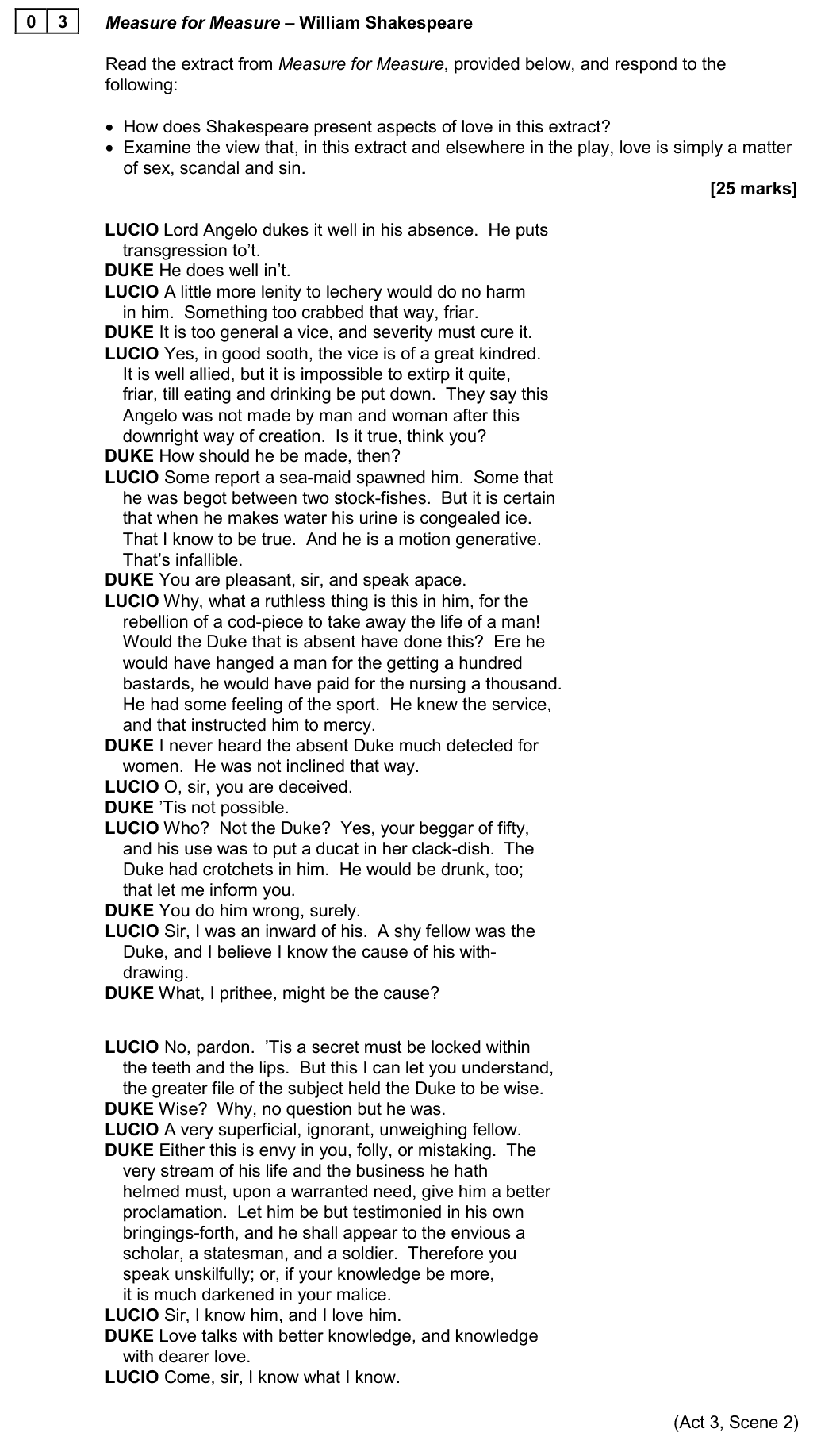
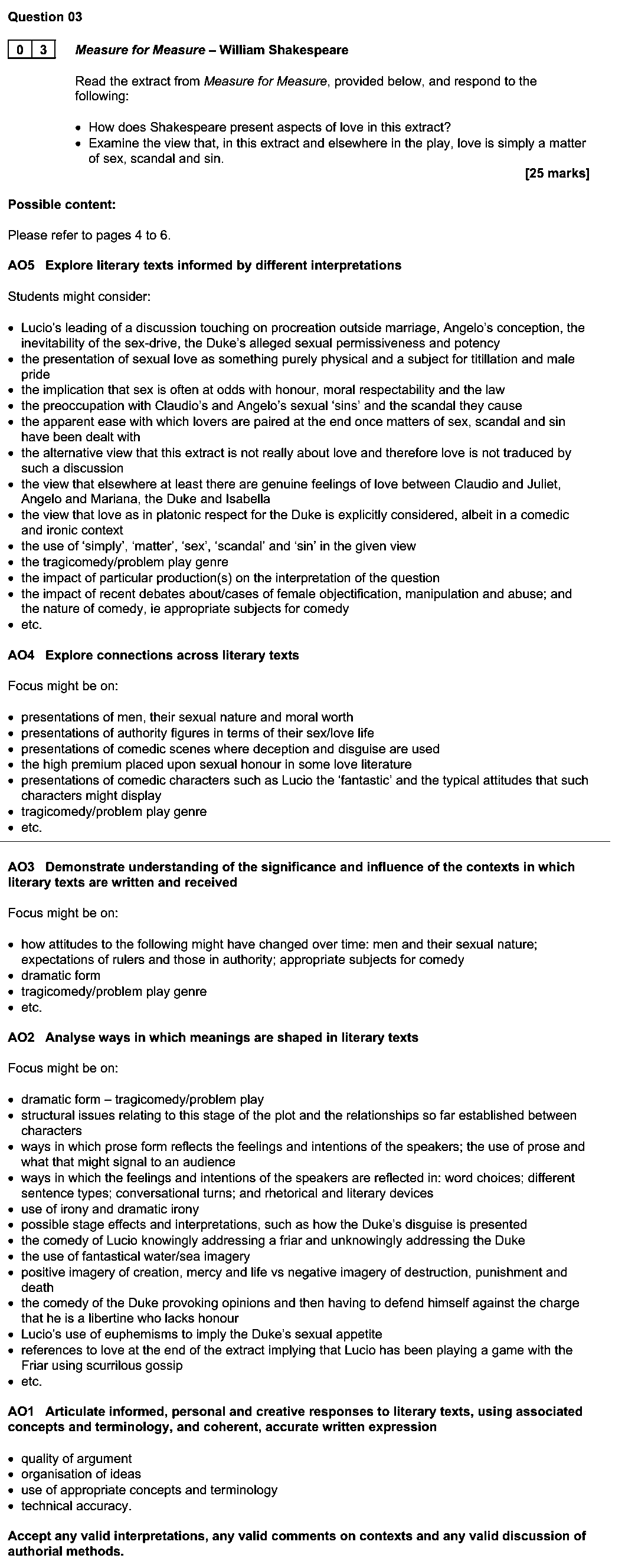
June 2024 · AS Paper 1 · Q3 25 marks Shakespeare extract measure for measure
Measure for Measure – William Shakespeare
Read the extract from Measure for Measure, provided below, and respond to the
following:
• How does Shakespeare present aspects of love in this extract?
• Examine the view that, in this extract and elsewhere in the play, love is simply a matter
of sex, scandal and sin.
[25 marks]
LUCIO Lord Angelo dukes it well in his absence. He puts
transgression to’t.
DUKE He does well in’t.
LUCIO A little more lenity to lechery would do no harm
in him. Something too crabbed that way, friar.
DUKE It is too general a vice, and severity must cure it.
LUCIO Yes, in good sooth, the vice is of a great kindred.
It is well allied, but it is impossible to extirp it quite,
friar, till eating and drinking be put down. They say this
Angelo was not made by man and woman after this
downright way of creation. Is it true, think you?
DUKE How should he be made, then?
LUCIO Some report a sea-maid spawned him. Some that
he was begot between two stock-fishes. But it is certain
that when he makes water his urine is congealed ice.
That I know to be true. And he is a motion generative.
That’s infallible.
DUKE You are pleasant, sir, and speak apace.
LUCIO Why, what a ruthless thing is this in him, for the
rebellion of a cod-piece to take away the life of a man!
Would the Duke that is absent have done this? Ere he
would have hanged a man for the getting a hundred
bastards, he would have paid for the nursing a thousand.
He had some feeling of the sport. He knew the service,
and that instructed him to mercy.
DUKE I never heard the absent Duke much detected for
women. He was not inclined that way.
LUCIO O, sir, you are deceived.
DUKE ’Tis not possible.
LUCIO Who? Not the Duke? Yes, your beggar of fifty,
and his use was to put a ducat in her clack-dish. The
Duke had crotchets in him. He would be drunk, too;
that let me inform you.
DUKE You do him wrong, surely.
LUCIO Sir, I was an inward of his. A shy fellow was the
Duke, and I believe I know the cause of his with-
drawing.
DUKE What, I prithee, might be the cause?
LUCIO No, pardon. ’Tis a secret must be locked within
the teeth and the lips. But this I can let you understand,
the greater file of the subject held the Duke to be wise.
DUKE Wise? Why, no question but he was.
LUCIO A very superficial, ignorant, unweighing fellow.
DUKE Either this is envy in you, folly, or mistaking. The
very stream of his life and the business he hath
helmed must, upon a warranted need, give him a better
proclamation. Let him be but testimonied in his own
bringings-forth, and he shall appear to the envious a
scholar, a statesman, and a soldier. Therefore you
speak unskilfully; or, if your knowledge be more,
it is much darkened in your malice.
LUCIO Sir, I know him, and I love him.
DUKE Love talks with better knowledge, and knowledge
with dearer love.
LUCIO Come, sir, I know what I know.
(Act 3, Scene 2)
June 2024 · AS Paper 1 · Q4 25 marks Shakespeare extract the winters tale
The Winter’s Tale – William Shakespeare
Read the extract from The Winter’s Tale, provided below, and respond to the following:
• How does Shakespeare present aspects of love in this extract?
• Examine the view that, in this extract and elsewhere in the play, unbelievable events
distract from the audience’s experience of the pains and joys of love.
[25 marks]
SECOND GENTLEMAN How goes it now, sir? This news, which is
called true, is so like an old tale that the verity of it is in
strong suspicion. Has the King found his heir?
THIRD GENTLEMAN Most true, if ever truth were preg-
nant by circumstance. That which you hear you’ll swear
you see, there is such unity in the proofs: the mantle of
Queen Hermione’s; her jewel about the neck of it; the
letters of Antigonus found with it, which they know to
be his character; the majesty of the creature in resem-
blance of the mother; the affection of nobleness which
nature shows above her breeding, and many other
evidences proclaim her with all certainty to be the King’s
daughter. Did you see the meeting of the two kings?
SECOND GENTLEMAN No.
THIRD GENTLEMAN Then have you lost a sight which
was to be seen, cannot be spoken of. There might you
have beheld one joy crown another, so and in such
manner that it seemed sorrow wept to take leave of
them: for their joy waded in tears. There was casting up
of eyes, holding up of hands, with countenance of such
distraction that they were to be known by garment, not
by favour. Our king, being ready to leap out of himself
for joy of his found daughter, as if that joy were now
become a loss cries ‘O, thy mother, thy mother!’; then
asks Bohemia forgiveness; then embraces his son-in-
law; then again worries he his daughter with clipping
her; now he thanks the old shepherd, which stands by
like a weather-bitten conduit of many kings’ reigns. I
never heard of such another encounter, which lames
report to follow it and undoes description to do it.
SECOND GENTLEMAN What, pray you, became of Anti-
gonus, that carried hence the child?
THIRD GENTLEMAN Like an old tale still, which will
have matter to rehearse, though credit be asleep and not
an ear open: he was torn to pieces with a bear. This
avouches the shepherd’s son, who has not only his in-
nocence, which seems much, to justify him, but a hand-
kerchief and rings of his that Paulina knows.
FIRST GENTLEMAN What became of his bark and his
followers?
THIRD GENTLEMAN Wracked the same instant of their
master’s death, and in the view of the shepherd: so that
all the instruments which aided to expose the child were
even then lost when it was found. But O, the noble
combat that ’twixt joy and sorrow was fought in
Paulina! She had one eye declined for the loss of her
husband, another elevated that the oracle was fulfilled.
She lifted the Princess from the earth, and so locks her
in embracing as if she would pin her to her heart, that
she might no more be in danger of losing.
FIRST GENTLEMAN The dignity of this act was worth
the audience of kings and princes, for by such was it
acted.
THIRD GENTLEMAN One of the prettiest touches of all,
and that which angled for mine eyes – caught the water
though not the fish – was when at the relation of the
Queen’s death, with the manner how she came to’t
bravely confessed and lamented by the King, how
attentiveness wounded his daughter; till, from one sign
of dolour to another, she did, with an ‘Alas!’, I would
fain say bleed tears; for I am sure my heart wept blood.
Who was most marble there changed colour; some
swooned, all sorrowed. If all the world could have seen’t,
the woe had been universal.
(Act 5, Scene 2)
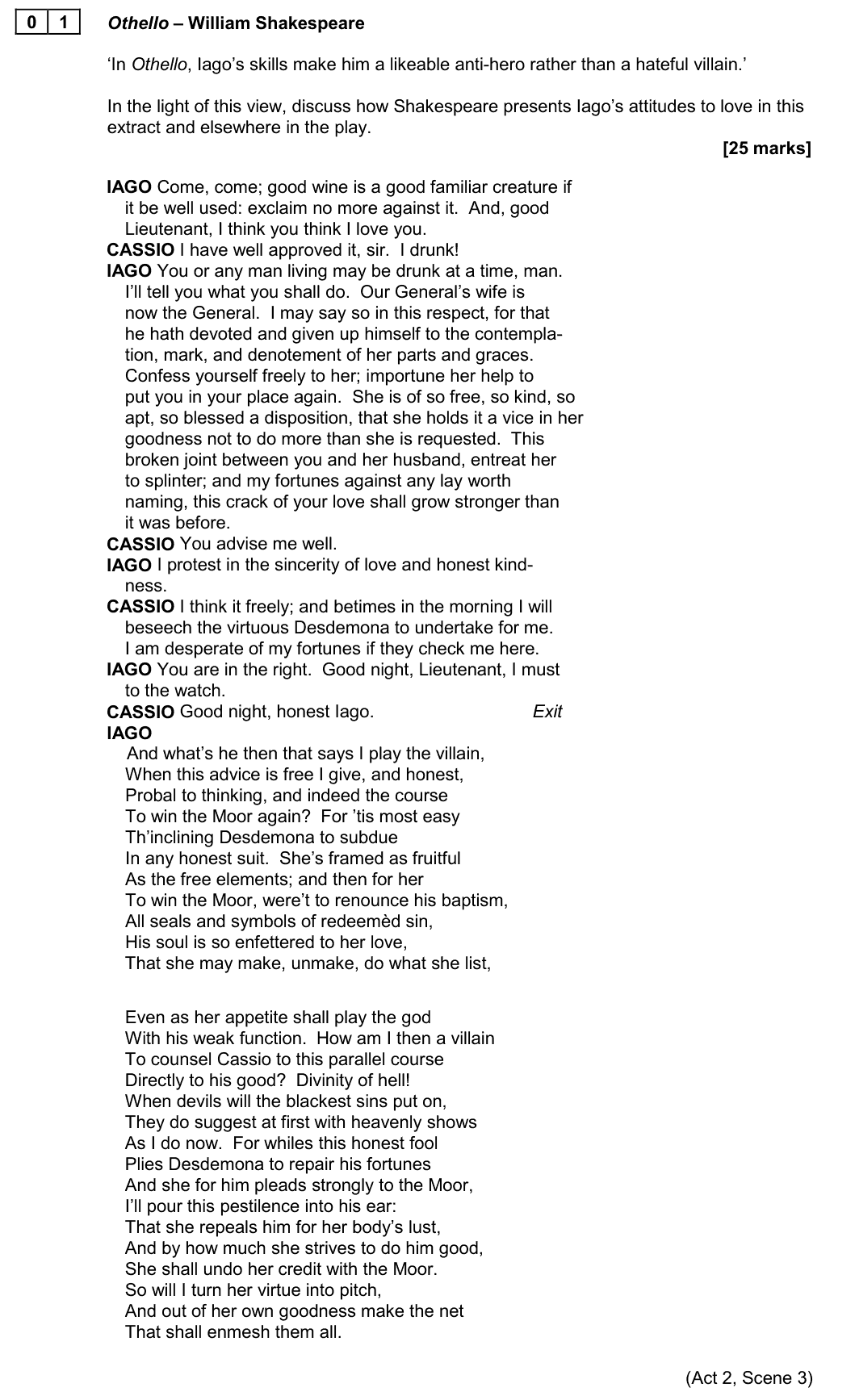
June 2024 · Paper 1 · Q1 25 marks Shakespeare extract othello
Othello – William Shakespeare
‘In Othello, Iago’s skills make him a likeable anti-hero rather than a hateful villain.’
In the light of this view, discuss how Shakespeare presents Iago’s attitudes to love in this
extract and elsewhere in the play.
[25 marks]
IAGO Come, come; good wine is a good familiar creature if
it be well used: exclaim no more against it. And, good
Lieutenant, I think you think I love you.
CASSIO I have well approved it, sir. I drunk!
IAGO You or any man living may be drunk at a time, man.
I’ll tell you what you shall do. Our General’s wife is
now the General. I may say so in this respect, for that
he hath devoted and given up himself to the contempla-
tion, mark, and denotement of her parts and graces.
Confess yourself freely to her; importune her help to
put you in your place again. She is of so free, so kind, so
apt, so blessed a disposition, that she holds it a vice in her
goodness not to do more than she is requested. This
broken joint between you and her husband, entreat her
to splinter; and my fortunes against any lay worth
naming, this crack of your love shall grow stronger than
it was before.
CASSIO You advise me well.
IAGO I protest in the sincerity of love and honest kind-
ness.
CASSIO I think it freely; and betimes in the morning I will
beseech the virtuous Desdemona to undertake for me.
I am desperate of my fortunes if they check me here.
IAGO You are in the right. Good night, Lieutenant, I must
to the watch.
CASSIO Good night, honest Iago. Exit
IAGO
And what’s he then that says I play the villain,
When this advice is free I give, and honest,
Probal to thinking, and indeed the course
To win the Moor again? For ’tis most easy
Th’inclining Desdemona to subdue
In any honest suit. She’s framed as fruitful
As the free elements; and then for her
To win the Moor, were’t to renounce his baptism,
All seals and symbols of redeemèd sin,
His soul is so enfettered to her love,
That she may make, unmake, do what she list,
Even as her appetite shall play the god
With his weak function. How am I then a villain
To counsel Cassio to this parallel course
Directly to his good? Divinity of hell!
When devils will the blackest sins put on,
They do suggest at first with heavenly shows
As I do now. For whiles this honest fool
Plies Desdemona to repair his fortunes
And she for him pleads strongly to the Moor,
I’ll pour this pestilence into his ear:
That she repeals him for her body’s lust,
And by how much she strives to do him good,
She shall undo her credit with the Moor.
So will I turn her virtue into pitch,
And out of her own goodness make the net
That shall enmesh them all.
(Act 2, Scene 3)
June 2024 · Paper 1 · Q2 25 marks Shakespeare extract taming of the shrew
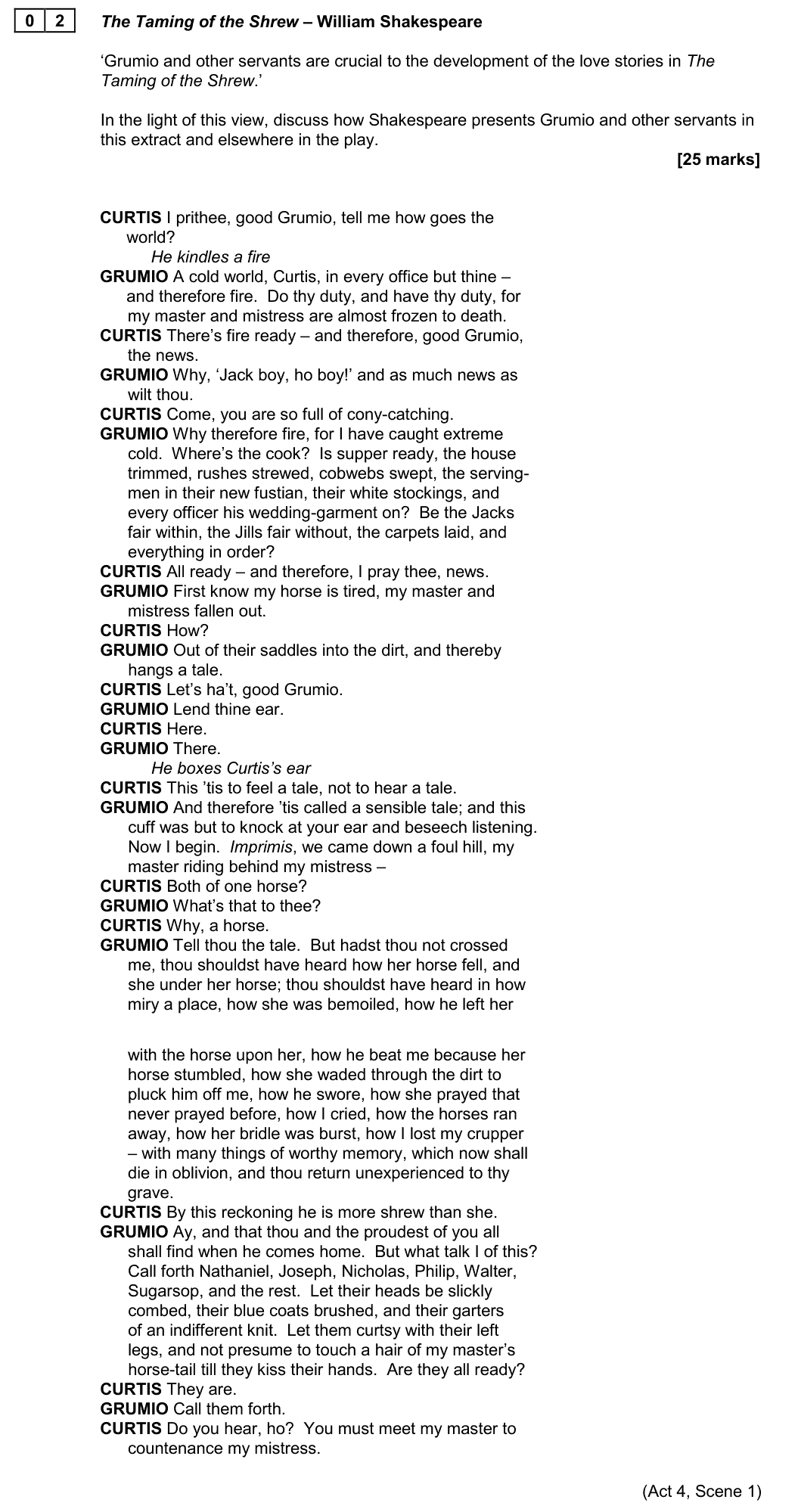
The Taming of the Shrew – William Shakespeare
‘Grumio and other servants are crucial to the development of the love stories in The
Taming of the Shrew.’
In the light of this view, discuss how Shakespeare presents Grumio and other servants in
this extract and elsewhere in the play.
[25 marks]
CURTIS I prithee, good Grumio, tell me how goes the
world?
He kindles a fire
GRUMIO A cold world, Curtis, in every office but thine –
and therefore fire. Do thy duty, and have thy duty, for
my master and mistress are almost frozen to death.
CURTIS There’s fire ready – and therefore, good Grumio,
the news.
GRUMIO Why, ‘Jack boy, ho boy!’ and as much news as
wilt thou.
CURTIS Come, you are so full of cony-catching.
GRUMIO Why therefore fire, for I have caught extreme
cold. Where’s the cook? Is supper ready, the house
trimmed, rushes strewed, cobwebs swept, the serving-
men in their new fustian, their white stockings, and
every officer his wedding-garment on? Be the Jacks
fair within, the Jills fair without, the carpets laid, and
everything in order?
CURTIS All ready – and therefore, I pray thee, news.
GRUMIO First know my horse is tired, my master and
mistress fallen out.
CURTIS How?
GRUMIO Out of their saddles into the dirt, and thereby
hangs a tale.
CURTIS Let’s ha’t, good Grumio.
GRUMIO Lend thine ear.
CURTIS Here.
GRUMIO There.
He boxes Curtis’s ear
CURTIS This ’tis to feel a tale, not to hear a tale.
GRUMIO And therefore ’tis called a sensible tale; and this
cuff was but to knock at your ear and beseech listening.
Now I begin. Imprimis, we came down a foul hill, my
master riding behind my mistress –
CURTIS Both of one horse?
GRUMIO What’s that to thee?
CURTIS Why, a horse.
GRUMIO Tell thou the tale. But hadst thou not crossed
me, thou shouldst have heard how her horse fell, and
she under her horse; thou shouldst have heard in how
miry a place, how she was bemoiled, how he left her
with the horse upon her, how he beat me because her
horse stumbled, how she waded through the dirt to
pluck him off me, how he swore, how she prayed that
never prayed before, how I cried, how the horses ran
away, how her bridle was burst, how I lost my crupper
– with many things of worthy memory, which now shall
die in oblivion, and thou return unexperienced to thy
grave.
CURTIS By this reckoning he is more shrew than she.
GRUMIO Ay, and that thou and the proudest of you all
shall find when he comes home. But what talk I of this?
Call forth Nathaniel, Joseph, Nicholas, Philip, Walter,
Sugarsop, and the rest. Let their heads be slickly
combed, their blue coats brushed, and their garters
of an indifferent knit. Let them curtsy with their left
legs, and not presume to touch a hair of my master’s
horse-tail till they kiss their hands. Are they all ready?
CURTIS They are.
GRUMIO Call them forth.
CURTIS Do you hear, ho? You must meet my master to
countenance my mistress.
(Act 4, Scene 1)
June 2024 · Paper 1 · Q3 25 marks Shakespeare extract measure for measure
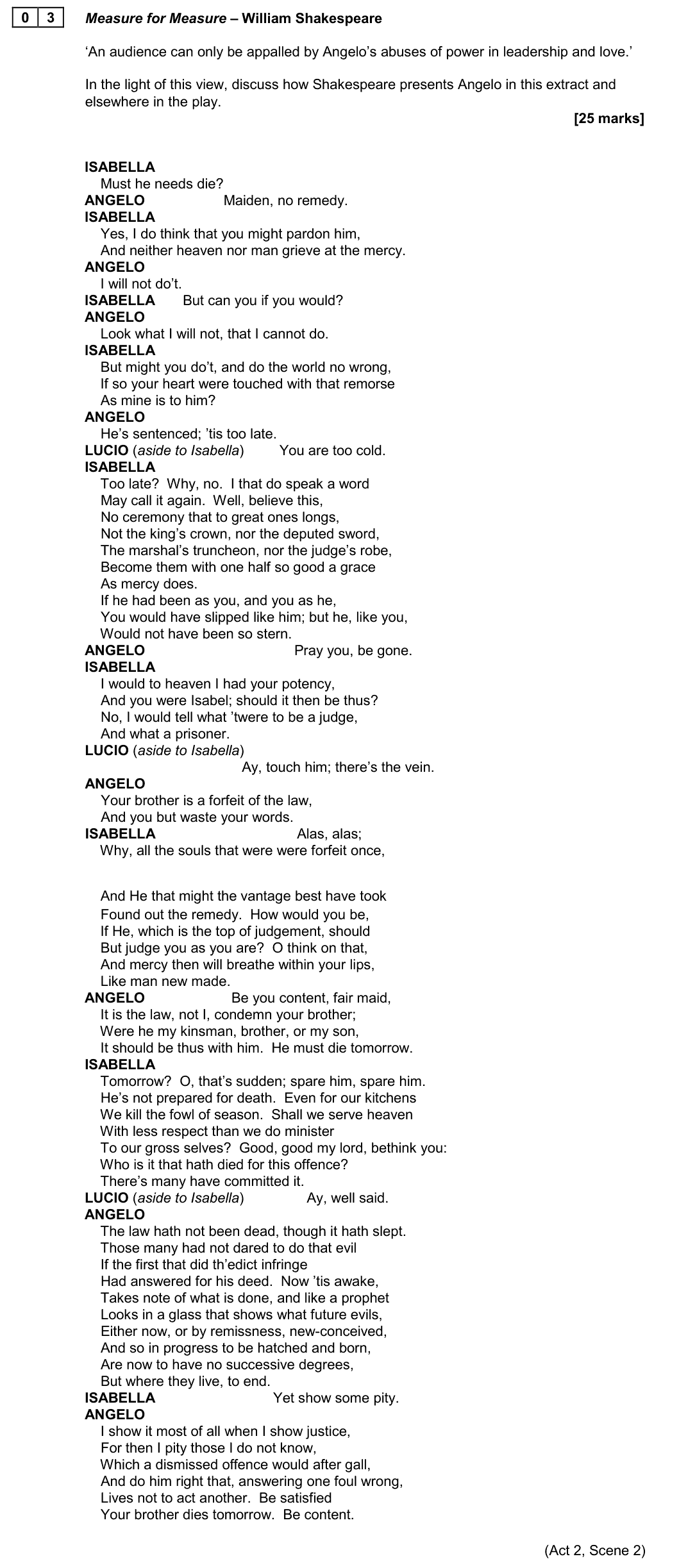
Measure for Measure – William Shakespeare
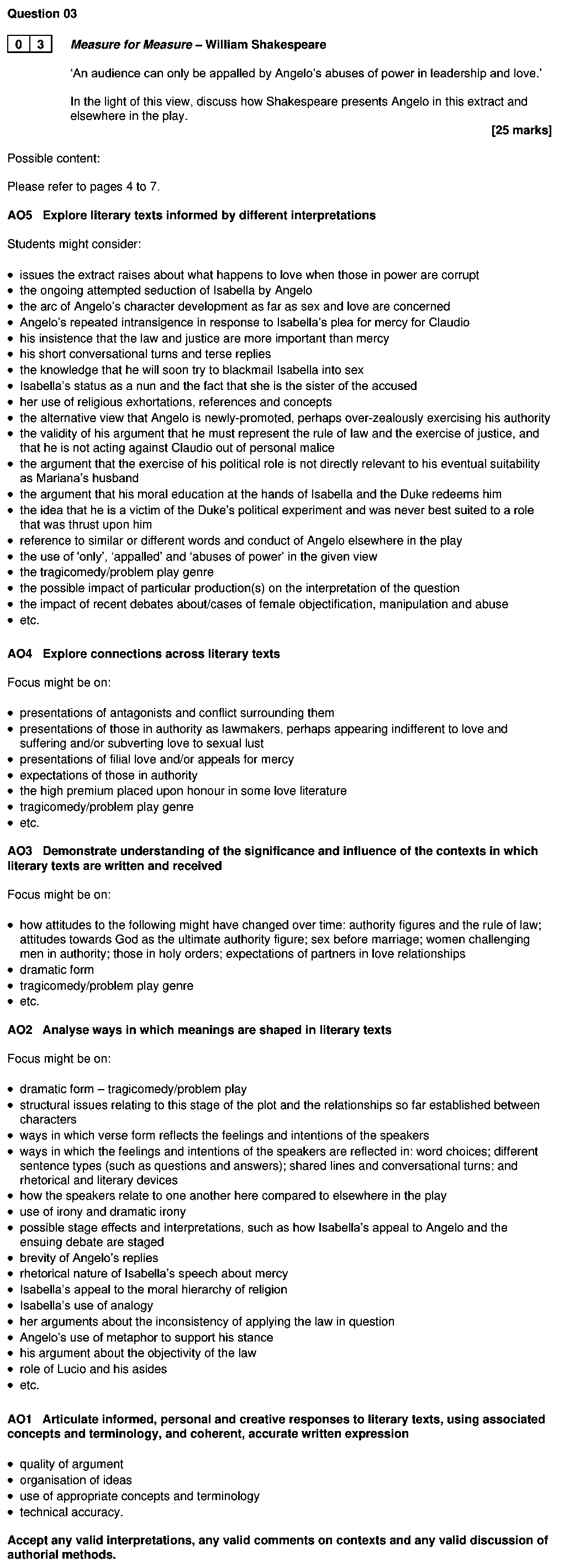
‘An audience can only be appalled by Angelo’s abuses of power in leadership and love.’
In the light of this view, discuss how Shakespeare presents Angelo in this extract and
elsewhere in the play.
[25 marks]
ISABELLA
Must he needs die?
ANGELO Maiden, no remedy.
ISABELLA
Yes, I do think that you might pardon him,
And neither heaven nor man grieve at the mercy.
ANGELO
I will not do’t.
ISABELLA But can you if you would?
ANGELO
Look what I will not, that I cannot do.
ISABELLA
But might you do’t, and do the world no wrong,
If so your heart were touched with that remorse
As mine is to him?
ANGELO
He’s sentenced; ’tis too late.
LUCIO (aside to Isabella) You are too cold.
ISABELLA
Too late? Why, no. I that do speak a word
May call it again. Well, believe this,
No ceremony that to great ones longs,
Not the king’s crown, nor the deputed sword,
The marshal’s truncheon, nor the judge’s robe,
Become them with one half so good a grace
As mercy does.
If he had been as you, and you as he,
You would have slipped like him; but he, like you,
Would not have been so stern.
ANGELO Pray you, be gone.
ISABELLA
I would to heaven I had your potency,
And you were Isabel; should it then be thus?
No, I would tell what ’twere to be a judge,
And what a prisoner.
LUCIO (aside to Isabella)
Ay, touch him; there’s the vein.
ANGELO
Your brother is a forfeit of the law,
And you but waste your words.
ISABELLA Alas, alas;
Why, all the souls that were were forfeit once,
And He that might the vantage best have took
Found out the remedy. How would you be,
If He, which is the top of judgement, should
But judge you as you are? O think on that,
And mercy then will breathe within your lips,
Like man new made.
ANGELO Be you content, fair maid,
It is the law, not I, condemn your brother;
Were he my kinsman, brother, or my son,
It should be thus with him. He must die tomorrow.
ISABELLA
Tomorrow? O, that’s sudden; spare him, spare him.
He’s not prepared for death. Even for our kitchens
We kill the fowl of season. Shall we serve heaven
With less respect than we do minister
To our gross selves? Good, good my lord, bethink you:
Who is it that hath died for this offence?
There’s many have committed it.
LUCIO (aside to Isabella) Ay, well said.
ANGELO
The law hath not been dead, though it hath slept.
Those many had not dared to do that evil
If the first that did th’edict infringe
Had answered for his deed. Now ’tis awake,
Takes note of what is done, and like a prophet
Looks in a glass that shows what future evils,
Either now, or by remissness, new-conceived,
And so in progress to be hatched and born,
Are now to have no successive degrees,
But where they live, to end.
ISABELLA Yet show some pity.
ANGELO
I show it most of all when I show justice,
For then I pity those I do not know,
Which a dismissed offence would after gall,
And do him right that, answering one foul wrong,
Lives not to act another. Be satisfied
Your brother dies tomorrow. Be content.
(Act 2, Scene 2)
June 2024 · Paper 1 · Q4 25 marks Shakespeare extract the winters tale
The Winter’s Tale – William Shakespeare
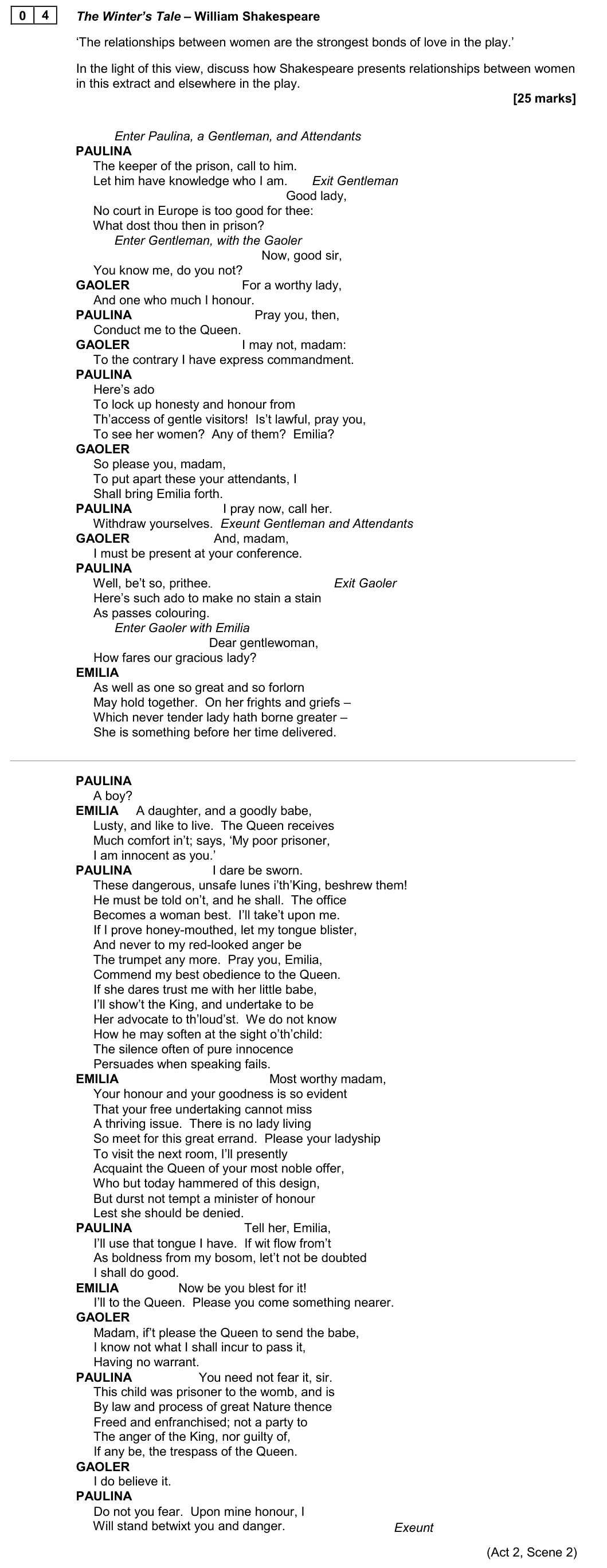
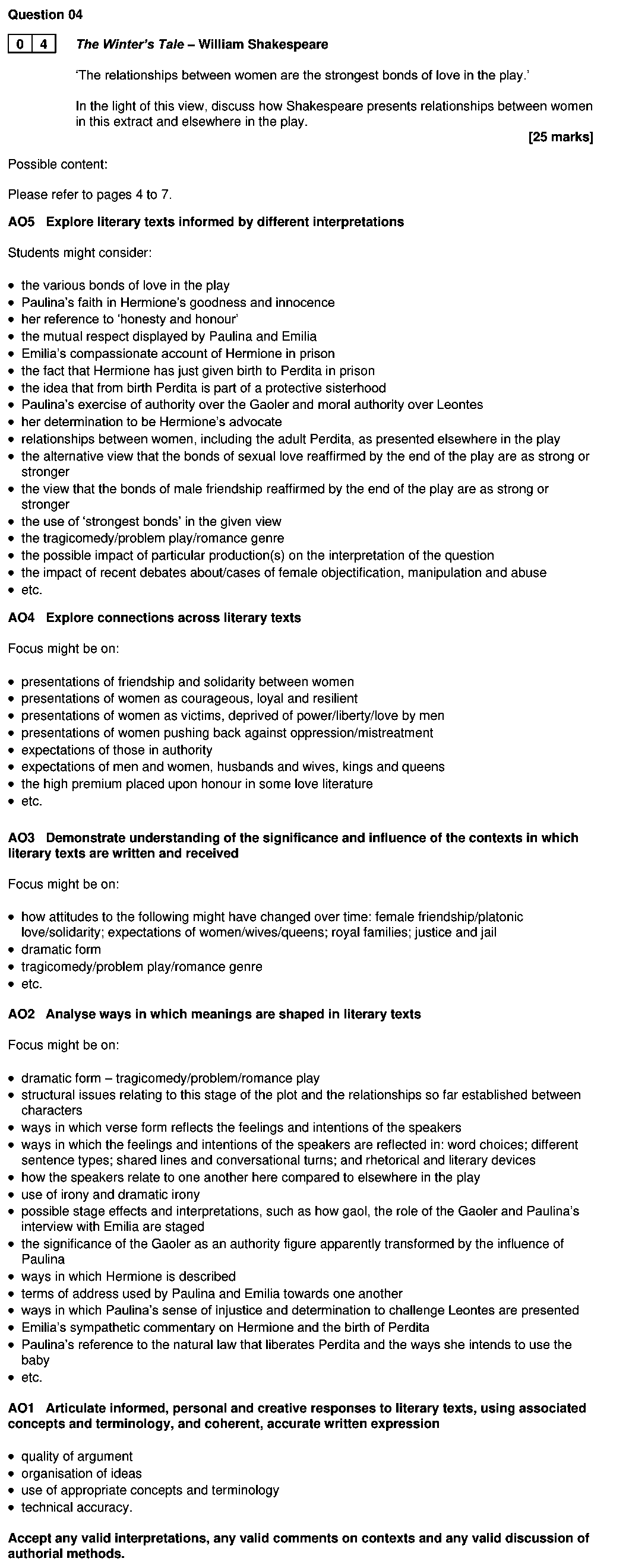
‘The relationships between women are the strongest bonds of love in the play.’
In the light of this view, discuss how Shakespeare presents relationships between women
in this extract and elsewhere in the play.
[25 marks]
Enter Paulina, a Gentleman, and Attendants
PAULINA
The keeper of the prison, call to him.
Let him have knowledge who I am. Exit Gentleman
Good lady,
No court in Europe is too good for thee:
What dost thou then in prison?
Enter Gentleman, with the Gaoler
Now, good sir,
You know me, do you not?
GAOLER For a worthy lady,
And one who much I honour.
PAULINA Pray you, then,
Conduct me to the Queen.
GAOLER I may not, madam:
To the contrary I have express commandment.
PAULINA
Here’s ado
To lock up honesty and honour from
Th’access of gentle visitors! Is’t lawful, pray you,
To see her women? Any of them? Emilia?
GAOLER
So please you, madam,
To put apart these your attendants, I
Shall bring Emilia forth.
PAULINA I pray now, call her.
Withdraw yourselves. Exeunt Gentleman and Attendants
GAOLER And, madam,
I must be present at your conference.
PAULINA
Well, be’t so, prithee. Exit Gaoler
Here’s such ado to make no stain a stain
As passes colouring.
Enter Gaoler with Emilia
Dear gentlewoman,
How fares our gracious lady?
EMILIA
As well as one so great and so forlorn
May hold together. On her frights and griefs –
Which never tender lady hath borne greater –
She is something before her time delivered.
PAULINA
A boy?
EMILIA A daughter, and a goodly babe,
Lusty, and like to live. The Queen receives
Much comfort in’t; says, ‘My poor prisoner,
I am innocent as you.’
PAULINA I dare be sworn.
These dangerous, unsafe lunes i’th’King, beshrew them!
He must be told on’t, and he shall. The office
Becomes a woman best. I’ll take’t upon me.
If I prove honey-mouthed, let my tongue blister,
And never to my red-looked anger be
The trumpet any more. Pray you, Emilia,
Commend my best obedience to the Queen.
If she dares trust me with her little babe,
I’ll show’t the King, and undertake to be
Her advocate to th’loud’st. We do not know
How he may soften at the sight o’th’child:
The silence often of pure innocence
Persuades when speaking fails.
EMILIA Most worthy madam,
Your honour and your goodness is so evident
That your free undertaking cannot miss
A thriving issue. There is no lady living
So meet for this great errand. Please your ladyship
To visit the next room, I’ll presently
Acquaint the Queen of your most noble offer,
Who but today hammered of this design,
But durst not tempt a minister of honour
Lest she should be denied.
PAULINA Tell her, Emilia,
I’ll use that tongue I have. If wit flow from’t
As boldness from my bosom, let’t not be doubted
I shall do good.
EMILIA Now be you blest for it!
I’ll to the Queen. Please you come something nearer.
GAOLER
Madam, if’t please the Queen to send the babe,
I know not what I shall incur to pass it,
Having no warrant.
PAULINA You need not fear it, sir.
This child was prisoner to the womb, and is
By law and process of great Nature thence
Freed and enfranchised; not a party to
The anger of the King, nor guilty of,
If any be, the trespass of the Queen.
GAOLER
I do believe it.
PAULINA
Do not you fear. Upon mine honour, I
Will stand betwixt you and danger. Exeunt
(Act 2, Scene 2)
June 2023 · AS Paper 1 · Q1 25 marks Shakespeare extract othello
Othello – William Shakespeare
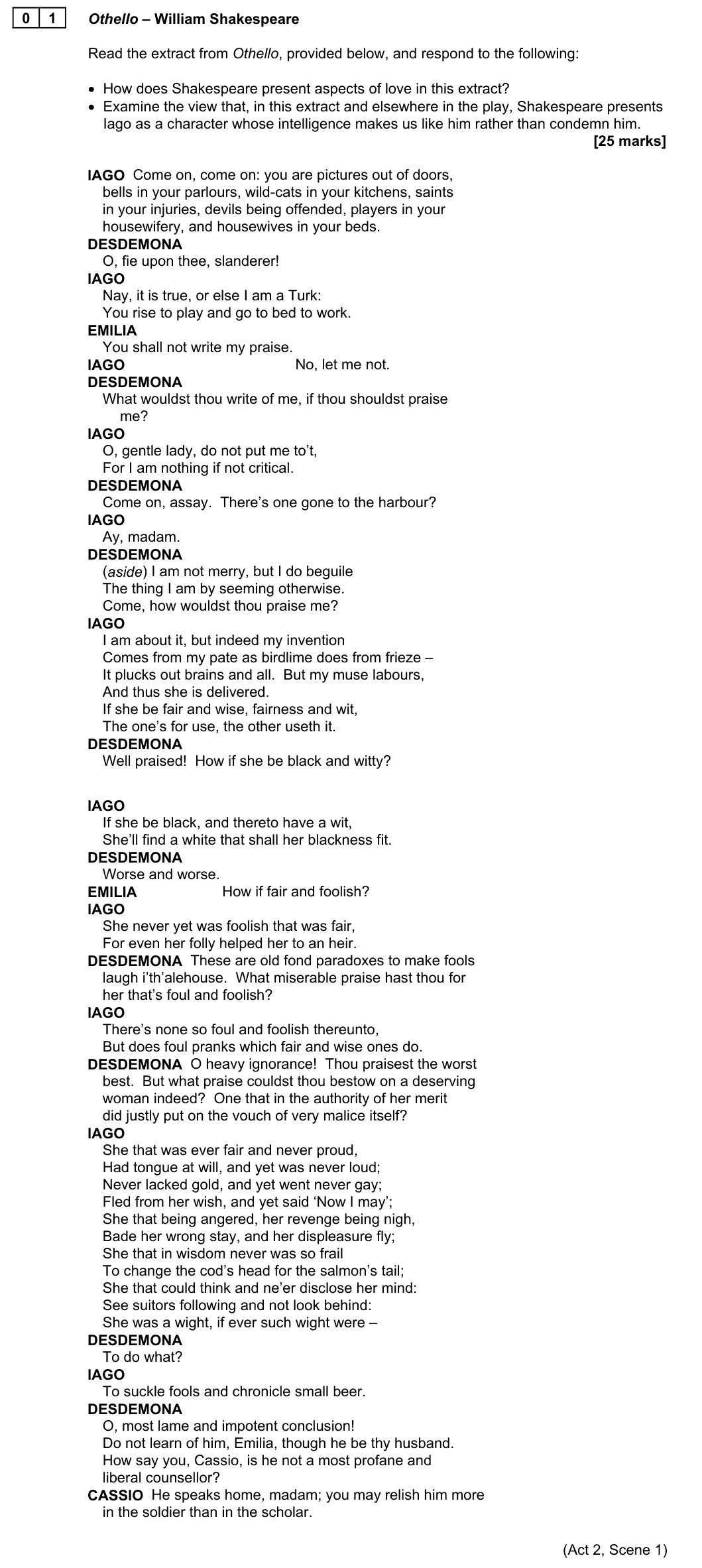
Read the extract from Othello, provided below, and respond to the following:
• How does Shakespeare present aspects of love in this extract?
• Examine the view that, in this extract and elsewhere in the play, Shakespeare presents
Iago as a character whose intelligence makes us like him rather than condemn him.
[25 marks]
IAGO Come on, come on: you are pictures out of doors,
bells in your parlours, wild-cats in your kitchens, saints
in your injuries, devils being offended, players in your
housewifery, and housewives in your beds.
DESDEMONA
O, fie upon thee, slanderer!
IAGO
Nay, it is true, or else I am a Turk:
You rise to play and go to bed to work.
EMILIA
You shall not write my praise.
IAGO No, let me not.
DESDEMONA
What wouldst thou write of me, if thou shouldst praise
me?
IAGO
O, gentle lady, do not put me to’t,
For I am nothing if not critical.
DESDEMONA
Come on, assay. There’s one gone to the harbour?
IAGO
Ay, madam.
DESDEMONA
(aside) I am not merry, but I do beguile
The thing I am by seeming otherwise.
Come, how wouldst thou praise me?
IAGO
I am about it, but indeed my invention
Comes from my pate as birdlime does from frieze –
It plucks out brains and all. But my muse labours,
And thus she is delivered.
If she be fair and wise, fairness and wit,
The one’s for use, the other useth it.
DESDEMONA
Well praised! How if she be black and witty?
IAGO
If she be black, and thereto have a wit,
She’ll find a white that shall her blackness fit.
DESDEMONA
Worse and worse.
EMILIA How if fair and foolish?
IAGO
She never yet was foolish that was fair,
For even her folly helped her to an heir.
DESDEMONA These are old fond paradoxes to make fools
laugh i’th’alehouse. What miserable praise hast thou for
her that’s foul and foolish?
IAGO
There’s none so foul and foolish thereunto,
But does foul pranks which fair and wise ones do.
DESDEMONA O heavy ignorance! Thou praisest the worst
best. But what praise couldst thou bestow on a deserving
woman indeed? One that in the authority of her merit
did justly put on the vouch of very malice itself?
IAGO
She that was ever fair and never proud,
Had tongue at will, and yet was never loud;
Never lacked gold, and yet went never gay;
Fled from her wish, and yet said ‘Now I may’;
She that being angered, her revenge being nigh,
Bade her wrong stay, and her displeasure fly;
She that in wisdom never was so frail
To change the cod’s head for the salmon’s tail;
She that could think and ne’er disclose her mind:
See suitors following and not look behind:
She was a wight, if ever such wight were –
DESDEMONA
To do what?
IAGO
To suckle fools and chronicle small beer.
DESDEMONA
O, most lame and impotent conclusion!
Do not learn of him, Emilia, though he be thy husband.
How say you, Cassio, is he not a most profane and
liberal counsellor?
CASSIO He speaks home, madam; you may relish him more
in the soldier than in the scholar.
(Act 2, Scene 1)
June 2023 · AS Paper 1 · Q2 25 marks Shakespeare extract taming of the shrew
The Taming of the Shrew – William Shakespeare
Read the extract from The Taming of the Shrew, provided below, and respond to the
following:
• How does Shakespeare present aspects of love in this extract?
• Examine the view that, in this extract and elsewhere in the play, Shakespeare presents
love as a silly game.
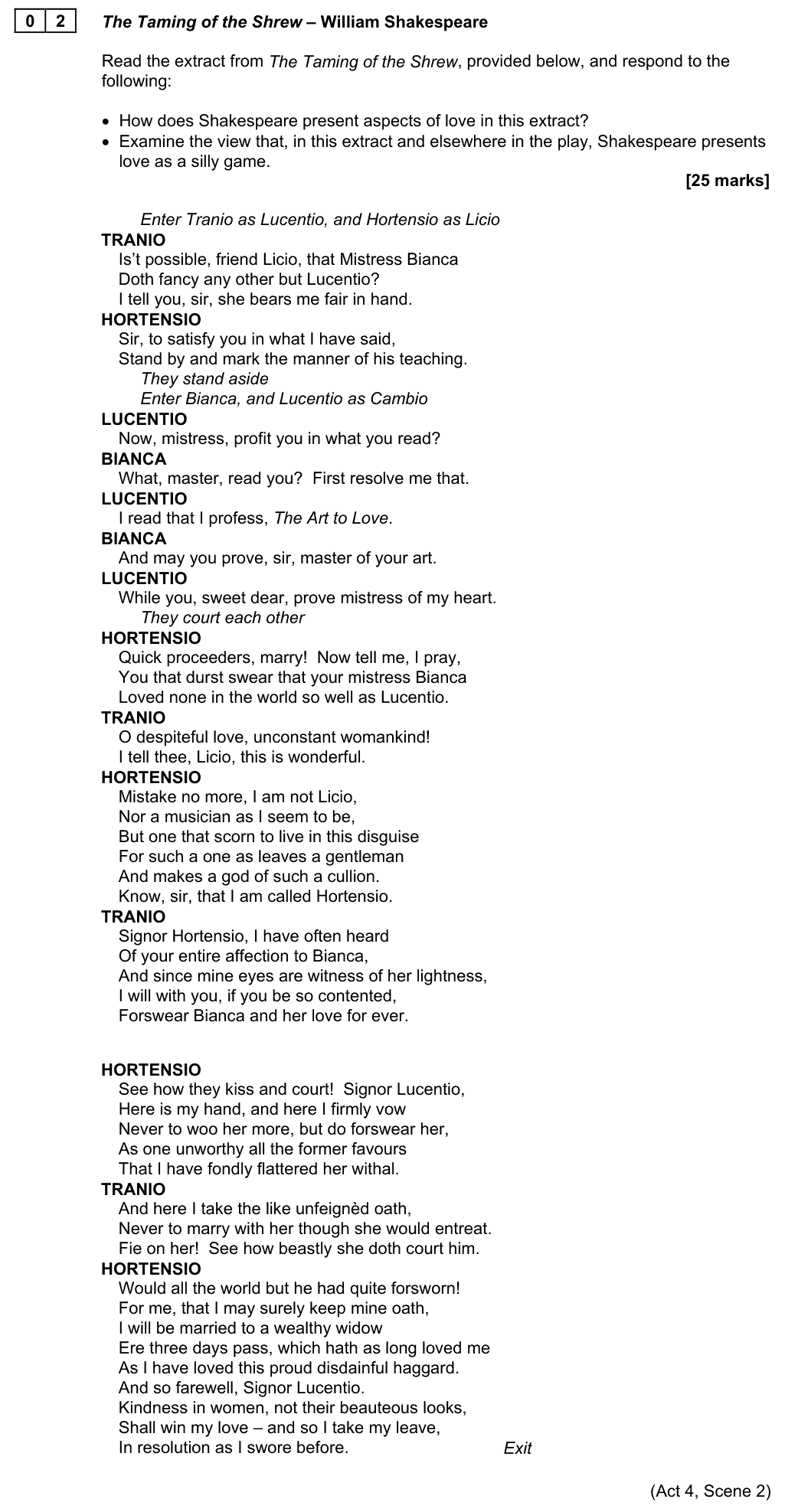
[25 marks]
Enter Tranio as Lucentio, and Hortensio as Licio
TRANIO
Is’t possible, friend Licio, that Mistress Bianca
Doth fancy any other but Lucentio?
I tell you, sir, she bears me fair in hand.
HORTENSIO
Sir, to satisfy you in what I have said,
Stand by and mark the manner of his teaching.
They stand aside
Enter Bianca, and Lucentio as Cambio
LUCENTIO
Now, mistress, profit you in what you read?
BIANCA
What, master, read you? First resolve me that.
LUCENTIO
I read that I profess, The Art to Love.
BIANCA
And may you prove, sir, master of your art.
LUCENTIO
While you, sweet dear, prove mistress of my heart.
They court each other
HORTENSIO
Quick proceeders, marry! Now tell me, I pray,
You that durst swear that your mistress Bianca
Loved none in the world so well as Lucentio.
TRANIO
O despiteful love, unconstant womankind!
I tell thee, Licio, this is wonderful.
HORTENSIO
Mistake no more, I am not Licio,
Nor a musician as I seem to be,
But one that scorn to live in this disguise
For such a one as leaves a gentleman
And makes a god of such a cullion.
Know, sir, that I am called Hortensio.
TRANIO
Signor Hortensio, I have often heard
Of your entire affection to Bianca,
And since mine eyes are witness of her lightness,
I will with you, if you be so contented,
Forswear Bianca and her love for ever.
HORTENSIO
See how they kiss and court! Signor Lucentio,
Here is my hand, and here I firmly vow
Never to woo her more, but do forswear her,
As one unworthy all the former favours
That I have fondly flattered her withal.
TRANIO
And here I take the like unfeignèd oath,
Never to marry with her though she would entreat.
Fie on her! See how beastly she doth court him.
HORTENSIO
Would all the world but he had quite forsworn!
For me, that I may surely keep mine oath,
I will be married to a wealthy widow
Ere three days pass, which hath as long loved me
As I have loved this proud disdainful haggard.
And so farewell, Signor Lucentio.
Kindness in women, not their beauteous looks,
Shall win my love – and so I take my leave,
In resolution as I swore before. Exit
(Act 4, Scene 2)
June 2023 · AS Paper 1 · Q3 25 marks Shakespeare extract measure for measure
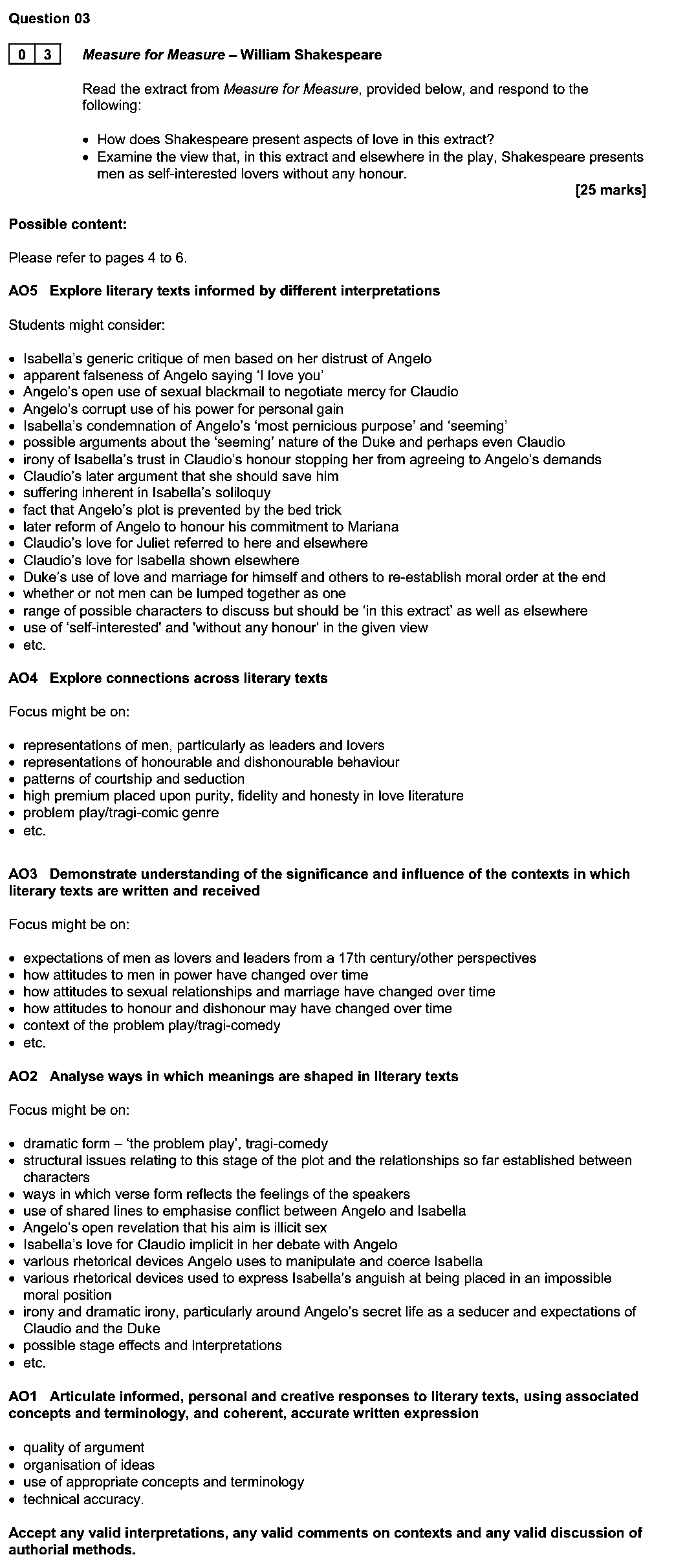
Measure for Measure – William Shakespeare
Read the extract from Measure for Measure, provided below, and respond to the
following:
• How does Shakespeare present aspects of love in this extract?
• Examine the view that, in this extract and elsewhere in the play, Shakespeare presents
men as self-interested lovers without any honour.
[25 marks]
ISABELLA
Women, help heaven! Men their creation mar
In profiting by them. Nay, call us ten times frail,
For we are soft as our complexions are,
And credulous to false prints.
ANGELO I think it well,
And from this testimony of your own sex –
Since I suppose we are made to be no stronger
Than faults may shake our frames – let me be bold.
I do arrest your words. Be that you are,
That is, a woman; if you be more, you’re none.
If you be one, as you are well expressed
By all external warrants, show it now,
By putting on the destined livery.
ISABELLA
I have no tongue but one. Gentle my lord,
Let me entreat you speak the former language.
ANGELO
Plainly conceive, I love you.
ISABELLA
My brother did love Juliet,
And you tell me that he shall die for’t.
ANGELO
He shall not, Isabel, if you give me love.
ISABELLA
I know your virtue hath a licence in’t,
Which seems a little fouler than it is,
To pluck on others.
ANGELO Believe me, on mine honour,
My words express my purpose.
ISABELLA
Ha! Little honour to be much believed,
And most pernicious purpose. Seeming, seeming!
I will proclaim thee, Angelo, look for’t!
Sign me a present pardon for my brother,
Or with an outstretched throat I’ll tell the world
Aloud what man thou art.
ANGELO Who will believe thee, Isabel?
My unsoiled name, th’austereness of my life,
My vouch against you, and my place i’th’state,
Will so your accusation overweigh
That you shall stifle in your own report
And smell of calumny. I have begun,
And now I give my sensual race the rein.
Fit thy consent to my sharp appetite,
Lay by all nicety and prolixious blushes,
That banish what they sue for. Redeem thy brother
By yielding up thy body to my will,
Or else he must not only die the death,
But thy unkindness shall his death draw out
To lingering sufferance. Answer me tomorrow,
Or, by the affection that now guides me most,
I’ll prove a tyrant to him. As for you,
Say what you can, my false o’erweighs your true. Exit
ISABELLA
To whom should I complain? Did I tell this,
Who would believe me? O perilous mouths,
That bear in them one and the selfsame tongue,
Either of condemnation or approof,
Bidding the law make curtsy to their will,
Hooking both right and wrong to th’appetite,
To follow as it draws. I’ll to my brother.
Though he hath fall’n by prompture of the blood,
Yet hath he in him such a mind of honour
That, had he twenty heads to tender down
On twenty bloody blocks, he’d yield them up,
Before his sister should her body stoop
To such abhorred pollution.
Then, Isabel, live chaste, and, brother, die.
More than our brother is our chastity.
I’ll tell him yet of Angelo’s request,
And fit his mind to death, for his soul’s rest. Exit
(Act 2, Scene 4)
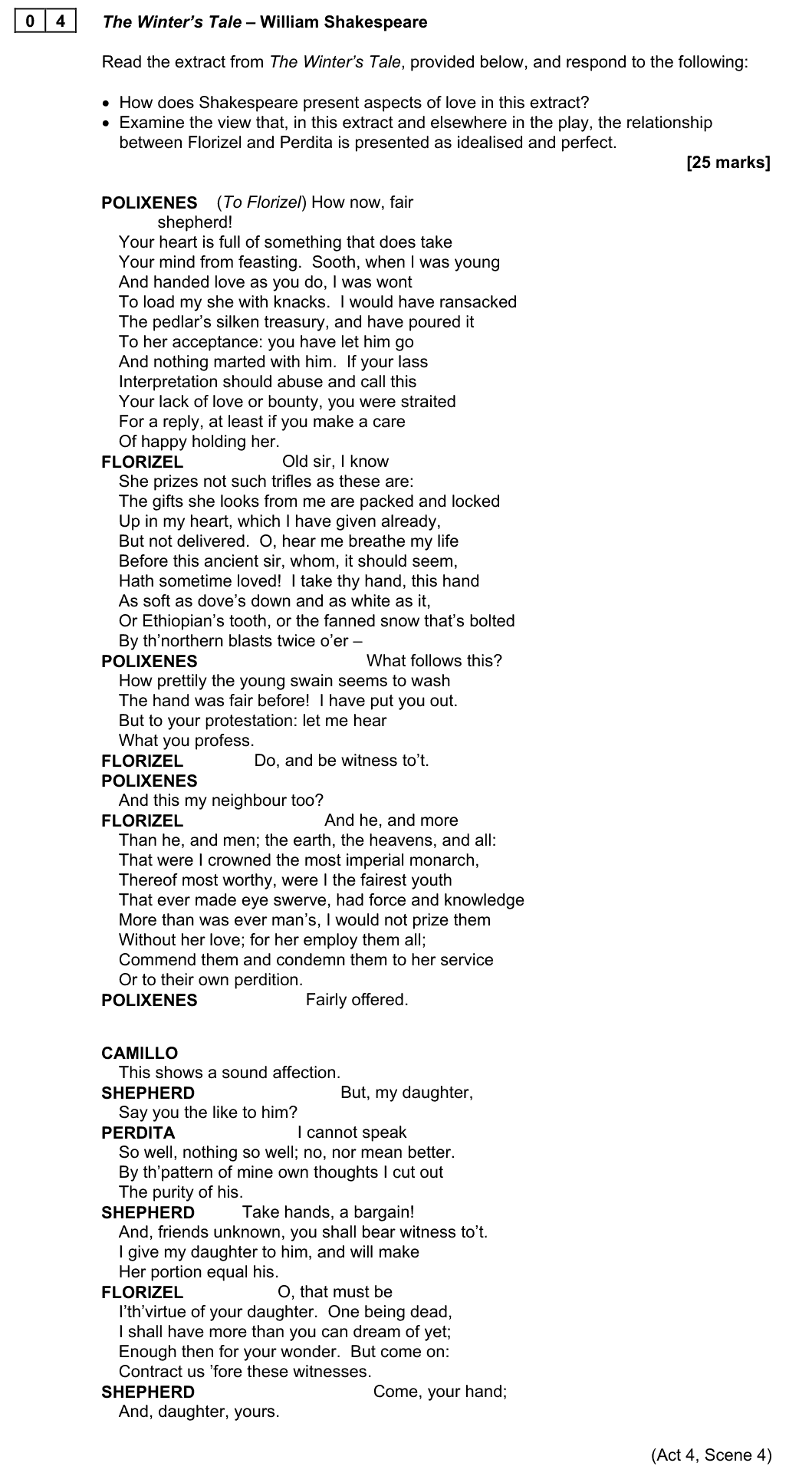
June 2023 · AS Paper 1 · Q4 25 marks Shakespeare extract the winters tale
The Winter’s Tale – William Shakespeare
Read the extract from The Winter’s Tale, provided below, and respond to the following:
• How does Shakespeare present aspects of love in this extract?
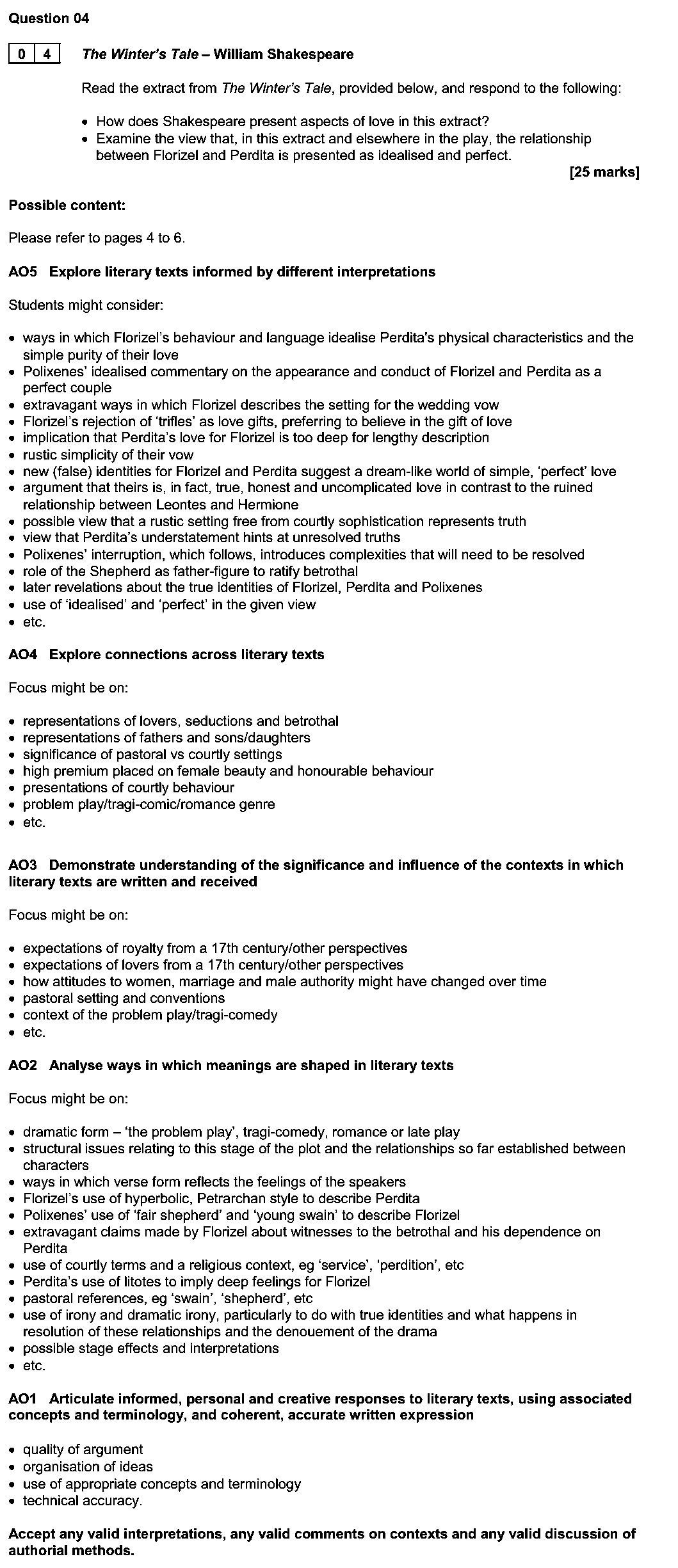
• Examine the view that, in this extract and elsewhere in the play, the relationship
between Florizel and Perdita is presented as idealised and perfect.
[25 marks]
POLIXENES (To Florizel) How now, fair
shepherd!
Your heart is full of something that does take
Your mind from feasting. Sooth, when I was young
And handed love as you do, I was wont
To load my she with knacks. I would have ransacked
The pedlar’s silken treasury, and have poured it
To her acceptance: you have let him go
And nothing marted with him. If your lass
Interpretation should abuse and call this
Your lack of love or bounty, you were straited
For a reply, at least if you make a care
Of happy holding her.
FLORIZEL Old sir, I know
She prizes not such trifles as these are:
The gifts she looks from me are packed and locked
Up in my heart, which I have given already,
But not delivered. O, hear me breathe my life
Before this ancient sir, whom, it should seem,
Hath sometime loved! I take thy hand, this hand
As soft as dove’s down and as white as it,
Or Ethiopian’s tooth, or the fanned snow that’s bolted
By th’northern blasts twice o’er –
POLIXENES What follows this?
How prettily the young swain seems to wash
The hand was fair before! I have put you out.
But to your protestation: let me hear
What you profess.
FLORIZEL Do, and be witness to’t.
POLIXENES
And this my neighbour too?
FLORIZEL And he, and more
Than he, and men; the earth, the heavens, and all:
That were I crowned the most imperial monarch,
Thereof most worthy, were I the fairest youth
That ever made eye swerve, had force and knowledge
More than was ever man’s, I would not prize them
Without her love; for her employ them all;
Commend them and condemn them to her service
Or to their own perdition.
POLIXENES Fairly offered.
CAMILLO
This shows a sound affection.
SHEPHERD But, my daughter,
Say you the like to him?
PERDITA I cannot speak
So well, nothing so well; no, nor mean better.
By th’pattern of mine own thoughts I cut out
The purity of his.
SHEPHERD Take hands, a bargain!
And, friends unknown, you shall bear witness to’t.
I give my daughter to him, and will make
Her portion equal his.
FLORIZEL O, that must be
I’th’virtue of your daughter. One being dead,
I shall have more than you can dream of yet;
Enough then for your wonder. But come on:
Contract us ’fore these witnesses.
SHEPHERD Come, your hand;
And, daughter, yours.
(Act 4, Scene 4)
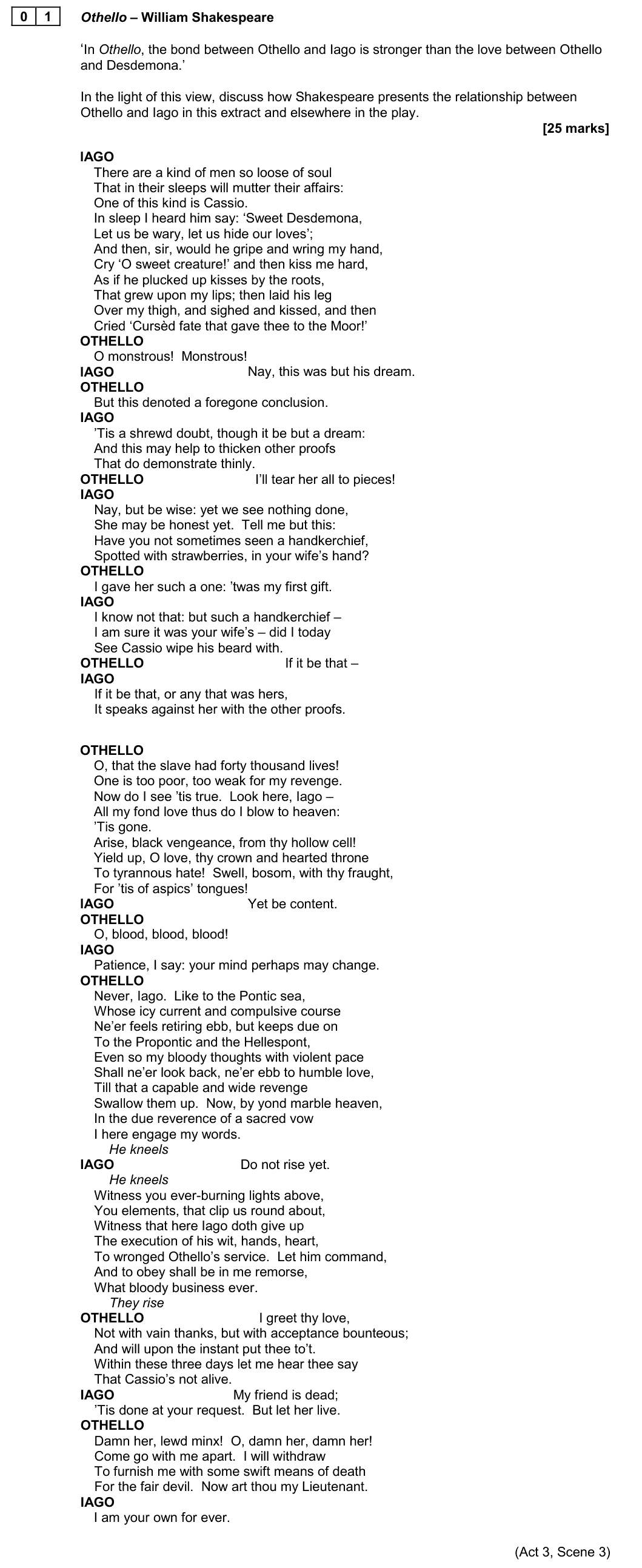
June 2023 · Paper 1 · Q1 25 marks Shakespeare extract othello
Othello – William Shakespeare
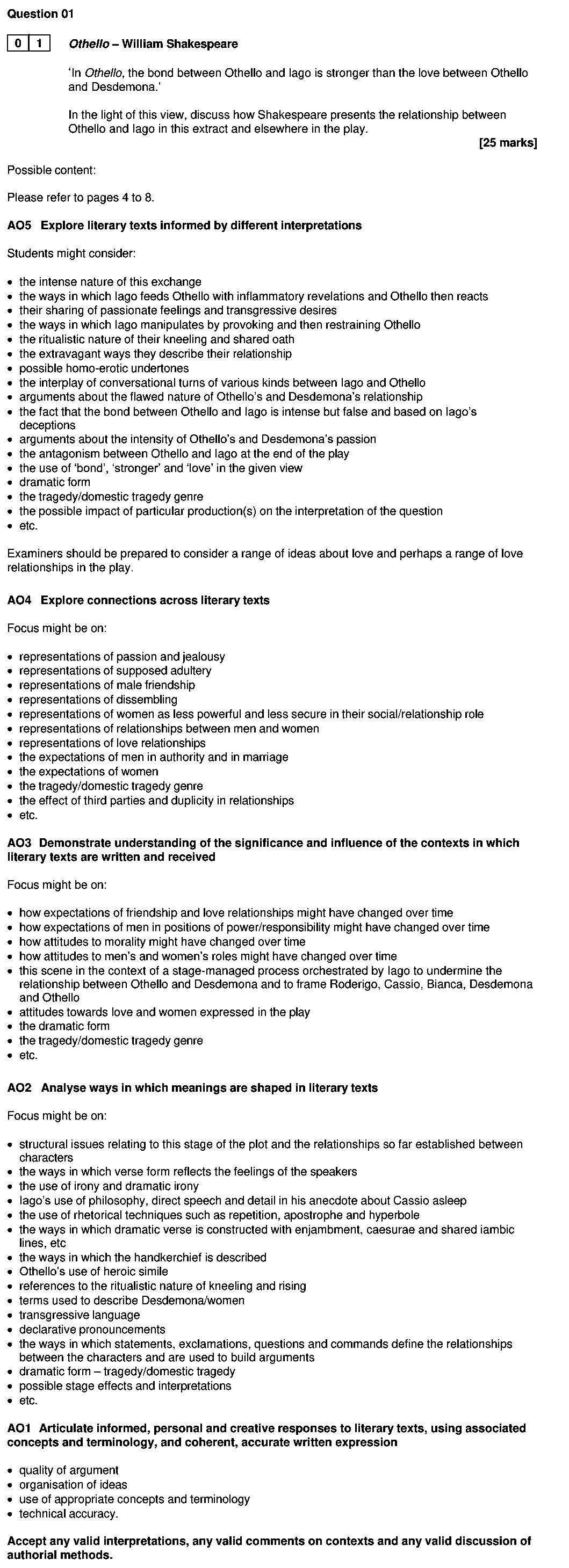
‘In Othello, the bond between Othello and Iago is stronger than the love between Othello
and Desdemona.’
In the light of this view, discuss how Shakespeare presents the relationship between
Othello and Iago in this extract and elsewhere in the play.
[25 marks]
IAGO
There are a kind of men so loose of soul
That in their sleeps will mutter their affairs:
One of this kind is Cassio.
In sleep I heard him say: ‘Sweet Desdemona,
Let us be wary, let us hide our loves’;
And then, sir, would he gripe and wring my hand,
Cry ‘O sweet creature!’ and then kiss me hard,
As if he plucked up kisses by the roots,
That grew upon my lips; then laid his leg
Over my thigh, and sighed and kissed, and then
Cried ‘Cursèd fate that gave thee to the Moor!’
OTHELLO
O monstrous! Monstrous!
IAGO Nay, this was but his dream.
OTHELLO
But this denoted a foregone conclusion.
IAGO
’Tis a shrewd doubt, though it be but a dream:
And this may help to thicken other proofs
That do demonstrate thinly.
OTHELLO I’ll tear her all to pieces!
IAGO
Nay, but be wise: yet we see nothing done,
She may be honest yet. Tell me but this:
Have you not sometimes seen a handkerchief,
Spotted with strawberries, in your wife’s hand?
OTHELLO
I gave her such a one: ’twas my first gift.
IAGO
I know not that: but such a handkerchief –
I am sure it was your wife’s – did I today
See Cassio wipe his beard with.
OTHELLO If it be that –
IAGO
If it be that, or any that was hers,
It speaks against her with the other proofs.
OTHELLO
O, that the slave had forty thousand lives!
One is too poor, too weak for my revenge.
Now do I see ’tis true. Look here, Iago –
All my fond love thus do I blow to heaven:
’Tis gone.
Arise, black vengeance, from thy hollow cell!
Yield up, O love, thy crown and hearted throne
To tyrannous hate! Swell, bosom, with thy fraught,
For ’tis of aspics’ tongues!
IAGO Yet be content.
OTHELLO
O, blood, blood, blood!
IAGO
Patience, I say: your mind perhaps may change.
OTHELLO
Never, Iago. Like to the Pontic sea,
Whose icy current and compulsive course
Ne’er feels retiring ebb, but keeps due on
To the Propontic and the Hellespont,
Even so my bloody thoughts with violent pace
Shall ne’er look back, ne’er ebb to humble love,
Till that a capable and wide revenge
Swallow them up. Now, by yond marble heaven,
In the due reverence of a sacred vow
I here engage my words.
He kneels
IAGO Do not rise yet.
He kneels
Witness you ever-burning lights above,
You elements, that clip us round about,
Witness that here Iago doth give up
The execution of his wit, hands, heart,
To wronged Othello’s service. Let him command,
And to obey shall be in me remorse,
What bloody business ever.
They rise
OTHELLO I greet thy love,
Not with vain thanks, but with acceptance bounteous;
And will upon the instant put thee to’t.
Within these three days let me hear thee say
That Cassio’s not alive.
IAGO My friend is dead;
’Tis done at your request. But let her live.
OTHELLO
Damn her, lewd minx! O, damn her, damn her!
Come go with me apart. I will withdraw
To furnish me with some swift means of death
For the fair devil. Now art thou my Lieutenant.
IAGO
I am your own for ever.
(Act 3, Scene 3)
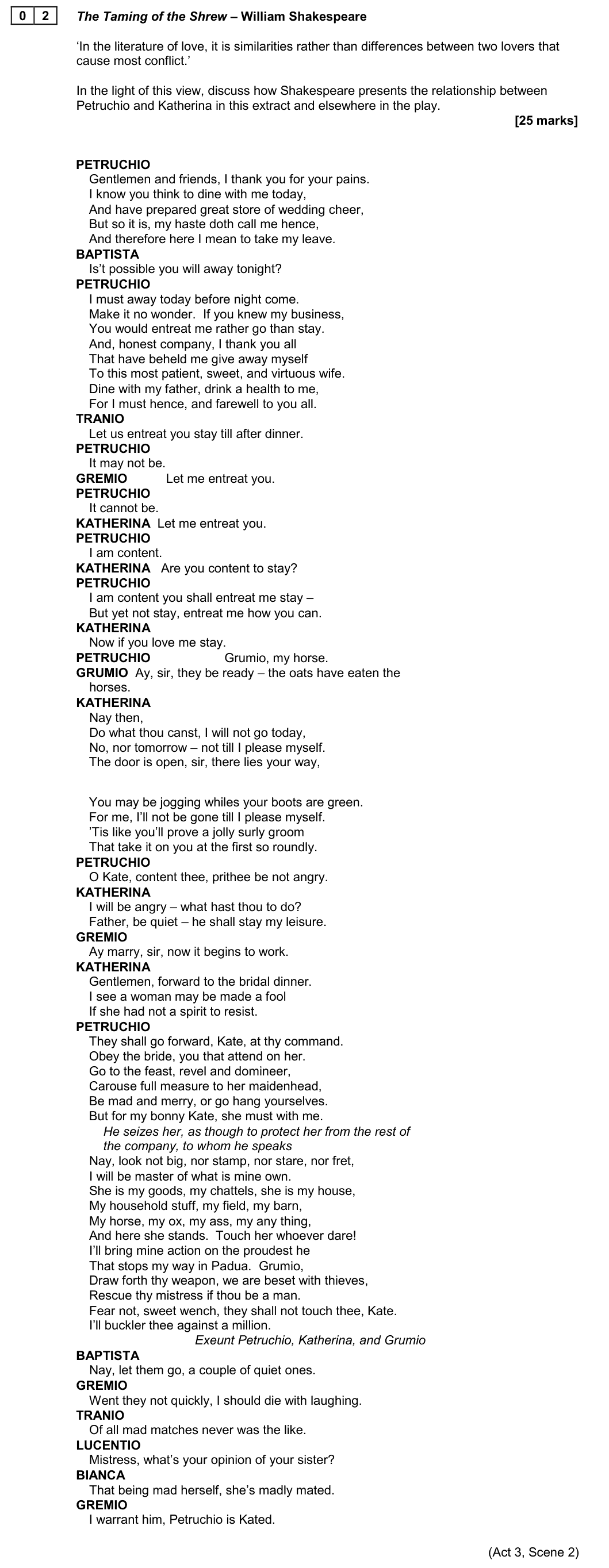
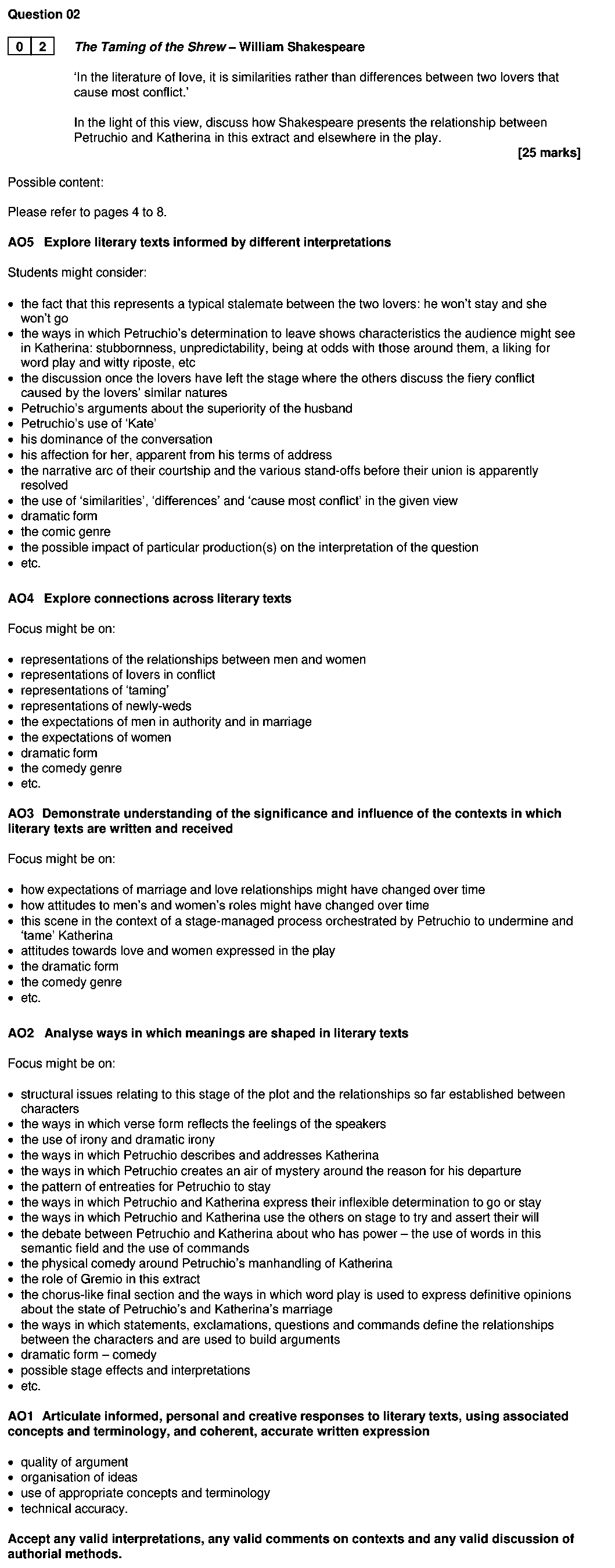
June 2023 · Paper 1 · Q2 25 marks Shakespeare extract taming of the shrew
The Taming of the Shrew – William Shakespeare
‘In the literature of love, it is similarities rather than differences between two lovers that
cause most conflict.’
In the light of this view, discuss how Shakespeare presents the relationship between
Petruchio and Katherina in this extract and elsewhere in the play.
[25 marks]
PETRUCHIO
Gentlemen and friends, I thank you for your pains.
I know you think to dine with me today,
And have prepared great store of wedding cheer,
But so it is, my haste doth call me hence,
And therefore here I mean to take my leave.
BAPTISTA
Is’t possible you will away tonight?
PETRUCHIO
I must away today before night come.
Make it no wonder. If you knew my business,
You would entreat me rather go than stay.
And, honest company, I thank you all
That have beheld me give away myself
To this most patient, sweet, and virtuous wife.
Dine with my father, drink a health to me,
For I must hence, and farewell to you all.
TRANIO
Let us entreat you stay till after dinner.
PETRUCHIO
It may not be.
GREMIO Let me entreat you.
PETRUCHIO
It cannot be.
KATHERINA Let me entreat you.
PETRUCHIO
I am content.
KATHERINA Are you content to stay?
PETRUCHIO
I am content you shall entreat me stay –
But yet not stay, entreat me how you can.
KATHERINA
Now if you love me stay.
PETRUCHIO Grumio, my horse.
GRUMIO Ay, sir, they be ready – the oats have eaten the
horses.
KATHERINA
Nay then,
Do what thou canst, I will not go today,
No, nor tomorrow – not till I please myself.
The door is open, sir, there lies your way,
You may be jogging whiles your boots are green.
For me, I’ll not be gone till I please myself.
’Tis like you’ll prove a jolly surly groom
That take it on you at the first so roundly.
PETRUCHIO
O Kate, content thee, prithee be not angry.
KATHERINA
I will be angry – what hast thou to do?
Father, be quiet – he shall stay my leisure.
GREMIO
Ay marry, sir, now it begins to work.
KATHERINA
Gentlemen, forward to the bridal dinner.
I see a woman may be made a fool
If she had not a spirit to resist.
PETRUCHIO
They shall go forward, Kate, at thy command.
Obey the bride, you that attend on her.
Go to the feast, revel and domineer,
Carouse full measure to her maidenhead,
Be mad and merry, or go hang yourselves.
But for my bonny Kate, she must with me.
He seizes her, as though to protect her from the rest of
the company, to whom he speaks
Nay, look not big, nor stamp, nor stare, nor fret,
I will be master of what is mine own.
She is my goods, my chattels, she is my house,
My household stuff, my field, my barn,
My horse, my ox, my ass, my any thing,
And here she stands. Touch her whoever dare!
I’ll bring mine action on the proudest he
That stops my way in Padua. Grumio,
Draw forth thy weapon, we are beset with thieves,
Rescue thy mistress if thou be a man.
Fear not, sweet wench, they shall not touch thee, Kate.
I’ll buckler thee against a million.
Exeunt Petruchio, Katherina, and Grumio
BAPTISTA
Nay, let them go, a couple of quiet ones.
GREMIO
Went they not quickly, I should die with laughing.
TRANIO
Of all mad matches never was the like.
LUCENTIO
Mistress, what’s your opinion of your sister?
BIANCA
That being mad herself, she’s madly mated.
GREMIO
I warrant him, Petruchio is Kated.
(Act 3, Scene 2)
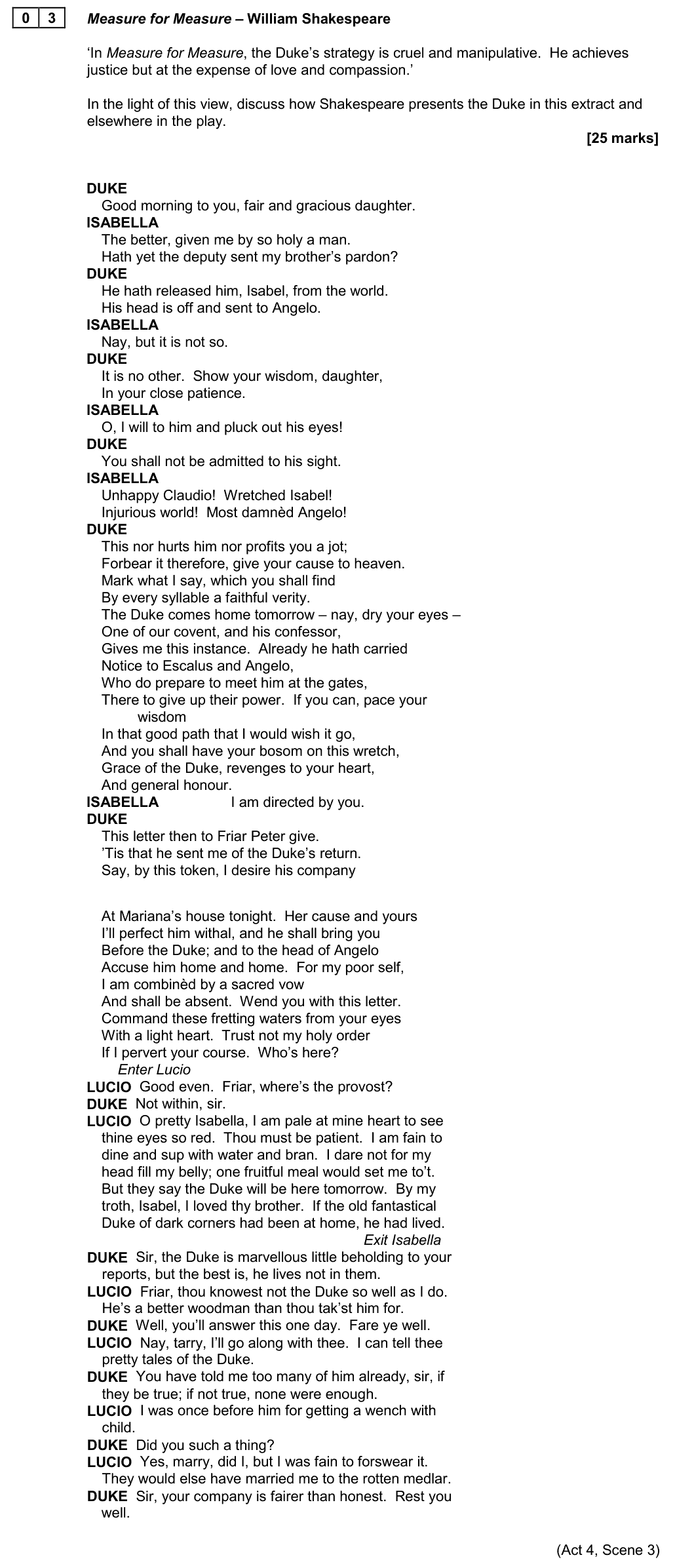
June 2023 · Paper 1 · Q3 25 marks Shakespeare extract measure for measure
Measure for Measure – William Shakespeare
‘In Measure for Measure, the Duke’s strategy is cruel and manipulative. He achieves
justice but at the expense of love and compassion.’
In the light of this view, discuss how Shakespeare presents the Duke in this extract and
elsewhere in the play.
[25 marks]
DUKE
Good morning to you, fair and gracious daughter.
ISABELLA
The better, given me by so holy a man.
Hath yet the deputy sent my brother’s pardon?
DUKE
He hath released him, Isabel, from the world.
His head is off and sent to Angelo.
ISABELLA
Nay, but it is not so.
DUKE
It is no other. Show your wisdom, daughter,
In your close patience.
ISABELLA
O, I will to him and pluck out his eyes!
DUKE
You shall not be admitted to his sight.
ISABELLA
Unhappy Claudio! Wretched Isabel!
Injurious world! Most damnèd Angelo!
DUKE
This nor hurts him nor profits you a jot;
Forbear it therefore, give your cause to heaven.
Mark what I say, which you shall find
By every syllable a faithful verity.
The Duke comes home tomorrow – nay, dry your eyes –
One of our covent, and his confessor,
Gives me this instance. Already he hath carried
Notice to Escalus and Angelo,
Who do prepare to meet him at the gates,
There to give up their power. If you can, pace your
wisdom
In that good path that I would wish it go,
And you shall have your bosom on this wretch,
Grace of the Duke, revenges to your heart,
And general honour.
ISABELLA I am directed by you.
DUKE
This letter then to Friar Peter give.
’Tis that he sent me of the Duke’s return.
Say, by this token, I desire his company
At Mariana’s house tonight. Her cause and yours
I’ll perfect him withal, and he shall bring you
Before the Duke; and to the head of Angelo
Accuse him home and home. For my poor self,
I am combinèd by a sacred vow
And shall be absent. Wend you with this letter.
Command these fretting waters from your eyes
With a light heart. Trust not my holy order
If I pervert your course. Who’s here?
Enter Lucio
LUCIO Good even. Friar, where’s the provost?
DUKE Not within, sir.
LUCIO O pretty Isabella, I am pale at mine heart to see
thine eyes so red. Thou must be patient. I am fain to
dine and sup with water and bran. I dare not for my
head fill my belly; one fruitful meal would set me to’t.
But they say the Duke will be here tomorrow. By my
troth, Isabel, I loved thy brother. If the old fantastical
Duke of dark corners had been at home, he had lived.
Exit Isabella
DUKE Sir, the Duke is marvellous little beholding to your
reports, but the best is, he lives not in them.
LUCIO Friar, thou knowest not the Duke so well as I do.
He’s a better woodman than thou tak’st him for.
DUKE Well, you’ll answer this one day. Fare ye well.
LUCIO Nay, tarry, I’ll go along with thee. I can tell thee
pretty tales of the Duke.
DUKE You have told me too many of him already, sir, if
they be true; if not true, none were enough.
LUCIO I was once before him for getting a wench with
child.
DUKE Did you such a thing?
LUCIO Yes, marry, did I, but I was fain to forswear it.
They would else have married me to the rotten medlar.
DUKE Sir, your company is fairer than honest. Rest you
well.
(Act 4, Scene 3)
June 2023 · Paper 1 · Q4 25 marks Shakespeare extract the winters tale
The Winter’s Tale – William Shakespeare
‘In the literature of love, marriage is seen as essential to personal happiness and the
social order.’
In the light of this view, discuss how Shakespeare presents ideas about marriage in this
extract and elsewhere in the play.
[25 marks]
PAULINA You are one of those
Would have him wed again.
DION If you would not so,
You pity not the state, nor the remembrance
Of his most sovereign name; consider little
What dangers by his highness’ fail of issue
May drop upon his kingdom and devour
Incertain lookers-on. What were more holy
Than to rejoice the former queen is well?
What holier than, for royalty’s repair,
For present comfort and for future good,
To bless the bed of majesty again
With a sweet fellow to’t?
PAULINA There is none worthy,
Respecting her that’s gone. Besides the gods
Will have fulfilled their secret purposes:
For has not the divine Apollo said,
Is’t not the tenor of his oracle,
That King Leontes shall not have an heir
Till his lost child be found? Which that it shall
Is all as monstrous to our human reason
As my Antigonus to break his grave
And come again to me; who, on my life,
Did perish with the infant. ’Tis your counsel
My lord should to the heavens be contrary,
Oppose against their wills. (To Leontes) Care not for
issue.
The crown will find an heir. Great Alexander
Left his to th’worthiest; so his successor
Was like to be the best.
LEONTES Good Paulina,
Who hast the memory of Hermione,
I know, in honour, O that ever I
Had squared me to thy counsel! Then even now
I might have looked upon my queen’s full eyes,
Have taken treasure from her lips –
PAULINA And left them
More rich for what they yielded.
LEONTES Thou speak’st truth.
No more such wives, therefore no wife: one worse,
And better used, would make her sainted spirit
Again possess her corpse, and on this stage,
Where we offenders move, appear soul-vexed,
And begin, ‘Why to me?’
PAULINA Had she such power,
She had just cause.
LEONTES She had, and would incense me
To murder her I married.
PAULINA I should so.
Were I the ghost that walked, I’d bid you mark
Her eye, and tell me for what dull part in’t
You chose her; then I’d shriek, that even your ears
Should rift to hear me; and the words that followed
Should be ‘Remember mine.’
LEONTES Stars, stars,
And all eyes else dead coals! Fear thou no wife;
I’ll have no wife, Paulina.
PAULINA Will you swear
Never to marry but by my free leave?
LEONTES
Never, Paulina, so be blest my spirit!
PAULINA
Then, good my lords, bear witness to his oath.
CLEOMENES
You tempt him over-much.
PAULINA Unless another,
As like Hermione as is her picture,
Affront his eye.
CLEOMENES Good madam –
PAULINA I have done.
Yet if my lord will marry – if you will, sir,
No remedy, but you will – give me the office
To choose you a queen: she shall not be so young
As was your former, but she shall be such
As, walked your first queen’s ghost, it should take joy
To see her in your arms.
LEONTES My true Paulina,
We shall not marry till thou bid’st us.
PAULINA That
Shall be when your first queen’s again in breath;
Never till then.
(Act 5, Scene 1)
June 2022 · AS Paper 1 · Q1 25 marks Shakespeare extract othello
Othello – William Shakespeare
Read the extract from Othello, provided below, and respond to the following:
• How does Shakespeare present aspects of love in this extract?
• Examine the view that, in this extract and elsewhere in the play, women are passive
victims of men.
[25 marks]
DESDEMONA
Am I that name, Iago?
IAGO What name, fair lady?
DESDEMONA
Such as she said my lord did say I was.
EMILIA
He called her whore: a beggar in his drink
Could not have laid such terms upon his callet.
IAGO
Why did he so?
DESDEMONA
I do not know: I am sure I am none such.
IAGO
Do not weep, do not weep. Alas the day!
EMILIA
Hath she forsook so many noble matches,
Her father, and her country, all her friends,
To be called whore? Would it not make one weep?
DESDEMONA
It is my wretched fortune.
IAGO Beshrew him for’t!
How comes this trick upon him?
DESDEMONA Nay, heaven doth know.
EMILIA
I will be hanged if some eternal villain,
Some busy and insinuating rogue,
Some cogging, cozening slave, to get some office,
Have not devised this slander; I’ll be hanged else.
IAGO
Fie, there is no such man! It is impossible.
DESDEMONA
If any such there be, heaven pardon him.
EMILIA
A halter pardon him and hell gnaw his bones!
Why should he call her whore? Who keeps her company?
What place, what time, what form, what likelihood?
The Moor’s abused by some most villainous knave,
Some base notorious knave, some scurvy fellow.
O heaven, that such companions thou’dst unfold,
And put in every honest hand a whip
To lash the rascals naked through the world,
Even from the east to th’west!
IAGO Speak within door.
EMILIA
O fie upon them! Some such squire he was
That turned your wit the seamy side without
And made you to suspect me with the Moor.
IAGO
You are a fool, go to.
DESDEMONA O good Iago,
What shall I do to win my lord again?
Good friend, go to him; for, by this light of heaven,
I know not how I lost him. Here I kneel:
If e’er my will did trespass ’gainst his love,
Either in discourse of thought or actual deed;
Or that mine eyes, mine ears, or any sense
Delighted them in any other form;
Or that I do not yet, and ever did,
And ever will – though he do shake me off
To beggarly divorcement – love him dearly,
Comfort forswear me! Unkindness may do much,
And his unkindness may defeat my life,
But never taint my love. I cannot say ‘whore’:
It does abhor me now I speak the word;
To do the act that might the addition earn
Not the world’s mass of vanity could make me.
IAGO
I pray you, be content: ’tis but his humour;
The business of the state does him offence,
And he does chide with you.
DESDEMONA
If ’twere no other –
IAGO It is so, I warrant.
Hark how these instruments summon to supper!
The messengers of Venice stay the meat.
Go in, and weep not; all things shall be well.
(Act 4, Scene 2)
June 2022 · AS Paper 1 · Q2 25 marks Shakespeare extract taming of the shrew
The Taming of the Shrew – William Shakespeare
Read the extract from The Taming of the Shrew, provided below, and respond to the
following:
• How does Shakespeare present aspects of love in this extract?
• Examine the view that, in this extract and elsewhere in the play, men judge women
solely on their monetary value.
[25 marks]
PETRUCHIO
...I have thrust myself into this maze,
Haply to wive and thrive as best I may.
Crowns in my purse I have, and goods at home,
And so am come abroad to see the world.
HORTENSIO
Petruchio, shall I then come roundly to thee
And wish thee to a shrewd ill-favoured wife?
Thou’dst thank me but a little for my counsel,
And yet I’ll promise thee she shall be rich,
And very rich. But th’ art too much my friend,
And I’ll not wish thee to her.
PETRUCHIO
Signor Hortensio, ’twixt such friends as we
Few words suffice; and therefore, if thou know
One rich enough to be Petruchio’s wife –
As wealth is burden of my wooing dance –
Be she as foul as was Florentius’ love,
As old as Sibyl, and as curst and shrewd
As Socrates’ Xanthippe, or a worse,
She moves me not, or not removes at least
Affection’s edge in me, were she as rough
As are the swelling Adriatic seas.
I come to wive it wealthily in Padua;
If wealthily, then happily in Padua.
GRUMIO Nay, look you, sir, he tells you flatly what his
mind is. Why, give him gold enough and marry him to
a puppet or an aglet-baby, or an old trot with ne’er a
tooth in her head, though she have as many diseases
as two and fifty horses. Why, nothing comes amiss, so
money comes withal.
HORTENSIO
Petruchio, since we are stepped thus far in,
I will continue that I broached in jest.
I can, Petruchio, help thee to a wife
With wealth enough, and young and beauteous,
Brought up as best becomes a gentlewoman.
Her only fault – and that is faults enough –
Is that she is intolerable curst,
And shrewd and froward so beyond all measure
That, were my state far worser than it is,
I would not wed her for a mine of gold.
PETRUCHIO
Hortensio, peace. Thou know’st not gold’s effect.
Tell me her father’s name and ’tis enough.
For I will board her though she chide as loud
As thunder when the clouds in autumn crack.
HORTENSIO
Her father is Baptista Minola,
An affable and courteous gentleman.
Her name is Katherina Minola,
Renowned in Padua for her scolding tongue.
PETRUCHIO
I know her father, though I know not her,
And he knew my deceasèd father well.
I will not sleep, Hortensio, till I see her,
And therefore let me be thus bold with you
To give you over at this first encounter,
Unless you will accompany me thither.
GRUMIO I pray you, sir, let him go while the humour lasts.
O’ my word, an she knew him as well as I do, she would
think scolding would do little good upon him. She may
perhaps call him half a score knaves or so. Why, that’s
nothing; an he begin once, he’ll rail in his rope-tricks.
I’ll tell you what, sir, an she stand him but a little, he
will throw a figure in her face, and so disfigure her with
it that she shall have no more eyes to see withal than a
cat. You know him not, sir.
HORTENSIO
Tarry, Petruchio, I must go with thee,
For in Baptista’s keep my treasure is.
He hath the jewel of my life in hold,
His youngest daughter, beautiful Bianca,
And her withholds from me and other more,
Suitors to her and rivals in my love,
Supposing it a thing impossible,
For those defects I have before rehearsed,
That ever Katherina will be wooed.
Therefore this order hath Baptista ta’en,
That none shall have access unto Bianca
Till Katherine the curst have got a husband.
GRUMIO
Katherine the curst,
A title for a maid of all titles the worst.
(Act 1, Scene 2)
June 2022 · AS Paper 1 · Q3 25 marks Shakespeare extract measure for measure
Measure for Measure – William Shakespeare
Read the extract from Measure for Measure, provided below, and respond to the
following:
• How does Shakespeare present aspects of love in this extract?
• Examine the view that, in this extract and elsewhere in the play, Isabella’s love for truth
and justice is the quality that makes her admirable.
[25 marks]
FRIAR PETER
Now is your time. Speak loud and kneel before him.
ISABELLA
Justice, O royal Duke! Vail your regard
Upon a wronged – I would fain have said, a maid.
O worthy prince, dishonour not your eye
By throwing it on any other object
Till you have heard me in my true complaint
And given me justice, justice, justice, justice!
DUKE
Relate your wrongs. In what? By whom? Be brief.
Here is Lord Angelo shall give you justice.
Reveal yourself to him.
ISABELLA O worthy Duke,
You bid me seek redemption of the devil.
Hear me yourself, for that which I must speak
Must either punish me, not being believed,
Or wring redress from you. Hear me, O hear me, hear.
ANGELO
My lord, her wits, I fear me, are not firm.
She hath been a suitor to me for her brother,
Cut off by course of justice –
ISABELLA By course of justice!
ANGELO
And she will speak most bitterly and strange.
ISABELLA
Most strange, but yet most truly, will I speak.
That Angelo’s forsworn, is it not strange?
That Angelo’s a murderer, is’t not strange?
That Angelo is an adulterous thief,
An hypocrite, a virgin-violator,
Is it not strange, and strange?
DUKE Nay, it is ten times strange.
ISABELLA
It is not truer he is Angelo
Than this is all as true as it is strange.
Nay, it is ten times true, for truth is truth
To th’end of reck’ning.
DUKE Away with her. Poor soul,
She speaks this in th’infirmity of sense.
ISABELLA
O prince, I conjure thee, as thou believ’st
There is another comfort than this world,
That thou neglect me not with that opinion
That I am touched with madness. Make not impossible
That which but seems unlike. ’Tis not impossible
But one, the wicked’st caitiff on the ground,
May seem as shy, as grave, as just, as absolute
As Angelo. Even so may Angelo,
In all his dressings, characts, titles, forms,
Be an arch-villain. Believe it, royal prince.
If he be less, he’s nothing: but he’s more,
Had I more name for badness.
DUKE By mine honesty,
If she be mad, as I believe no other,
Her madness hath the oddest frame of sense,
Such a dependency of thing on thing,
As e’er I heard in madness.
ISABELLA O gracious Duke,
Harp not on that, nor do not banish reason
For inequality, but let your reason serve
To make the truth appear where it seems hid,
And hide the false seems true.
(Act 5, Scene 1)
June 2022 · AS Paper 1 · Q4 25 marks Shakespeare extract the winters tale
The Winter’s Tale – William Shakespeare
Read the extract from The Winter’s Tale, provided below, and respond to the following:
• How does Shakespeare present aspects of love in this extract?
• Examine the view that, in this extract and elsewhere in the play, the restoration of male
friendship is crucial to the happy ending of the play.
[25 marks]
LEONTES They are come.
Enter Florizel, Perdita, Cleomenes, and others
Your mother was most true to wedlock, Prince:
For she did print your royal father off,
Conceiving you. Were I but twenty-one,
Your father’s image is so hit in you,
His very air, that I should call you brother,
As I did him, and speak of something wildly
By us performed before. Most dearly welcome,
And your fair princess – goddess! O! Alas,
I lost a couple that ’twixt heaven and earth
Might thus have stood, begetting wonder, as
You, gracious couple, do. And then I lost –
All mine own folly – the society,
Amity too, of your brave father, whom,
Though bearing misery, I desire my life
Once more to look on him.
FLORIZEL By his command
Have I here touched Sicilia, and from him
Give you all greetings that a king, at friend,
Can send his brother; and but infirmity,
Which waits upon worn times, hath something seized
His wished ability, he had himself
The lands and waters ’twixt your throne and his
Measured to look upon you, whom he loves –
He bade me say so – more than all the sceptres
And those that bear them living.
LEONTES O my brother –
Good gentleman – the wrongs I have done thee stir
Afresh within me; and these thy offices,
So rarely kind, are as interpreters
Of my behindhand slackness! – Welcome hither
As is the spring to th’earth! And hath he too
Exposed this paragon to th’fearful usage,
At least ungentle, of the dreadful Neptune
To greet a man not worth her pains, much less
Th’adventure of her person?
FLORIZEL Good my lord,
She came from Libya.
LEONTES Where the warlike Smalus,
That noble, honoured lord, is feared and loved?
FLORIZEL
Most royal sir, from thence; from him whose daughter
His tears proclaimed his, parting with her; thence,
A prosperous south wind friendly, we have crossed,
To execute the charge my father gave me
For visiting your highness. My best train
I have from your Sicilian shores dismissed;
Who for Bohemia bend, to signify
Not only my success in Libya, sir,
But my arrival, and my wife’s, in safety
Here where we are.
LEONTES The blessèd gods
Purge all infection from our air whilst you
Do climate here! You have a holy father,
A graceful gentleman, against whose person,
So sacred as it is, I have done sin:
For which the heavens, taking angry note,
Have left me issueless; and your father’s blessed,
As he from heaven merits it, with you,
Worthy his goodness. What might I have been,
Might I a son and daughter now have looked on,
Such goodly things as you!
(Act 5, Scene 1)
June 2022 · Paper 1 · Q1 25 marks Shakespeare extract othello
Othello – William Shakespeare
‘It is Desdemona’s naivety about men that brings about her downfall.’
In the light of this view, discuss how Shakespeare presents Desdemona in this extract
and elsewhere in the play.
[25 marks]
DESDEMONA
My lord shall never rest.
I’ll watch him tame and talk him out of patience;
His bed shall seem a school, his board a shrift;
I’ll intermingle everything he does
With Cassio’s suit. Therefore be merry, Cassio,
For thy solicitor shall rather die
Than give thy cause away.
Enter Othello and Iago
EMILIA
Madam, here comes my lord.
CASSIO
Madam, I’ll take my leave.
DESDEMONA
Why, stay and hear me speak.
CASSIO
Madam, not now: I am very ill at ease,
Unfit for mine own purposes.
DESDEMONA
Well, do your discretion. Exit Cassio
IAGO
Ha! I like not that.
OTHELLO What dost thou say?
IAGO
Nothing, my lord; or if – I know not what.
OTHELLO
Was not that Cassio parted from my wife?
IAGO
Cassio, my lord? No, sure, I cannot think it
That he would sneak away so guilty-like,
Seeing you coming.
OTHELLO I do believe ’twas he.
DESDEMONA
How now, my lord?
I have been talking with a suitor here,
A man that languishes in your displeasure.
OTHELLO
Who is’t you mean?
DESDEMONA
Why, your Lieutenant, Cassio. Good my lord,
If I have any grace or power to move you,
His present reconciliation take.
For if he be not one that truly loves you,
That errs in ignorance, and not in cunning,
I have no judgement in an honest face.
I prithee call him back.
OTHELLO Went he hence now?
DESDEMONA
Yes, faith; so humbled
That he hath left part of his grief with me
To suffer with him. Good love, call him back.
OTHELLO
Not now, sweet Desdemon; some other time.
DESDEMONA
But shall’t be shortly?
OTHELLO The sooner, sweet, for you.
DESDEMONA
Shall’t be tonight, at supper?
OTHELLO No, not tonight.
DESDEMONA
Tomorrow dinner then?
OTHELLO I shall not dine at home.
I meet the captains at the citadel.
DESDEMONA
Why, then, tomorrow night, or Tuesday morn,
On Tuesday noon, or night; on Wednesday morn.
I prithee name the time, but let it not
Exceed three days. In faith, he’s penitent:
And yet his trespass in our common reason –
Save that, they say, the wars must make example
Out of their best – is not almost a fault
T’incur a private check. When shall he come?
Tell me, Othello. I wonder in my soul
What you would ask me that I should deny,
Or stand so mammering on? What! Michael Cassio,
That came a-wooing with you? And so many a time –
When I have spoke of you dispraisingly –
Hath ta’en your part, to have so much to do
To bring him in? By’r Lady, I could do much.
OTHELLO
Prithee, no more: let him come when he will;
I will deny thee nothing.
DESDEMONA Why, this is not a boon:
’Tis as I should entreat you wear your gloves
Or feed on nourishing dishes, or keep you warm,
Or sue to you to do a peculiar profit
To your own person. Nay, when I have a suit
Wherein I mean to touch your love indeed
It shall be full of poise and difficult weight,
And fearful to be granted.
OTHELLO I will deny thee nothing.
(Act 3, Scene 3)
June 2022 · Paper 1 · Q2 25 marks Shakespeare extract taming of the shrew
The Taming of the Shrew – William Shakespeare
‘Scorned by all men, even her own father, Katherina is victimised by patriarchy.’
In the light of this view, discuss how Shakespeare presents male attitudes towards
Katherina in this extract and elsewhere in the play.
[25 marks]
BAPTISTA
Gentlemen, importune me no farther,
For how I firmly am resolved you know;
That is, not to bestow my youngest daughter
Before I have a husband for the elder.
If either of you both love Katherina,
Because I know you well and love you well,
Leave shall you have to court her at your pleasure.
GREMIO
To cart her rather. She’s too rough for me.
There, there, Hortensio, will you any wife?
KATHERINA (to Baptista)
I pray you, sir, is it your will
To make a stale of me amongst these mates?
HORTENSIO
Mates, maid, how mean you that? No mates for you
Unless you were of gentler, milder mould.
KATHERINA
I’faith, sir, you shall never need to fear.
Iwis it is not halfway to her heart.
But if it were, doubt not her care should be
To comb your noddle with a three-legged stool,
And paint your face, and use you like a fool.
HORTENSIO
From all such devils, good Lord deliver us!
GREMIO
And me too, good Lord!
TRANIO (aside to Lucentio)
Husht, master, here’s some good pastime toward.
That wench is stark mad or wonderful froward.
LUCENTIO (aside to Tranio)
But in the other’s silence do I see
Maid’s mild behaviour and sobriety.
Peace, Tranio.
TRANIO (aside to Lucentio)
Well said, master. Mum! And gaze your fill.
BAPTISTA
Gentlemen, that I may soon make good
What I have said – Bianca, get you in.
And let it not displease thee, good Bianca,
For I will love thee ne’er the less, my girl.
KATHERINA
A pretty peat! It is best
Put finger in the eye, an she knew why.
BIANCA
Sister, content you in my discontent.
Sir, to your pleasure humbly I subscribe.
My books and instruments shall be my company,
On them to look and practise by myself.
LUCENTIO (aside)
Hark, Tranio, thou mayst hear Minerva speak.
HORTENSIO
Signor Baptista, will you be so strange?
Sorry am I that our good will effects
Bianca’s grief.
GREMIO Why will you mew her up,
Signor Baptista, for this fiend of hell,
And make her bear the penance of her tongue?
BAPTISTA
Gentlemen, content ye. I am resolved.
Go in, Bianca. Exit Bianca
And for I know she taketh most delight
In music, instruments, and poetry,
Schoolmasters will I keep within my house
Fit to instruct her youth. If you, Hortensio,
Or Signor Gremio, you, know any such,
Prefer them hither; for to cunning men
I will be very kind, and liberal
To mine own children in good bringing-up.
And so farewell. Katherina, you may stay,
For I have more to commune with Bianca. Exit
KATHERINA
Why, and I trust I may go too, may I not?
What, shall I be appointed hours, as though, belike,
I knew not what to take, and what to leave? Ha? Exit
GREMIO You may go to the devil’s dam. Your gifts are so
good here’s none will hold you. There! Love is not so
great, Hortensio, but we may blow our nails together,
and fast it fairly out. Our cake’s dough on both sides.
Farewell. Yet, for the love I bear my sweet Bianca, if I
can by any means light on a fit man to teach her that
wherein she delights, I will wish him to her father.
HORTENSIO So will I, Signor Gremio.
(Act 1, Scene 1)
June 2022 · Paper 1 · Q3 25 marks Shakespeare extract measure for measure
Measure for Measure – William Shakespeare
‘The function of this group of characters is simply to provide crude comedy. They do not
add to the serious debate about love in the play.’
In the light of this view, discuss how Shakespeare presents the citizens of Vienna in this
extract and elsewhere in the play.
[25 marks]
Enter Mistress Overdone
LUCIO Behold, behold, where Madam Mitigation comes.
I have purchased as many diseases under her roof as
come to –
SECOND GENTLEMAN To what, I pray?
LUCIO Judge.
SECOND GENTLEMAN To three thousand dolours a year.
FIRST GENTLEMAN Ay, and more.
LUCIO A French crown more.
FIRST GENTLEMAN Thou art always figuring diseases
in me, but thou art full of error. I am sound.
LUCIO Nay, not, as one would say, healthy, but so sound
as things that are hollow. Thy bones are hollow.
Impiety has made a feast of thee.
FIRST GENTLEMAN How now, which of your hips has
the most profound sciatica?
MISTRESS OVERDONE Well, well; there’s one yonder
arrested and carried to prison was worth five thousand
of you all.
SECOND GENTLEMAN Who’s that, I pray thee?
MISTRESS OVERDONE Marry, sir, that’s Claudio, Signor
Claudio.
FIRST GENTLEMAN Claudio to prison? ’Tis not so.
MISTRESS OVERDONE Nay, but I know ’tis so. I saw him
arrested, saw him carried away, and, which is more,
within these three days his head to be chopped off.
LUCIO But, after all this fooling, I would not have it so.
Art thou sure of this?
MISTRESS OVERDONE I am too sure of it; and it is for
getting Madam Julietta with child.
LUCIO Believe me, this may be. He promised to meet me
two hours since, and he was ever precise in promise-
keeping.
SECOND GENTLEMAN Besides, you know, it draws
something near to the speech we had to such a purpose.
FIRST GENTLEMAN But most of all agreeing with the
proclamation.
LUCIO Away. Let’s go learn the truth of it.
Exeunt Lucio and Gentlemen
MISTRESS OVERDONE Thus, what with the war, what with
the sweat, what with the gallows, and what with
poverty, I am custom-shrunk.
Enter Pompey
How now? What’s the news with you?
POMPEY Yonder man is carried to prison.
MISTRESS OVERDONE Well, what has he done?
POMPEY A woman.
MISTRESS OVERDONE But what’s his offence?
POMPEY Groping for trouts in a peculiar river.
MISTRESS OVERDONE What? Is there a maid with child
by him?
POMPEY No, but there’s a woman with maid by him. You
have not heard of the proclamation, have you?
MISTRESS OVERDONE What proclamation, man?
POMPEY All houses in the suburbs of Vienna must be
plucked down.
MISTRESS OVERDONE And what shall become of those
in the city?
POMPEY They shall stand for seed. They had gone down
too, but that a wise burgher put in for them.
MISTRESS OVERDONE But shall all our houses of resort
in the suburbs be pulled down?
POMPEY To the ground, mistress.
MISTRESS OVERDONE Why, here’s a change indeed in
the commonwealth. What shall become of me?
POMPEY Come, fear not you; good counsellors lack no
clients. Though you change your place, you need not
change your trade. I’ll be your tapster still. Courage,
there will be pity taken on you. You that have worn your
eyes almost out in the service, you will be considered.
MISTRESS OVERDONE What’s to do here, Thomas
Tapster? Let’s withdraw.
(Act 1, Scene 2)
June 2022 · Paper 1 · Q4 25 marks Shakespeare extract the winters tale
The Winter’s Tale – William Shakespeare
‘The relationship between Florizel and Perdita is built upon a foundation of lies and
deceit.’
In the light of this view, discuss how Shakespeare presents the relationship between
Florizel and Perdita in this extract and elsewhere in the play.
[25 marks]
Enter Florizel and Perdita
FLORIZEL
These your unusual weeds to each part of you
Does give a life: no shepherdess, but Flora
Peering in April’s front. This your sheep-shearing
Is as a meeting of the petty gods,
And you the queen on’t.
PERDITA Sir, my gracious lord,
To chide at your extremes it not becomes me –
O, pardon that I name them: your high self,
The gracious mark o’th’land, you have obscured
With a swain’s wearing, and me, poor lowly maid,
Most goddess-like pranked up. But that our feasts
In every mess have folly, and the feeders
Digest it with accustom, I should blush
To see you so attired, swoon, I think,
To show myself a glass.
FLORIZEL I bless the time
When my good falcon made her flight across
Thy father’s ground.
PERDITA Now Jove afford you cause!
To me the difference forges dread; your greatness
Hath not been used to fear. Even now I tremble
To think your father by some accident
Should pass this way as you did. O, the Fates!
How would he look to see his work, so noble,
Vilely bound up? What would he say? Or how
Should I, in these my borrowed flaunts, behold
The sternness of his presence?
FLORIZEL Apprehend
Nothing but jollity. The gods themselves,
Humbling their deities to love, have taken
The shapes of beasts upon them: Jupiter
Became a bull, and bellowed; the green Neptune
A ram, and bleated; and the fire-robed god,
Golden Apollo, a poor humble swain,
As I seem now. Their transformations
Were never for a piece of beauty rarer,
Nor in a way so chaste, since my desires
Run not before mine honour, nor my lusts
Burn hotter than my faith.
PERDITA O, but sir,
Your resolution cannot hold when ’tis
Opposed, as it must be, by th’power of the King.
One of these two must be necessities,
Which then will speak: that you must change this
purpose
Or I my life.
FLORIZEL Thou dearest Perdita,
With these forced thoughts, I prithee, darken not
The mirth o’th’feast. Or I’ll be thine, my fair,
Or not my father’s. For I cannot be
Mine own, nor anything to any, if
I be not thine. To this I am most constant,
Though destiny say no. Be merry, gentle;
Strangle such thoughts as these with anything
That you behold the while. Your guests are coming:
Lift up your countenance as it were the day
Of celebration of that nuptial which
We two have sworn shall come.
PERDITA O Lady Fortune,
Stand you auspicious!
FLORIZEL See, your guests approach.
Address yourself to entertain them sprightly,
And let’s be red with mirth.
(Act 4, Scene 4)
November 2021 · Paper 1 · Q1 25 marks Shakespeare extract othello
Othello – William Shakespeare
‘By the end of the play, love and loyalty have been completely destroyed.’
In the light of this view, discuss how Shakespeare presents ideas about love and loyalty
in this extract and elsewhere in the play.
[25 marks]
DESDEMONA
O, falsely, falsely murdered!
EMILIA O Lord! What cry is that?
OTHELLO
That? What?
EMILIA
Out and alas, that was my lady’s voice!
She draws back the curtains
Help, help, ho, help! O, lady, speak again!
Sweet Desdemona, O sweet mistress, speak!
DESDEMONA
A guiltless death I die.
EMILIA
O, who hath done this deed?
DESDEMONA
Nobody – I myself – farewell.
Commend me to my kind lord – O, farewell! She dies
OTHELLO
Why, how should she be murdered?
EMILIA
Alas, who knows?
OTHELLO
You heard her say herself it was not I.
EMILIA
She said so: I must needs report the truth.
OTHELLO
She’s like a liar gone to burning hell:
’Twas I that killed her.
EMILIA
O, the more angel she,
And you the blacker devil!
OTHELLO
She turned to folly; and she was a whore.
EMILIA
Thou dost belie her, and thou art a devil.
OTHELLO
She was false as water.
EMILIA Thou art rash as fire to say
That she was false. O, she was heavenly true!
OTHELLO
Cassio did top her: ask thy husband else.
O, I were damned beneath all depth in hell
But that I did proceed upon just grounds
To this extremity. Thy husband knew it all.
EMILIA
My husband!
OTHELLO Thy husband.
EMILIA That she was false to wedlock?
OTHELLO
Ay, with Cassio. Nay, had she been true,
If heaven would make me such another world
Of one entire and perfect chrysolite,
l’d not have sold her for it.
EMILIA My husband!
OTHELLO
Ay, ’twas he that told me on her first.
An honest man he is, and hates the slime
That sticks on filthy deeds.
EMILIA My husband!
OTHELLO
What needs this iterance, woman? I say thy husband.
EMILIA
O mistress, villainy hath made mocks with love!
My husband say that she was false?
OTHELLO He, woman;
I say thy husband; dost understand the word?
My friend, thy husband, honest, honest Iago.
EMILIA
If he say so, may his pernicious soul
Rot half a grain a day! He lies to th’heart.
She was too fond of her most filthy bargain.
OTHELLO
Ha!
EMILIA
Do thy worst:
This deed of thine is no more worthy heaven
Than thou wast worthy her.
OTHELLO Peace, you were best.
EMILIA
Thou hast not half that power to do me harm
As I have to be hurt. O gull! O dolt!
As ignorant as dirt! Thou hast done a deed –
I care not for thy sword – I’ll make thee known,
Though I lost twenty lives. Help! Help, ho! Help!
The Moor hath killed my mistress! Murder! Murder!
(Act 5, Scene 2)
November 2021 · Paper 1 · Q2 25 marks Shakespeare extract taming of the shrew
The Taming of the Shrew – William Shakespeare
‘The test of obedience initiated by Petruchio is a dark demonstration of male power which
undermines the comedy of the play.’
In the light of this view, discuss how Shakespeare presents attitudes towards marriage in
this extract and elsewhere in the play.
[25 marks]
BAPTISTA
Now, in good sadness, son Petruchio,
I think thou hast the veriest shrew of all.
PETRUCHIO
Well, I say no. And therefore for assurance
Let’s each one send unto his wife,
And he whose wife is most obedient,
To come at first when he doth send for her,
Shall win the wager which we will propose.
HORTENSIO
Content. What’s the wager?
LUCENTIO Twenty crowns.
PETRUCHIO
Twenty crowns?
I’ll venture so much of my hawk or hound,
But twenty times so much upon my wife.
LUCENTIO
A hundred then.
HORTENSIO Content.
PETRUCHIO A match! ’Tis done.
HORTENSIO
Who shall begin?
LUCENTIO That will I. Biondello,
Go bid your mistress come to me.
BIONDELLO I go. Exit
BAPTISTA
Son, I’ll be your half Bianca comes.
LUCENTIO
I’ll have no halves. I’ll bear it all myself.
Enter Biondello
How now, what news?
BIONDELLO Sir, my mistress sends you word
That she is busy and she cannot come.
PETRUCHIO
How? She’s busy, and she cannot come!
Is that an answer?
GREMIO Ay, and a kind one too.
Pray God, sir, your wife send you not a worse.
PETRUCHIO
I hope better.
HORTENSIO
Sirrah Biondello, go and entreat my wife
To come to me forthwith. Exit Biondello
PETRUCHIO O ho, entreat her!
Nay, then she must needs come.
HORTENSIO I am afraid, sir,
Do what you can, yours will not be entreated.
Enter Biondello
Now, where’s my wife?
BIONDELLO
She says you have some goodly jest in hand.
She will not come. She bids you come to her.
PETRUCHIO
Worse and worse, she will not come! O vile,
Intolerable, not to be endured!
Sirrah Grumio, go to your mistress,
Say I command her come to me. Exit Grumio
HORTENSIO
I know her answer.
PETRUCHIO What?
HORTENSIO She will not.
PETRUCHIO
The fouler fortune mine, and there an end.
Enter Katherina
BAPTISTA
Now, by my holidame, here comes Katherina.
KATHERINA
What is your will, sir, that you send for me?
PETRUCHIO
Where is your sister, and Hortensio’s wife?
KATHERINA
They sit conferring by the parlour fire.
PETRUCHIO
Go fetch them hither. If they deny to come,
Swinge me them soundly forth unto their husbands.
Away, I say, and bring them hither straight.
Exit Katherina
LUCENTIO
Here is a wonder, if you talk of a wonder.
HORTENSIO
And so it is. I wonder what it bodes.
PETRUCHIO
Marry, peace it bodes, and love, and quiet life,
An awful rule, and right supremacy,
And, to be short, what not that’s sweet and happy.
BAPTISTA
Now fair befall thee, good Petruchio!
The wager thou hast won, and I will add
Unto their losses twenty thousand crowns –
Another dowry to another daughter,
For she is changed, as she had never been.
(Act 5, Scene 2)
November 2021 · Paper 1 · Q3 25 marks Shakespeare extract measure for measure
Measure for Measure – William Shakespeare
‘The way in which Viennese law equates sex and love with sin causes the audience to
lose all respect for those in authority.’
In the light of this view, discuss how Shakespeare presents sexual morality in this extract
and elsewhere in the play.
[25 marks]
DUKE
Bound by my charity and my blessed order,
I come to visit the afflicted spirits
Here in the prison. Do me the common right
To let me see them and to make me know
The nature of their crimes, that I may minister
To them accordingly.
PROVOST
I would do more than that, if more were needful.
Enter Juliet
Look, here comes one: a gentlewoman of mine,
Who, falling in the flaws of her own youth,
Hath blistered her report. She is with child,
And he that got it, sentenced: a young man
More fit to do another such offence
Than die for this.
DUKE
When must he die?
PROVOST As I do think, tomorrow.
(To Juliet) I have provided for you; stay a while
And you shall be conducted.
DUKE
Repent you, fair one, of the sin you carry?
JULIET
I do, and bear the shame most patiently.
DUKE
I’ll teach you how you shall arraign your conscience
And try your penitence, if it be sound,
Or hollowly put on.
JULIET I’ll gladly learn.
DUKE
Love you the man that wronged you?
JULIET
Yes, as I love the woman that wronged him.
DUKE
So then it seems your most offenceful act
Was mutually committed?
JULIET Mutually.
DUKE
Then was your sin of heavier kind than his.
JULIET
I do confess it, and repent it, father.
DUKE
’Tis meet so, daughter, but least you do repent
As that the sin hath brought you to this shame,
Which sorrow is always toward ourselves, not heaven,
Showing we would not spare heaven as we love it,
But as we stand in fear.
JULIET
I do repent me as it is an evil,
And take the shame with joy.
DUKE There rest.
Your partner, as I hear, must die tomorrow,
And I am going with instruction to him.
Grace go with you. Benedicite. Exit
JULIET
Must die tomorrow? O injurious love,
That respites me a life whose very comfort
Is still a dying horror.
PROVOST ’Tis pity of him. Exeunt
(Act 2, Scene 3)
November 2021 · Paper 1 · Q4 25 marks Shakespeare extract the winters tale
The Winter’s Tale – William Shakespeare
‘Leontes’ jealousy is entirely irrational.’
In the light of this view, discuss how Shakespeare presents Leontes’ feelings for
Hermione in this extract and elsewhere in the play.
[25 marks]
LEONTES (approaching) Is he won yet?
HERMIONE
He’ll stay, my lord.
LEONTES At my request he would not.
Hermione, my dearest, thou never spok’st
To better purpose.
HERMIONE Never?
LEONTES Never but once.
HERMIONE
What? Have I twice said well? When was’t before?
I prithee tell me. Cram’s with praise, and make’s
As fat as tame things. One good deed dying tongueless
Slaughters a thousand waiting upon that.
Our praises are our wages. You may ride’s
With one soft kiss a thousand furlongs ere
With spur we heat an acre. But to th’goal:
My last good deed was to entreat his stay.
What was my first? It has an elder sister,
Or I mistake you. O, would her name were Grace!
But once before I spoke to th’purpose? When?
Nay, let me have’t; I long.
LEONTES Why, that was when
Three crabbèd months had soured themselves to death
Ere I could make thee open thy white hand
And clap thyself my love: then didst thou utter
‘I am yours for ever.’
HERMIONE ’Tis Grace indeed.
Why, lo you now, I have spoke to th’purpose twice:
The one for ever earned a royal husband;
Th’other for some while a friend.
She gives her hand to Polixenes
LEONTES (aside) Too hot, too hot!
To mingle friendship far is mingling bloods.
I have tremor cordis on me: my heart dances,
But not for joy, not joy. This entertainment
May a free face put on, derive a liberty
From heartiness, from bounty, fertile bosom,
And well become the agent – ’t may, I grant.
But to be paddling palms and pinching fingers,
As now they are, and making practised smiles
As in a looking glass; and then to sigh, as ’twere
The mort o’th’deer – O, that is entertainment
My bosom likes not, nor my brows! Mamillius,
Art thou my boy?
MAMILLIUS Ay, my good lord.
LEONTES I’fecks!
Why, that’s my bawcock. What, hast smutched thy nose?
They say it is a copy out of mine. Come, captain,
We must be neat – not neat but cleanly, captain.
And yet the steer, the heifer, and the calf
Are all called neat. Still virginalling
Upon his palm? – How now, you wanton calf!
Art thou my calf?
MAMILLIUS Yes, if you will, my lord.
LEONTES
Thou want’st a rough pash and the shoots that I have
To be full like me; yet they say we are
Almost as like as eggs. Women say so,
That will say anything. But were they false
As o’er-dyed blacks, as wind, as waters, false
As dice are to be wished by one that fixes
No bourn ’twixt his and mine, yet were it true
To say this boy were like me. Come, sir page,
Look on me with your welkin eye. Sweet villain!
Most dear’st! My collop! Can thy dam? May’t be?
Affection, thy intention stabs the centre.
Thou dost make possible things not so held,
Communicat’st with dreams – how can this be? –
With what’s unreal thou coactive art,
And fellow’st nothing. Then ’tis very credent
Thou mayst co-join with something; and thou dost,
And that beyond commission, and I find it,
And that to the infection of my brains
And hardening of my brows.
POLIXENES What means Sicilia?
HERMIONE
He something seems unsettled.
(Act 1, Scene 2)
November 2020 · AS Paper 1 · Q1 25 marks Shakespeare extract othello
Othello – William Shakespeare
Read the passage from Othello, provided below, and respond to the following:
• How does Shakespeare present aspects of love in this passage?
• Examine the view that, in this passage and elsewhere in the play, Shakespeare
presents Bianca as a character who says little but plays an important part in the play as
a whole.
[25 marks]
Enter Bianca
BIANCA
What is the matter, ho? Who is’t that cried?
IAGO
Who is’t that cried?
BIANCA
O, my dear Cassio, my sweet Cassio,
O Cassio, Cassio, Cassio!
IAGO
O notable strumpet! Cassio, may you suspect
Who they should be that have thus mangled you?
CASSIO
No.
GRATIANO
I am sorry to find you thus: I have been to seek you.
IAGO
Lend me a garter: so. O, for a chair
To bear him easily hence!
BIANCA Alas, he faints!
O Cassio, Cassio, Cassio!
IAGO
Gentlemen all, I do suspect this trash
To be a party in this injury.
Patience awhile, good Cassio. Come, come,
Lend me a light. Know we this face or no?
Alas, my friend, and my dear countryman
Roderigo? No – yes, sure – O heaven, Roderigo!
GRATIANO
What! Of Venice?
IAGO
Even he, sir. Did you know him?
GRATIANO Know him? Ay.
IAGO
Signor Gratiano? I cry you gentle pardon.
These bloody accidents must excuse my manners
That so neglected you.
GRATIANO I am glad to see you.
IAGO
How do you, Cassio? O, a chair, a chair!
GRATIANO
Roderigo!
IAGO
He, he, ’tis he.
Enter attendants with chair
O, that’s well said, the chair!
Some good man bear him carefully from hence.
I’ll fetch the General’s surgeon. For you, mistress,
Save you your labour. He that lies slain here, Cassio,
Was my dear friend. What malice was between you?
CASSIO
None in the world, nor do I know the man.
IAGO
(to Bianca) What, look you pale? O, bear him out
o’th’air.
Cassio is borne in. Roderigo’s body is removed
Stay you, good gentlemen. Look you pale, mistress?
Do you perceive the gastness of her eye?
Nay, if you stare, we shall hear more anon.
Behold her well; I pray you look upon her.
Do you see, gentlemen? Nay, guiltiness will speak
Though tongues were out of use.
Enter Emilia
EMILIA
’Las, what’s the matter? What’s the matter, husband?
IAGO
Cassio hath here been set on in the dark
By Roderigo and fellows that are scaped:
He’s almost slain and Roderigo quite.
EMILIA
Alas, good gentleman! Alas, good Cassio!
IAGO
This is the fruit of whoring. Prithee, Emilia,
Go know of Cassio where he supped tonight.
What, do you shake at that?
BIANCA
He supped at my house, but I therefore shake not.
IAGO
O, did he so? I charge you go with me.
EMILIA
O, fie upon thee, strumpet!
BIANCA
I am no strumpet, but of life as honest
As you that thus abuse me.
EMILIA As I? Foh! Fie upon thee!
IAGO
Kind gentlemen, let’s see poor Cassio dressed.
Come, mistress, you must tell’s another tale.
Emilia, run you to the citadel,
And tell my lord and lady what hath happed.
Will you go on afore? (Aside) This is the night
That either makes me, or fordoes me quite. Exeunt
(Act 5, Scene 1)
November 2020 · AS Paper 1 · Q2 25 marks Shakespeare extract taming of the shrew
The Taming of the Shrew – William Shakespeare
Read the passage from The Taming of the Shrew, provided below, and respond to the
following:
• How does Shakespeare present aspects of love in this passage?
• Examine the view that, in this passage and elsewhere in the play, Shakespeare
presents Katherina as the winner of the contest with Petruchio.
[25 marks]
PETRUCHIO
I’ll attend her here,
And woo her with some spirit when she comes.
Say that she rail, why then I’ll tell her plain
She sings as sweetly as a nightingale.
Say that she frown, I’ll say she looks as clear
As morning roses newly washed with dew.
Say she be mute and will not speak a word,
Then I’ll commend her volubility,
And say she uttereth piercing eloquence.
If she do bid me pack, I’ll give her thanks,
As though she bid me stay by her a week.
If she deny to wed, I’ll crave the day
When I shall ask the banns, and when be married.
But here she comes, and now, Petruchio, speak.
Enter Katherina
Good morrow, Kate – for that’s your name, I hear.
KATHERINA
Well have you heard, but something hard of hearing;
They call me Katherine that do talk of me.
PETRUCHIO
You lie, in faith, for you are called plain Kate,
And bonny Kate, and sometimes Kate the curst.
But Kate, the prettiest Kate in Christendom,
Kate of Kate Hall, my super-dainty Kate,
For dainties are all Kates, and therefore, Kate,
Take this of me, Kate of my consolation –
Hearing thy mildness praised in every town,
Thy virtues spoke of, and thy beauty sounded,
Yet not so deeply as to thee belongs,
Myself am moved to woo thee for my wife.
KATHERINA
Moved, in good time! Let him that moved you hither
Remove you hence. I knew you at the first
You were a movable.
PETRUCHIO Why, what’s a movable?
KATHERINA
A joint-stool.
PETRUCHIO Thou hast hit it. Come, sit on me.
KATHERINA
Asses are made to bear, and so are you.
PETRUCHIO
Women are made to bear, and so are you.
KATHERINA
No such jade as you, if me you mean.
PETRUCHIO
Alas, good Kate, I will not burden thee!
For knowing thee to be but young and light –
KATHERINA
Too light for such a swain as you to catch,
And yet as heavy as my weight should be.
PETRUCHIO
Should be? Should – buzz!
KATHERINA Well ta’en, and like a buzzard.
PETRUCHIO
O slow-winged turtle, shall a buzzard take thee?
KATHERINA
Ay, for a turtle, as he takes a buzzard.
PETRUCHIO
Come, come, you wasp, i’faith, you are too angry.
KATHERINA
If I be waspish, best beware my sting.
PETRUCHIO
My remedy is then to pluck it out.
KATHERINA
Ay, if the fool could find it where it lies.
PETRUCHIO
Who knows not where a wasp does wear his sting?
In his tail.
KATHERINA In his tongue.
PETRUCHIO Whose tongue?
KATHERINA
Yours, if you talk of tales, and so farewell.
She turns to go
PETRUCHIO
What, with my tongue in your tail? Nay, come again.
He takes her in his arms
Good Kate, I am a gentleman –
KATHERINA That I’ll try.
She strikes him
PETRUCHIO
I swear I’ll cuff you, if you strike again.
KATHERINA
So may you loose your arms.
If you strike me, you are no gentleman,
And if no gentleman, why then no arms.
PETRUCHIO
A herald, Kate? O, put me in thy books!
KATHERINA
What is your crest – a coxcomb?
PETRUCHIO
A combless cock, so Kate will be my hen.
KATHERINA
No cock of mine, you crow too like a craven.
(Act 2, Scene 1)
November 2020 · AS Paper 1 · Q3 25 marks Shakespeare extract measure for measure
Measure for Measure – William Shakespeare
Read the passage from Measure for Measure, provided below, and respond to the
following:
• How does Shakespeare present aspects of love in this passage?
• Examine the view that, in this passage and elsewhere in the play, Angelo’s behaviour
makes it impossible for the audience to sympathise with him.
[25 marks]
Enter Angelo
ANGELO
When I would pray and think, I think and pray
To several subjects: heaven hath my empty words,
Whilst my invention, hearing not my tongue,
Anchors on Isabel: God in my mouth,
As if I did but only chew His name,
And in my heart the strong and swelling evil
Of my conception. The state, whereon I studied,
Is like a good thing, being often read,
Grown seared and tedious; yea, my gravity,
Wherein, let no man hear me, I take pride,
Could I, with boot, change for an idle plume
Which the air beats for vain. O place, O form,
How often dost thou with thy case, thy habit,
Wrench awe from fools, and tie the wiser souls
To thy false seeming! Blood, thou art blood;
Let’s write ‘good Angel’ on the devil’s horn,
’Tis not the devil’s crest. How now? Who’s there?
Enter Servant
SERVANT
One Isabel, a sister, desires access to you.
ANGELO
Teach her the way. Exit Servant
O heavens,
Why does my blood thus muster to my heart,
Making both it unable for itself,
And dispossessing all my other parts
Of necessary fitness?
So play the foolish throngs with one that swoons,
Come all to help him, and so stop the air
By which he should revive; and even so
The general, subject to a well-wished king,
Quit their own part, and in obsequious fondness
Crowd to his presence, where their untaught love
Must needs appear offence.
Enter Isabella
How now, fair maid!
ISABELLA
I am come to know your pleasure.
ANGELO
That you might know it, would much better please me
Than to demand what ’tis. Your brother cannot live.
ISABELLA
Even so. Heaven keep your honour.
ANGELO
Yet may he live a while; and it may be
As long as you or I, yet he must die.
ISABELLA
Under your sentence?
ANGELO
Yea.
ISABELLA
When, I beseech you? That in his reprieve,
Longer or shorter, he may be so fitted
That his soul sicken not.
ANGELO
Ha! fie, these filthy vices! It were as good
To pardon him that hath from nature stol’n
A man already made as to remit
Their saucy sweetness that do coin God’s image
In stamps that are forbid: ’tis all as easy
Falsely to take away a life true made
As to put metal in restrainèd means
To make a false one.
ISABELLA
’Tis set down so in heaven, but not in earth.
ANGELO
Say you so? Then I shall pose you quickly.
Which had you rather, that the most just law
Now took your brother’s life, or to redeem him
Give up your body to such sweet uncleanness
As she that he hath stained?
ISABELLA Sir, believe this,
I had rather give my body than my soul.
ANGELO
I talk not of your soul. Our compelled sins
Stand more for number than for accompt.
ISABELLA How say you?
ANGELO
Nay, I’ll not warrant that, for I can speak
Against the thing I say. Answer to this:
I, now the voice of the recorded law,
Pronounce a sentence on your brother’s life;
Might there not be a charity in sin
To save this brother’s life?
ISABELLA Please you to do’t,
I’ll take it as a peril to my soul;
It is no sin at all, but charity.
ANGELO
Pleased you to do’t, at peril of your soul,
Were equal poise of sin and charity.
This extract continues on the next page
ISABELLA
That I do beg his life, if it be sin,
Heaven let me bear it: you granting of my suit,
If that be sin, I’ll make it my morn prayer
To have it added to the faults of mine
And nothing of your answer.
ANGELO Nay, but hear me;
Your sense pursues not mine. Either you are ignorant,
Or seem so crafty; and that’s not good.
ISABELLA
Let be ignorant, and in nothing good
But graciously to know I am no better.
ANGELO
Thus wisdom wishes to appear most bright
When it doth tax itself, as these black masks
Proclaim an enshield beauty ten times louder
Than beauty could, displayed. But mark me;
To be receivèd plain, I’ll speak more gross:
Your brother is to die.
(Act 2, Scene 4)
November 2020 · AS Paper 1 · Q4 25 marks Shakespeare extract the winters tale
The Winter’s Tale – William Shakespeare
Read the passage from The Winter’s Tale, provided below, and respond to the following:
• How does Shakespeare present aspects of love in this passage?
• Examine the view that, in this passage and elsewhere in the play, Hermione’s
presence on stage causes more pain than joy.
[25 marks]
PAULINA As she lived peerless,
So her dead likeness I do well believe
Excels whatever yet you looked upon,
Or hand of man hath done; therefore I keep it
Lonely, apart. But here it is: prepare
To see the life as lively mocked as ever
Still sleep mocked death. Behold, and say ’tis well!
Paulina draws a curtain and reveals Hermione, standing
like a statue
I like your silence: it the more shows off
Your wonder. But yet speak: first you, my liege.
Comes it not something near?
LEONTES Her natural posture!
Chide me, dear stone, that I may say indeed
Thou art Hermione; or rather, thou art she
In thy not chiding, for she was as tender
As infancy and grace. But yet, Paulina,
Hermione was not so much wrinkled, nothing
So agèd as this seems.
POLIXENES O, not by much!
PAULINA
So much the more our carver’s excellence,
Which lets go by some sixteen years and makes her
As she lived now.
LEONTES As now she might have done,
So much to my good comfort as it is
Now piercing to my soul. O, thus she stood,
Even with such life of majesty – warm life,
As now it coldly stands – when first I wooed her!
I am ashamed. Does not the stone rebuke me
For being more stone than it? O royal piece!
There’s magic in thy majesty, which has
My evils conjured to remembrance, and
From thy admiring daughter took the spirits,
Standing like stone with thee.
PERDITA And give me leave,
And do not say ’tis superstition, that
I kneel and then implore her blessing. Lady,
Dear queen, that ended when I but began,
Give me that hand of yours to kiss!
PAULINA O, patience!
The statue is but newly fixed, the colour’s
Not dry.
CAMILLO
My lord, your sorrow was too sore laid on,
Which sixteen winters cannot blow away,
So many summers dry. Scarce any joy
Did ever so long live; no sorrow
But killed itself much sooner.
POLIXENES Dear my brother,
Let him that was the cause of this have power
To take off so much grief from you as he
Will piece up in himself.
PAULINA Indeed, my lord,
If I had thought the sight of my poor image
Would thus have wrought you – for the stone is mine –
I’d not have showed it.
LEONTES Do not draw the curtain.
PAULINA
No longer shall you gaze on’t, lest your fancy
May think anon it moves.
LEONTES Let be, let be!
Would I were dead but that methinks already –
What was he that did make it? See, my lord:
Would you not deem it breathed, and that those veins
Did verily bear blood?
POLIXENES Masterly done!
The very life seems warm upon her lip.
LEONTES
The fixture of her eye has motion in’t
As we are mocked with art.
PAULINA I’ll draw the curtain.
My lord’s almost so far transported that
He’ll think anon it lives.
LEONTES O sweet Paulina,
Make me to think so twenty years together!
No settled senses of the world can match
The pleasure of that madness. Let’t alone.
PAULINA
I am sorry, sir, I have thus far stirred you; but
I could afflict you farther.
LEONTES Do, Paulina:
For this affliction has a taste as sweet
As any cordial comfort. Still methinks
There is an air comes from her. What fine chisel
Could ever yet cut breath? Let no man mock me,
For I will kiss her.
PAULINA Good my lord, forbear.
The ruddiness upon her lip is wet:
You’ll mar it if you kiss it; stain your own
With oily painting. Shall I draw the curtain?
LEONTES
No, not these twenty years.
PERDITA So long could I
Stand by, a looker-on.
(Act 5, Scene 3)
November 2020 · Paper 1 · Q1 25 marks Shakespeare extract othello
Othello – William Shakespeare
‘Iago does not understand love.’
In the light of this view, discuss how Shakespeare presents Iago’s attitudes to love in this
extract and elsewhere in the play.
[25 marks]
RODERIGO I will incontinently drown myself.
IAGO If thou dost, I shall never love thee after. Why, thou
silly gentleman!
RODERIGO It is silliness to live, when to live is torment:
and then we have a prescription to die, when death is
our physician.
IAGO O, villainous! I have looked upon the world for four
times seven years, and since I could distinguish betwixt
a benefit and an injury, I never found a man that knew
how to love himself. Ere I would say I would drown
myself for the love of a guinea-hen, I would change my
humanity with a baboon.
RODERIGO What should I do? I confess it is my shame to
be so fond, but it is not in my virtue to amend it.
IAGO Virtue? A fig! ’Tis in ourselves that we are thus, or
thus. Our bodies are our gardens, to the which our wills
are gardeners. So that if we will plant nettles or sow
lettuce, set hyssop and weed up thyme, supply it with
one gender of herbs or distract it with many, either to
have it sterile with idleness or manured with industry,
why the power and corrigible authority of this lies
in our wills. If the beam of our lives had not one scale
of reason to poise another of sensuality, the blood and
baseness of our natures would conduct us to most
preposterous conclusions. But we have reason to cool
our raging motions, our carnal stings, our unbitted lusts:
whereof I take this, that you call love, to be a sect or
scion.
RODERIGO It cannot be.
IAGO It is merely a lust of the blood and a permission of
the will. Come, be a man. Drown thyself? Drown cats
and blind puppies. I have professed me thy friend, and
I confess me knit to thy deserving with cables of per-
durable toughness. I could never better stead thee than
now. Put money in thy purse. Follow thou these wars;
defeat thy favour with an usurped beard. I say, put
money in thy purse. It cannot be that Desdemona should
long continue her love to the Moor – put money in thy
purse – nor he his to her. It was a violent commence-
ment, and thou shalt see an answerable sequestration –
put but money in thy purse. These Moors are change-
able in their wills – fill thy purse with money. The food
that to him now is as luscious as locusts shall be to him
shortly as acerbe as the coloquintida. She must change
for youth: when she is sated with his body she will find
the error of her choice. Therefore put money in thy
purse. If thou wilt needs damn thyself, do it a more
delicate way than drowning. Make all the money thou
canst. If sanctimony and a frail vow betwixt an erring
barbarian and a super-subtle Venetian be not too hard
for my wits and all the tribe of hell, thou shalt enjoy
her – therefore make money. A pox of drowning thyself!
It is clean out of the way. Seek thou rather to be hanged
in compassing thy joy than to be drowned and go with-
out her.
RODERIGO Wilt thou be fast to my hopes, if I depend on
the issue?
IAGO Thou art sure of me. Go make money. I have told
thee often, and I re-tell thee again and again, I hate
the Moor. My cause is hearted: thine hath no less
reason. Let us be conjunctive in our revenge against
him. If thou canst cuckold him, thou dost thyself a
pleasure, me a sport. There are many events in the
womb of time, which will be delivered. Traverse! Go,
provide thy money. We will have more of this tomorrow.
Adieu.
RODERIGO Where shall we meet i’th’morning?
IAGO At my lodging.
RODERIGO I’ll be with thee betimes.
IAGO Go to; farewell. Do you hear, Roderigo?
RODERIGO What say you?
IAGO No more of drowning, do you hear?
RODERIGO I am changed.
IAGO Go to; farewell. Put money enough in your purse.
RODERIGO I’ll sell all my land. Exit
IAGO
Thus do I ever make my fool my purse:
For I mine own gained knowledge should profane
If I would time expend with such a snipe
But for my sport and profit. I hate the Moor,
And it is thought abroad that ’twixt my sheets
He’s done my office. I know not if’t be true
But I, for mere suspicion in that kind,
Will do as if for surety. He holds me well:
The better shall my purpose work on him.
(Act 1 Scene 3)
November 2020 · Paper 1 · Q2 25 marks Shakespeare extract taming of the shrew
The Taming of the Shrew – William Shakespeare
‘The Induction is an essential part of The Taming of the Shrew, crucial to understanding
important ideas about love in the play.’
In the light of this view, discuss how Shakespeare presents ideas about love in this
extract and elsewhere in the play.
[25 marks]
SLY
Upon my life, I am a lord indeed,
And not a tinker nor Christophero Sly.
Well, bring our lady hither to our sight,
And once again a pot o’th’smallest ale.
SECOND SERVINGMAN
Will’t please your mightiness to wash your hands?
O, how we joy to see your wit restored!
O, that once more you knew but what you are!
These fifteen years you have been in a dream,
Or when you waked, so waked as if you slept.
SLY
These fifteen years! By my fay, a goodly nap.
But did I never speak of all that time?
FIRST SERVINGMAN
O, yes, my lord, but very idle words,
For though you lay here in this goodly chamber,
Yet would you say ye were beaten out of door,
And rail upon the hostess of the house,
And say you would present her at the leet,
Because she brought stone jugs and no sealed quarts.
Sometimes you would call out for Cicely Hacket.
SLY
Ay, the woman’s maid of the house.
THIRD SERVINGMAN
Why, sir, you know no house, nor no such maid,
Nor no such men as you have reckoned up,
As Stephen Sly, and old John Naps of Greece,
And Peter Turph, and Henry Pimpernell,
And twenty more such names and men as these,
Which never were nor no man ever saw.
SLY
Now Lord be thankèd for my good amends.
ALL Amen.
Enter Page as a lady, with attendants. One gives Sly
a pot of ale
SLY I thank thee, thou shalt not lose by it.
PAGE How fares my noble lord?
SLY Marry, I fare well, for here is cheer enough.
He drinks
Where is my wife?
PAGE
Here, noble lord, what is thy will with her?
SLY
Are you my wife, and will not call me husband?
My men should call me ‘lord’, I am your goodman.
PAGE
My husband and my lord, my lord and husband,
I am your wife in all obedience.
SLY I know it well. What must I call her?
LORD Madam.
SLY Al’ce madam, or Joan madam?
LORD
Madam and nothing else, so lords call ladies.
SLY
Madam wife, they say that I have dreamed
And slept above some fifteen year or more.
PAGE
Ay, and the time seems thirty unto me,
Being all this time abandoned from your bed.
SLY
’Tis much. Servants, leave me and her alone.
Exeunt Lord and Servingmen
Madam, undress you and come now to bed.
PAGE
Thrice-noble lord, let me entreat of you
To pardon me yet for a night or two,
Or, if not so, until the sun be set.
For your physicians have expressly charged,
In peril to incur your former malady,
That I should yet absent me from your bed.
I hope this reason stands for my excuse.
SLY Ay, it stands so that I may hardly tarry so long. But I
would be loath to fall into my dreams again. I will there-
fore tarry in despite of the flesh and the blood.
Enter the Lord as a Messenger
LORD
Your honour’s players, hearing your amendment,
Are come to play a pleasant comedy;
For so your doctors hold it very meet,
Seeing too much sadness hath congealed your blood,
And melancholy is the nurse of frenzy.
Therefore they thought it good you hear a play
And frame your mind to mirth and merriment,
Which bars a thousand harms and lengthens life.
SLY Marry, I will. Let them play it. Is not a comonty a
Christmas gambold or a tumbling-trick?
PAGE
No, my good lord, it is more pleasing stuff.
SLY What, household stuff?
PAGE It is a kind of history.
SLY Well, we’ll see’t. Come, madam wife, sit by my side
and let the world slip, we shall ne’er be younger.
They sit
A flourish of trumpets to announce the play
(Induction 2)
November 2020 · Paper 1 · Q3 25 marks Shakespeare extract measure for measure
Measure for Measure – William Shakespeare
‘In Measure for Measure, marriage is seen as a punishment and a means of control
rather than as a celebration and a reward.’
In the light of this view, discuss how Shakespeare presents ideas about marriage in this
extract and elsewhere in the play.
[25 marks]
ESCALUS
I am sorry one so learned and so wise
As you, Lord Angelo, have still appeared,
Should slip so grossly, both in the heat of blood
And lack of tempered judgement afterward.
ANGELO
I am sorry that such sorrow I procure,
And so deep sticks it in my penitent heart
That I crave death more willingly than mercy.
’Tis my deserving, and I do entreat it.
Enter Barnardine and Provost, Claudio muffled, and
Juliet
DUKE
Which is that Barnardine?
PROVOST This, my lord.
DUKE
There was a friar told me of this man.
Sirrah, thou art said to have a stubborn soul,
That apprehends no further than this world,
And squar’st thy life according. Thou’rt condemned,
But, for those earthly faults, I quit them all,
And pray thee take this mercy to provide
For better times to come. Friar, advise him:
I leave him to your hand. What muffled fellow’s that?
PROVOST
This is another prisoner that I saved,
Who should have died when Claudio lost his head,
As like almost to Claudio as himself.
He unmuffles Claudio
DUKE (to Isabella)
If he be like your brother, for his sake
Is he pardoned, and for your lovely sake,
Give me your hand and say you will be mine.
He is my brother too. But fitter time for that.
By this Lord Angelo perceives he’s safe;
Methinks I see a quickening in his eye.
Well, Angelo, your evil quits you well.
Look that you love your wife, her worth worth yours.
I find an apt remission in myself,
And yet here’s one in place I cannot pardon.
(To Lucio) You, sirrah, that knew me for a fool, a coward,
One all of luxury, an ass, a madman,
Wherein have I so deserved of you,
That you extol me thus?
LUCIO ’Faith, my lord, I spoke it but according to the
trick. If you will hang me for it, you may. But I had
rather it would please you I might be whipped.
DUKE
Whipped first, sir, and hanged after.
Proclaim it, provost, round about the city,
If any woman wronged by this lewd fellow –
As I have heard him swear himself there’s one
Whom he begot with child – let her appear,
And he shall marry her. The nuptial finished,
Let him be whipped and hanged.
LUCIO I beseech your highness, do not marry me to a
whore. Your highness said even now, I made you a
duke. Good my lord, do not recompense me in making
me a cuckold.
DUKE
Upon mine honour, thou shalt marry her.
Thy slanders I forgive, and therewithal
Remit thy other forfeits. Take him to prison,
And see our pleasure herein executed.
LUCIO Marrying a punk, my lord, is pressing to death,
whipping, and hanging.
DUKE
Slandering a prince deserves it.
Exeunt Officers with Lucio
She, Claudio, that you wronged, look you restore.
Joy to you, Mariana. Love her, Angelo.
I have confessed her and I know her virtue.
Thanks, good friend Escalus, for thy much goodness.
There’s more behind that is more gratulate.
Thanks, provost, for thy care and secrecy.
We shall employ thee in a worthier place.
Forgive him, Angelo, that brought you home
The head of Ragozine for Claudio’s.
Th’offence pardons itself. Dear Isabel,
I have a motion much imports your good,
Whereto if you’ll a willing ear incline,
What’s mine is yours, and what is yours is mine.
So, bring us to our palace, where we’ll show
What’s yet behind, that’s meet you all should know.
Exeunt
(Act 5, Scene 1)
November 2020 · Paper 1 · Q4 25 marks Shakespeare extract the winters tale
The Winter’s Tale – William Shakespeare
‘Hermione is merely a passive victim of Leontes’ jealousy.’
In the light of this view, discuss how Shakespeare presents Hermione in this extract and
elsewhere in the play.
[25 marks]
HERMIONE
You, my lord, best know –
Who least will seem to do so – my past life
Hath been as continent, as chaste, as true,
As I am now unhappy; which is more
Than history can pattern, though devised
And played to take spectators. For behold me,
A fellow of the royal bed, which owe
A moiety of the throne, a great king’s daughter,
The mother to a hopeful prince, here standing
To prate and talk for life and honour ’fore
Who please to come and hear. For life, I prize it
As I weigh grief, which I would spare; for honour,
’Tis a derivative from me to mine,
And only that I stand for. I appeal
To your own conscience, sir, before Polixenes
Came to your court, how I was in your grace,
How merited to be so; since he came,
With what encounter so uncurrent I
Have strained t’appear thus: if one jot beyond
The bound of honour, or in act or will
That way inclining, hardened be the hearts
Of all that hear me, and my near’st of kin
Cry fie upon my grave!
LEONTES I ne’er heard yet
That any of these bolder vices wanted
Less impudence to gainsay what they did
Than to perform it first.
HERMIONE That’s true enough,
Though ’tis a saying, sir, not due to me.
LEONTES
You will not own it.
HERMIONE More than mistress of
Which comes to me in name of fault I must not
At all acknowledge. For Polixenes,
With whom I am accused, I do confess
I loved him as in honour he required:
With such a kind of love as might become
A lady like me; with a love even such,
So and no other, as yourself commanded;
Which not to have done I think had been in me
Both disobedience and ingratitude
To you and toward your friend, whose love had spoke
Even since it could speak, from an infant, freely
That it was yours. Now, for conspiracy,
I know not how it tastes, though it be dished
For me to try how. All I know of it
Is that Camillo was an honest man;
And why he left your court the gods themselves,
Wotting no more than I, are ignorant.
LEONTES
You knew of his departure, as you know
What you have underta’en to do in’s absence.
HERMIONE
Sir,
You speak a language that I understand not.
My life stands in the level of your dreams,
Which I’ll lay down.
LEONTES Your actions are my dreams.
You had a bastard by Polixenes,
And I but dreamed it. As you were past all shame –
Those of your fact are so – so past all truth;
Which to deny concerns more than avails: for as
Thy brat hath been cast out, like to itself,
No father owning it – which is indeed
More criminal in thee than it – so thou
Shalt feel our justice, in whose easiest passage
Look for no less than death.
HERMIONE Sir, spare your threats!
The bug which you would fright me with I seek.
To me can life be no commodity:
The crown and comfort of my life, your favour,
I do give lost, for I do feel it gone,
But know not how it went. My second joy,
And first-fruits of my body, from his presence
I am barred, like one infectious. My third comfort,
Starred most unluckily, is from my breast –
The innocent milk in its most innocent mouth –
Haled out to murder. Myself on every post
Proclaimed a strumpet; with immodest hatred
The childbed privilege denied, which ’longs
To women of all fashion; lastly, hurried
Here to this place, i’th’open air, before
I have got strength of limit. Now, my liege,
Tell me what blessings I have here alive
That I should fear to die. Therefore proceed.
But yet hear this – mistake me not: no life,
I prize it not a straw; but for mine honour,
Which I would free – if I shall be condemned
Upon surmises, all proofs sleeping else
But what your jealousies awake, I tell you
’Tis rigour and not law. Your honours all,
I do refer me to the oracle:
Apollo be my judge!
(Act 3, Scene 2)
June 2019 · AS Paper 1 · Q1 25 marks Shakespeare extract othello
Othello – William Shakespeare
Read the passage from Othello, provided below, and respond to the following:
• How does Shakespeare present aspects of love in this passage?
• Examine the view that, in this passage and elsewhere in the play, Shakespeare
presents desire as dangerous.
[25 marks]
OTHELLO
Good Michael, look you to the guard tonight.
Let’s teach ourselves that honourable stop,
Not to outsport discretion.
CASSIO
Iago hath direction what to do;
But, notwithstanding, with my personal eye
Will I look to’t.
OTHELLO Iago is most honest.
Michael, good night. Tomorrow with your earliest
Let me have speech with you. (To Desdemona)
Come, my dear love,
The purchase made, the fruits are to ensue:
That profit’s yet to come ’tween me and you.
Good night.
Exeunt Othello, Desdemona, and attendants
Enter Iago
CASSIO Welcome, Iago; we must to the watch.
IAGO Not this hour, Lieutenant; ’tis not yet ten o’th’clock.
Our General cast us thus early for the love of his
Desdemona; who let us not therefore blame. He hath
not yet made wanton the night with her; and she is
sport for Jove.
CASSIO She is a most exquisite lady.
IAGO And, I’ll warrant her, full of game.
CASSIO Indeed, she is a most fresh and delicate creature.
IAGO What an eye she has! Methinks it sounds a parley to
provocation.
CASSIO An inviting eye, and yet methinks right modest.
IAGO And when she speaks, is it not an alarum to love?
CASSIO She is indeed perfection.
IAGO Well, happiness to their sheets! Come, Lieutenant,
I have a stoup of wine; and here without are a brace of
Cyprus gallants that would fain have a measure to the
health of black Othello.
CASSIO Not tonight, good Iago. I have very poor and
unhappy brains for drinking. I could well wish courtesy
would invent some other custom of entertainment.
IAGO O, they are our friends! But one cup; I’ll drink for
you.
CASSIO I have drunk but one cup tonight, and that was
craftily qualified too; and behold what innovation it
makes here. I am unfortunate in the infirmity and dare
not task my weakness with any more.
IAGO What, man! ’Tis a night of revels; the gallants desire
it.
CASSIO Where are they?
IAGO Here, at the door: I pray you call them in.
CASSIO I’ll do’t, but it dislikes me. Exit
IAGO
If I can fasten but one cup upon him,
With that which he hath drunk tonight already,
He’ll be as full of quarrel and offence
As my young mistress’ dog. Now my sick fool Roderigo,
Whom love hath turned almost the wrong side out,
To Desdemona hath tonight caroused
Potations pottle-deep; and he’s to watch.
Three else of Cyprus, noble swelling spirits –
That hold their honours in a wary distance,
The very elements of this warlike isle –
Have I tonight flustered with flowing cups,
And they watch too. Now ’mongst this flock of drunkards,
Am I to put our Cassio in some action
That may offend the isle. But here they come;
If consequence do but approve my dream,
My boat sails freely both with wind and stream.
(Act 2, Scene 3)
June 2019 · AS Paper 1 · Q2 25 marks Shakespeare extract taming of the shrew
The Taming of the Shrew – William Shakespeare
Read the passage from The Taming of the Shrew, provided below, and respond to the
following:
• How does Shakespeare present aspects of love in this passage?
• Examine the view that, in this passage and elsewhere in the play, Shakespeare
presents the relationship between Petruchio and Katherina as one based on power and
control rather than love.
[25 marks]
Enter Petruchio, Katherina, Hortensio and Servants
PETRUCHIO
Come on, a God’s name, once more toward our father’s.
Good Lord, how bright and goodly shines the moon!
KATHERINA
The moon? The sun! It is not moonlight now.
PETRUCHIO
I say it is the moon that shines so bright.
KATHERINA
I know it is the sun that shines so bright.
PETRUCHIO
Now by my mother’s son, and that’s myself,
It shall be moon, or star, or what I list,
Or e’er I journey to your father’s house.
(To the Servants) Go on and fetch our horses back again.
Evermore crossed and crossed, nothing but crossed!
HORTENSIO
Say as he says, or we shall never go.
KATHERINA
Forward, I pray, since we have come so far,
And be it moon, or sun, or what you please.
And if you please to call it a rush-candle,
Henceforth I vow it shall be so for me.
PETRUCHIO
I say it is the moon.
KATHERINA I know it is the moon.
PETRUCHIO
Nay, then you lie. It is the blessèd sun.
KATHERINA
Then, God be blessed, it is the blessèd sun.
But sun it is not, when you say it is not,
And the moon changes even as your mind.
What you will have it named, even that it is,
And so it shall be so for Katherine.
HORTENSIO (aside)
Petruchio, go thy ways, the field is won.
PETRUCHIO
Well, forward, forward! Thus the bowl should run,
And not unluckily against the bias.
But soft, company is coming here.
Enter Vincentio.
(To Vincentio) Good morrow, gentle mistress, where
away?
Tell me, sweet Kate, and tell me truly too,
Hast thou beheld a fresher gentlewoman?
Such war of white and red within her cheeks!
What stars do spangle heaven with such beauty
As those two eyes become that heavenly face?
Fair lovely maid, once more good day to thee.
Sweet Kate, embrace her for her beauty’s sake.
HORTENSIO (aside) ’A will make the man mad, to make the
woman of him.
KATHERINA
Young budding virgin, fair and fresh and sweet,
Whither away, or where is thy abode?
Happy the parents of so fair a child,
Happier the man whom favourable stars
Allots thee for his lovely bedfellow.
PETRUCHIO
Why, how now, Kate, I hope thou art not mad!
This is a man, old, wrinkled, faded, withered,
And not a maiden, as thou say’st he is.
KATHERINA
Pardon, old father, my mistaking eyes,
That have been so bedazzled with the sun
That everything I look on seemeth green.
Now I perceive thou art a reverend father.
Pardon, I pray thee, for my mad mistaking.
(Act 4, Scene 5)
June 2019 · AS Paper 1 · Q3 25 marks Shakespeare extract measure for measure
Measure for Measure – William Shakespeare
Read the passage from Measure for Measure, provided below, and respond to the
following:
• How does Shakespeare present aspects of love in this passage?
• Examine the view that, in this passage and elsewhere in the play, Shakespeare
presents the Duke as a cold and manipulative ruler.
[25 marks]
Enter Duke and Friar Thomas
DUKE
No, holy father, throw away that thought;
Believe not that the dribbling dart of love
Can pierce a complete bosom. Why I desire thee
To give me secret harbour hath a purpose
More grave and wrinkled than the aims and ends
Of burning youth.
FRIAR THOMAS May your grace speak of it?
DUKE
My holy sir, none better knows than you
How I have ever loved the life removed
And held in idle price to haunt assemblies
Where youth and cost a witless bravery keeps.
I have delivered to Lord Angelo,
A man of stricture and firm abstinence,
My absolute power and place here in Vienna,
And he supposes me travelled to Poland,
For so I have strewed it in the common ear,
And so it is received. Now, pious sir,
You will demand of me why I do this.
FRIAR THOMAS
Gladly, my lord.
DUKE
We have strict statutes and most biting laws,
The needful bits and curbs to headstrong weeds,
Which for this fourteen years we have let slip;
Even like an o’ergrown lion in a cave,
That goes not out to prey. Now, as fond fathers,
Having bound up the threatening twigs of birch,
Only to stick it in their children’s sight
For terror, not to use, in time the rod
Becomes more mocked than feared, so our decrees,
Dead to infliction, to themselves are dead,
And liberty plucks justice by the nose;
The baby beats the nurse, and quite athwart
Goes all decorum.
FRIAR THOMAS It rested in your grace
To unloose this tied-up justice when you pleased,
And it in you more dreadful would have seemed
Than in Lord Angelo.
DUKE I do fear, too dreadful.
Sith ’twas my fault to give the people scope,
’Twould be my tyranny to strike and gall them
For what I bid them do: for we bid this be done
When evil deeds have their permissive pass
And not the punishment. Therefore, indeed, my father,
I have on Angelo imposed the office,
Who may, in th’ambush of my name, strike home,
And yet my nature never in the fight
To do it slander. And to behold his sway
I will, as ’twere a brother of your order,
Visit both prince and people. Therefore, I prithee,
Supply me with the habit, and instruct me
How I may formally in person bear
Like a true friar. More reasons for this action
At our more leisure shall I render you;
Only this one – Lord Angelo is precise,
Stands at a guard with envy, scarce confesses
That his blood flows, or that his appetite
Is more to bread than stone. Hence shall we see,
If power change purpose, what our seemers be. Exeunt
(Act 1, Scene 3)
June 2019 · AS Paper 1 · Q4 25 marks Shakespeare extract the winters tale
The Winter’s Tale – William Shakespeare
Read the passage from The Winter’s Tale, provided below, and respond to the following:
• How does Shakespeare present aspects of love in this passage?
• Examine the view that, in this passage and elsewhere in the play, the presence of
Perdita brings out the best in those who meet her.
[25 marks]
ANTIGONUS Come, poor babe.
I have heard, but not believed, the spirits o’th’dead
May walk again: if such thing be, thy mother
Appeared to me last night; for ne’er was dream
So like a waking. To me comes a creature,
Sometimes her head on one side, some another:
I never saw a vessel of like sorrow,
So filled and so becoming. In pure white robes,
Like very sanctity, she did approach
My cabin where I lay; thrice bowed before me,
And, gasping to begin some speech, her eyes
Became two spouts; the fury spent, anon
Did this break from her: ‘Good Antigonus,
Since fate, against thy better disposition,
Hath made thy person for the thrower-out
Of my poor babe, according to thy oath,
Places remote enough are in Bohemia:
There weep, and leave it crying; and for the babe
Is counted lost forever, Perdita
I prithee call’t. For this ungentle business,
Put on thee by my lord, thou ne’er shalt see
Thy wife Paulina more.’ And so, with shrieks,
She melted into air. Affrighted much,
I did in time collect myself, and thought
This was so, and no slumber. Dreams are toys:
Yet for this once, yea superstitiously,
I will be squared by this. I do believe
Hermione hath suffered death, and that
Apollo would, this being indeed the issue
Of King Polixenes, it should here be laid,
Either for life or death, upon the earth
Of its right father. Blossom, speed thee well!
He lays down the child, and a scroll
There lie, and there thy character;
(he lays down a box)
there these,
Which may, if fortune please, both breed thee, pretty,
And still rest thine. The storm begins. Poor wretch,
That for thy mother’s fault art thus exposed
To loss and what may follow! Weep I cannot,
But my heart bleeds; and most accursed am I
To be by oath enjoined to this. Farewell!
The day frowns more and more. Thou’rt like to have
A lullaby too rough: I never saw
The heavens so dim by day. – A savage clamour!
Well may I get aboard! This is the chase.
I am gone forever! Exit, pursued by a bear
Enter an old Shepherd
SHEPHERD I would there were no age between ten and
three-and-twenty, or that youth would sleep out the
rest: for there is nothing in the between but getting
wenches with child, wronging the ancientry, stealing,
fighting. Hark you now: would any but these boiled
brains of nineteen and two-and-twenty hunt this
weather? They have scared away two of my best sheep,
which I fear the wolf will sooner find than the master. If
anywhere I have them, ’tis by the seaside, browsing of
ivy. Good luck, an’t be thy will!
He sees the child
What have we here? Mercy on’s, a barne! A very pretty
barne. A boy or a child, I wonder? A pretty one, a very
pretty one. Sure, some scape. Though I am not bookish,
yet I can read waiting gentlewoman in the scape: this
has been some stair-work, some trunk-work, some be-
hind-door-work. They were warmer that got this than
the poor thing is here. I’ll take it up for pity – yet I’ll
tarry till my son come: he hallowed but even now.
(Act 3, Scene 3)
June 2019 · Paper 1 · Q1 25 marks Shakespeare extract othello
Othello – William Shakespeare
‘Brabantio’s role as Desdemona’s father and Roderigo’s role as her suitor suggest that
they both love Desdemona. However, all that drives them is possessiveness, jealousy
and pride.’
In the light of this view, discuss how Shakespeare presents Brabantio and Roderigo in this
extract and elsewhere in the play.
[25 marks]
BRABANTIO
I know thee, Roderigo.
RODERIGO
Sir, I will answer anything. But I beseech you
If’t be your pleasure and most wise consent,
As partly I find it is, that your fair daughter,
At this odd-even and dull watch o’th’night,
Transported with no worse nor better guard
But with a knave of common hire, a gondolier,
To the gross clasps of a lascivious Moor –
If this be known to you, and your allowance,
We then have done you bold and saucy wrongs;
But if you know not this, my manners tell me
We have your wrong rebuke. Do not believe
That from the sense of all civility
I thus would play and trifle with your reverence.
Your daughter, if you have not given her leave,
I say again hath made a gross revolt,
Tying her duty, beauty, wit, and fortunes
In an extravagant and wheeling stranger
Of here and everywhere. Straight satisfy yourself:
If she be in her chamber or your house,
Let loose on me the justice of the state
For thus deluding you.
BRABANTIO Strike on the tinder, ho!
Give me a taper; call up all my people!
This accident is not unlike my dream:
Belief of it oppresses me already.
Light, I say, light! Exit above
IAGO Farewell, for I must leave you.
It seems not meet, nor wholesome to my place,
To be produced – as if I stay, I shall –
Against the Moor. For I do know the state,
However this may gall him with some check,
Cannot with safety cast him; for he’s embarked
With such loud reason to the Cyprus wars,
Which even now stand in act, that for their souls
Another of his fathom they have none
To lead their business. In which regard,
Though I do hate him as I do hell pains,
Yet for necessity of present life
I must show out a flag and sign of love,
Which is indeed but sign. That you shall surely find him,
Lead to the Sagittary the raisèd search;
And there will I be with him. So farewell. Exit
Enter Brabantio in his night-gown with servants and
torches
BRABANTIO
It is too true an evil. Gone she is,
And what’s to come of my despisèd time
Is naught but bitterness. Now, Roderigo,
Where didst thou see her? – O unhappy girl! –
With the Moor, say’st thou? – Who would be a father? –
How didst thou know ’twas she? – O, she deceives me
Past thought! – What said she to you? – Get more tapers.
Raise all my kindred. – Are they married, think you?
RODERIGO
Truly I think they are.
BRABANTIO
O heaven! How got she out? O treason of the blood!
Fathers, from hence trust not your daughters’ minds
By what you see them act. Is there not charms
By which the property of youth and maidhood
May be abused? Have you not read, Roderigo,
Of some such thing?
RODERIGO Yes, sir, I have indeed.
BRABANTIO
Call up my brother – O would you had had her!
Some one way, some another. Do you know
Where we may apprehend her and the Moor?
RODERIGO
I think I can discover him, if you please
To get good guard and go along with me.
BRABANTIO
Pray you, lead on. At every house I’ll call –
I may command at most. Get weapons, ho!
And raise some special officers of night.
On, good Roderigo, I’ll deserve your pains. Exeunt
(Act 1, Scene 1)
June 2019 · Paper 1 · Q2 25 marks Shakespeare extract taming of the shrew
The Taming of the Shrew – William Shakespeare
‘The Taming of the Shrew is a cruel comedy of bullying and coercion.’
In the light of this view, discuss how Shakespeare presents the taming process in this
extract and elsewhere in the play.
[25 marks]
Enter Tailor
PETRUCHIO
Come, tailor, let us see these ornaments.
Lay forth the gown.
Enter Haberdasher
What news with you, sir?
HABERDASHER
Here is the cap your worship did bespeak.
PETRUCHIO
Why, this was moulded on a porringer –
A velvet dish. Fie, fie, ’tis lewd and filthy!
Why, ’tis a cockle or a walnut-shell,
A knack, a toy, a trick, a baby’s cap.
Away with it! Come, let me have a bigger.
KATHERINA
I’ll have no bigger. This doth fit the time,
And gentlewomen wear such caps as these.
PETRUCHIO
When you are gentle, you shall have one too,
And not till then.
HORTENSIO (aside) That will not be in haste.
KATHERINA
Why sir, I trust I may have leave to speak,
And speak I will. I am no child, no babe.
Your betters have endured me say my mind,
And if you cannot, best you stop your ears.
My tongue will tell the anger of my heart,
Or else my heart concealing it will break,
And rather than it shall, I will be free
Even to the uttermost, as I please, in words.
PETRUCHIO
Why, thou say’st true – it is a paltry cap,
A custard-coffin, a bauble, a silken pie.
I love thee well in that thou lik’st it not.
KATHERINA
Love me, or love me not, I like the cap,
And it I will have, or I will have none.
PETRUCHIO
Thy gown? Why, ay. Come, tailor, let us see’t.
Exit Haberdasher
O mercy, God! What masquing stuff is here?
What’s this? A sleeve? ’Tis like a demi-cannon.
What, up and down carved like an apple-tart?
Here’s snip and nip and cut and slish and slash,
Like to a censer in a barber’s shop.
Why, what a devil’s name, tailor, call’st thou this?
HORTENSIO (aside)
I see she’s like to have neither cap nor gown.
TAILOR
You bid me make it orderly and well,
According to the fashion and the time.
PETRUCHIO
Marry, and did. But if you be remembered,
I did not bid you mar it to the time.
Go, hop me over every kennel home,
For you shall hop without my custom, sir.
I’ll none of it. Hence, make your best of it.
KATHERINA
I never saw a better-fashioned gown,
More quaint, more pleasing, nor more commendable.
Belike you mean to make a puppet of me.
PETRUCHIO
Why, true, he means to make a puppet of thee.
TAILOR
She says your worship means to make a puppet of her.
PETRUCHIO
O monstrous arrogance! Thou liest, thou thread, thou
thimble,
Thou yard, three-quarters, half-yard, quarter, nail,
Thou flea, thou nit, thou winter-cricket thou!
Braved in mine own house with a skein of thread?
Away, thou rag, thou quantity, thou remnant,
Or I shall so bemete thee with thy yard
As thou shalt think on prating whilst thou liv’st.
I tell thee, I, that thou hast marred her gown.
TAILOR
Your worship is deceived – the gown is made
Just as my master had direction.
Grumio gave order how it should be done.
GRUMIO I gave him no order, I gave him the stuff.
TAILOR
But how did you desire it should be made?
GRUMIO Marry, sir, with needle and thread.
TAILOR
But did you not request to have it cut?
GRUMIO Thou hast faced many things.
TAILOR I have.
GRUMIO Face not me. Thou hast braved many men, brave
not me. I will neither be faced nor braved. I say unto
thee, I bid thy master cut out the gown, but I did not
bid him cut it to pieces. Ergo, thou liest.
(Act 4, Scene 3)
June 2019 · Paper 1 · Q3 25 marks Shakespeare extract measure for measure
Measure for Measure – William Shakespeare
‘In the literature of love, deception and trickery often demean and devalue relationships
that should be based on honesty.’
In the light of this view, discuss how Shakespeare presents the collaboration between
Isabella and the Duke in this extract and elsewhere in the play.
[25 marks]
Enter Duke as a friar
MARIANA
Break off thy song, and haste thee quick away.
Here comes a man of comfort, whose advice
Hath often stilled my brawling discontent.
I cry you mercy, sir, and well could wish
You had not found me here so musical.
Let me excuse me, and believe me so,
My mirth it much displeased, but pleased my woe.
DUKE
’Tis good, though music oft hath such a charm
To make bad good, and good provoke to harm.
I pray you tell me, hath anybody inquired for me here
today? Much upon this time have I promised here to
meet.
MARIANA You have not been inquired after. I have sat
here all day.
Enter Isabella
DUKE I do constantly believe you. The time is come even
now. I shall crave your forbearance a little. May be I
will call upon you anon for some advantage to yourself.
MARIANA I am always bound to you. Exit
DUKE
Very well met, and welcome.
What is the news from this good deputy?
ISABELLA
He hath a garden circummured with brick,
Whose western side is with a vineyard backed;
And to that vineyard is a planchèd gate,
That makes his opening with this bigger key.
This other doth command a little door
Which from the vineyard to the garden leads.
There have I made my promise,
Upon the heavy middle of the night,
To call upon him.
DUKE
But shall you on your knowledge find this way?
ISABELLA
I have ta’en a due and wary note upon’t.
With whispering and most guilty diligence,
In action all of precept, he did show me
The way twice o’er.
DUKE Are there no other tokens
Between you ’greed concerning her observance?
ISABELLA
No, none, but only a repair i’th’dark,
And that I have possessed him my most stay
Can be but brief. For I have made him know
I have a servant comes with me along,
That stays upon me, whose persuasion is
I come about my brother.
DUKE ’Tis well borne up.
I have not yet made known to Mariana
A word of this. What ho, within. Come forth.
Enter Mariana
I pray you, be acquainted with this maid;
She comes to do you good.
ISABELLA I do desire the like.
DUKE
Do you persuade yourself that I respect you?
MARIANA
Good friar, I know you do, and so have found it.
DUKE
Take then this your companion by the hand,
Who hath a story ready for your ear.
I shall attend your leisure, but make haste.
The vaporous night approaches.
MARIANA
Will’t please you walk aside?
Exeunt Mariana and Isabella
DUKE
O place and greatness, millions of false eyes
Are stuck upon thee. Volumes of report
Run with these false, and most contrarious quest
Upon thy doings; thousand escapes of wit
Make thee the father of their idle dream,
And rack thee in their fancies.
Enter Mariana and Isabella
Welcome, how agreed?
ISABELLA
She’ll take the enterprise upon her, father,
If you advise it.
DUKE It is not my consent,
But my entreaty too.
ISABELLA Little have you to say
When you depart from him but, soft and low,
‘Remember now my brother.’
MARIANA Fear me not.
DUKE
Nor, gentle daughter, fear you not at all.
He is your husband on a pre-contract.
To bring you thus together, ’tis no sin,
Sith that the justice of your title to him
Doth flourish the deceit. Come, let us go;
Our corn’s to reap, for yet our tithe’s to sow. Exeunt
(Act 4, Scene 1)
June 2019 · Paper 1 · Q4 25 marks Shakespeare extract the winters tale
The Winter’s Tale – William Shakespeare
‘In literature, love is felt most profoundly at times of pain and loss.’
In the light of this view, discuss how far Shakespeare presents pain and loss as inevitable
aspects of love in this extract and elsewhere in the play.
[25 marks]
SERVANT
O sir, I shall be hated to report it:
The Prince your son, with mere conceit and fear
Of the Queen’s speed, is gone.
LEONTES How! Gone?
SERVANT Is dead.
LEONTES
Apollo’s angry, and the heavens themselves
Do strike at my injustice.
Hermione faints
How now there!
PAULINA
This news is mortal to the Queen: look down
And see what death is doing.
LEONTES Take her hence.
Her heart is but o’ercharged; she will recover.
I have too much believed mine own suspicion.
Beseech you, tenderly apply to her
Some remedies for life.
Exeunt Paulina and Ladies, bearing Hermione
Apollo, pardon
My great profaneness ’gainst thine oracle!
I’ll reconcile me to Polixenes;
New woo my queen; recall the good Camillo –
Whom I proclaim a man of truth, of mercy:
For, being transported by my jealousies
To bloody thoughts and to revenge, I chose
Camillo for the minister to poison
My friend Polixenes; which had been done,
But that the good mind of Camillo tardied
My swift command, though I with death and with
Reward did threaten and encourage him,
Not doing it and being done. He, most humane,
And filled with honour, to my kingly guest
Unclasped my practice, quit his fortunes here –
Which you knew great – and to the hazard
Of all incertainties himself commended,
No richer than his honour. How he glisters
Through my rust! And how his piety
Does my deeds make the blacker!
Enter Paulina
PAULINA Woe the while!
O cut my lace, lest my heart, cracking it,
Break too!
LORD What fit is this, good lady?
PAULINA
What studied torments, tyrant, hast for me?
What wheels? Racks? Fires? What flaying? Boiling
In leads or oils? What old or newer torture
Must I receive, whose every word deserves
To taste of thy most worst? Thy tyranny,
Together working with thy jealousies –
Fancies too weak for boys, too green and idle
For girls of nine – O think what they have done,
And then run mad indeed, stark mad! For all
Thy bygone fooleries were but spices of it.
That thou betrayedst Polixenes ’twas nothing:
That did but show thee of a fool inconstant,
And damnable ingrateful. Nor was’t much
Thou wouldst have poisoned good Camillo’s honour
To have him kill a king – poor trespasses,
More monstrous standing by: whereof I reckon
The casting forth to crows thy baby daughter
To be or none or little, though a devil
Would have shed water out of fire ere done’t;
Nor is’t directly laid to thee, the death
Of the young Prince, whose honourable thoughts –
Thoughts high for one so tender – cleft the heart
That could conceive a gross and foolish sire
Blemished his gracious dam. This is not, no,
Laid to thy answer. But the last – O lords,
When I have said, cry woe! The Queen, the Queen,
The sweet’st, dear’st creature’s dead! And vengeance
for’t
Not dropped down yet.
LORDS The higher powers forbid!
PAULINA
I say she’s dead; I’ll swear’t. If word nor oath
Prevail not, go and see. If you can bring
Tincture or lustre in her lip, her eye,
Heat outwardly or breath within, I’ll serve you
As I would do the gods. But, O thou tyrant,
Do not repent these things, for they are heavier
Than all thy woes can stir. Therefore betake thee
To nothing but despair. A thousand knees,
Ten thousand years together, naked, fasting,
Upon a barren mountain, and still winter
In storm perpetual, could not move the gods
To look that way thou wert.
LEONTES Go on, go on:
Thou canst not speak too much; I have deserved
All tongues to talk their bitt’rest.
(Act 3, Scene 2)
June 2018 · AS Paper 1 · Q1 25 marks Shakespeare extract othello
Othello – William Shakespeare
Read the passage from Othello, provided below, and respond to the following:
• How does Shakespeare present aspects of love in this passage?
• Examine the view that, in this passage and elsewhere in the play, Shakespeare
presents Othello as a victim.
[25 marks]
OTHELLO
Will you, I pray, demand that demi-devil
Why he hath thus ensnared my soul and body?
IAGO
Demand me nothing; what you know, you know:
From this time forth I never will speak word.
LODOVICO
What! Not to pray?
GRATIANO
Torments will ope your lips.
OTHELLO Well, thou dost best.
LODOVICO
Sir, you shall understand what hath befallen,
Which, as I think, you know not. Here is a letter
Found in the pocket of the slain Roderigo,
And here another: the one of them imports
The death of Cassio, to be undertook
By Roderigo.
OTHELLO O villain!
CASSIO Most heathenish and most gross!
LODOVICO
Now here’s another discontented paper
Found in his pocket too; and this, it seems
Roderigo meant to have sent this damnèd villain,
But that, belike, Iago, in the nick,
Came in and satisfied him.
OTHELLO O the pernicious caitiff!
How came you, Cassio, by that handkerchief
That was my wife’s?
CASSIO I found it in my chamber;
And he himself confessed but even now
That there he dropped it for a special purpose
Which wrought to his desire.
OTHELLO O fool, fool, fool!
CASSIO
There is besides, in Roderigo’s letter,
How he upbraids Iago, that he made him
Brave me upon the watch, whereon it came
That I was cast; and even but now he spake
After long seeming dead – Iago hurt him,
Iago set him on.
LODOVICO
You must forsake this room and go with us.
Your power and your command is taken off
And Cassio rules in Cyprus. For this slave,
If there be any cunning cruelty
That can torment him much, and hold him long,
It shall be his. You shall close prisoner rest,
Till that the nature of your fault be known
To the Venetian state. Come, bring him away.
OTHELLO
Soft you; a word or two before you go.
I have done the state some service and they know’t:
No more of that. I pray you in your letters
When you shall these unlucky deeds relate
Speak of me as I am: nothing extenuate,
Nor set down aught in malice. Then must you speak
Of one that loved not wisely, but too well;
Of one, not easily jealous but, being wrought,
Perplexed in the extreme; of one whose hand
Like the base Indian threw a pearl away
Richer than all his tribe; of one whose sùbdued eyes,
Albeit unusèd to the melting mood,
Drop tears as fast as the Arabian trees
Their med’cinable gum. Set you down this:
And say, besides, that in Aleppo once
Where a malignant and a turbaned Turk
Beat a Venetian and traduced the state,
I took by th’throat the circumcisèd dog
And smote him thus.
He stabs himself
LODOVICO
O bloody period!
GRATIANO All that’s spoke is marred!
OTHELLO
I kissed thee, ere I killed thee: no way but this,
Killing myself, to die upon a kiss.
He falls on the bed and dies
(Act 5, Scene 2)
June 2018 · AS Paper 1 · Q2 25 marks Shakespeare extract taming of the shrew
The Taming of the Shrew – William Shakespeare
Read the passage from The Taming of the Shrew, provided below, and respond to the
following:
•
How does Shakespeare present aspects of love in this passage?
•
Examine the view that, in this passage and elsewhere in the play, Shakespeare
presents Petruchio as a ridiculous fool.
[25 marks]
BAPTISTA Who comes with him?
BIONDELLO O sir, his lackey, for all the world caparisoned
like the horse; with a linen stock on one leg and a kersey
boot-hose on the other, gartered with a red and blue
list; an old hat, and the humour of forty fancies pricked
in’t for a feather; a monster, a very monster in apparel,
and not like a Christian footboy or a gentleman’s lackey.
TRANIO
’Tis some odd humour pricks him to this fashion.
Yet oftentimes he goes but mean-apparelled.
BAPTISTA I am glad he’s come, howsoe’er he comes.
BIONDELLO Why, sir, he comes not.
BAPTISTA Didst thou not say he comes?
BIONDELLO Who? That Petruchio came?
BAPTISTA Ay, that Petruchio came.
BIONDELLO No, sir. I say his horse comes with him on
his back.
BAPTISTA Why, that’s all one.
BIONDELLO
Nay, by Saint Jamy,
I hold you a penny,
A horse and a man
Is more than one,
And yet not many.
Enter Petruchio and Grumio
PETRUCHIO Come, where be these gallants? Who’s at
home?
BAPTISTA You are welcome, sir.
PETRUCHIO And yet I come not well?
BAPTISTA And yet you halt not.
TRANIO Not so well apparelled as I wish you were.
PETRUCHIO
Were it not better I should rush in thus?
But where is Kate? Where is my lovely bride?
How does my father? Gentles, methinks you frown.
And wherefore gaze this goodly company
As if they saw some wondrous monument,
Some comet, or unusual prodigy?
BAPTISTA
Why, sir, you know this is your wedding-day.
First were we sad, fearing you would not come,
Now sadder that you come so unprovided.
Fie, doff this habit, shame to your estate,
An eye-sore to our solemn festival.
TRANIO
And tell us what occasion of import
Hath all so long detained you from your wife
And sent you hither so unlike yourself?
PETRUCHIO
Tedious it were to tell, and harsh to hear –
Sufficeth I am come to keep my word,
Though in some part enforcèd to digress,
Which at more leisure I will so excuse
As you shall well be satisfied withal.
But where is Kate? I stay too long from her.
The morning wears, ’tis time we were at church.
TRANIO
See not your bride in these unreverent robes,
Go to my chamber, put on clothes of mine.
PETRUCHIO
Not I, believe me. Thus I’ll visit her.
BAPTISTA
But thus, I trust, you will not marry her.
PETRUCHIO
Good sooth, even thus. Therefore ha’ done with words;
To me she’s married, not unto my clothes.
Could I repair what she will wear in me
As I can change these poor accoutrements,
’Twere well for Kate and better for myself.
But what a fool am I to chat with you,
When I should bid good morrow to my bride,
And seal the title with a lovely kiss.
(Act 3, Scene 2)
June 2018 · AS Paper 1 · Q3 25 marks Shakespeare extract measure for measure
Measure for Measure – William Shakespeare
Read the passage from Measure for Measure, provided below, and respond to the
following:
•
How does Shakespeare present aspects of love in this passage?
•
Examine the view that, in this passage and elsewhere in the play, Shakespeare
presents Mariana as passive and submissive.
[25 marks]
MARIANA
Pardon, my lord, I will not show my face
Until my husband bid me.
DUKE What, are you married?
MARIANA No, my lord.
DUKE Are you a maid?
MARIANA No, my lord.
DUKE A widow, then?
MARIANA Neither, my lord.
DUKE Why, you are nothing, then. Neither maid, widow,
nor wife?
LUCIO My lord, she may be a punk. For many of them are
neither maid, widow, nor wife.
DUKE
Silence that fellow. I would he had some cause
To prattle for himself.
LUCIO Well, my lord.
MARIANA
My lord, I do confess I ne’er was married,
And I confess besides I am no maid;
I have known my husband, yet my husband
Knows not that ever he knew me.
LUCIO He was drunk, then, my lord. It can be no better.
DUKE For the benefit of silence, would thou wert so too.
LUCIO Well, my lord.
DUKE
This is no witness for Lord Angelo.
MARIANA
Now I come to’t, my lord:
She that accuses him of fornication
In selfsame manner doth accuse my husband;
And charges him, my lord, with such a time
When, I’ll depose, I had him in mine arms,
With all th’effect of love.
ANGELO
Charges she more than me?
MARIANA Not that I know.
DUKE
No? You say your husband?
MARIANA
Why, just, my lord, and that is Angelo,
Who thinks he knows that he ne’er knew my body,
But knows, he thinks, that he knows Isabel’s.
ANGELO
This is a strange abuse. Let’s see thy face.
MARIANA
My husband bids me. Now I will unmask.
She unveils
This is that face, thou cruel Angelo,
Which once thou swor’st was worth the looking on.
This is the hand which, with a vowed contract,
Was fast belocked in thine. This is the body
That took away the match from Isabel,
And did supply thee at thy garden-house
In her imagined person.
DUKE Know you this woman?
LUCIO
Carnally, she says.
DUKE Sirrah, no more!
LUCIO
Enough, my lord.
ANGELO
My lord, I must confess I know this woman,
And five years since there was some speech of marriage
Betwixt myself and her, which was broke off,
Partly for that her promisèd proportions
Came short of composition, but in chief
For that her reputation was disvalued
In levity; since which time of five years
I never spake with her, saw her, nor heard from her,
Upon my faith and honour.
MARIANA Noble prince,
As there comes light from heaven and words from breath,
As there is sense in truth and truth in virtue,
I am affianced this man’s wife as strongly
As words could make up vows, and, my good lord,
But Tuesday night last gone in’s garden-house
He knew me as a wife. As this is true,
Let me in safety raise me from my knees
Or else forever be confixèd here
A marble monument.
(Act 5, Scene 1)
June 2018 · AS Paper 1 · Q4 25 marks Shakespeare extract the winters tale
The Winter’s Tale – William Shakespeare
Read the passage from The Winter’s Tale, provided below, and respond to the following:
•
How does Shakespeare present aspects of love in this passage?
•
Examine the view that, in this passage and elsewhere in the play, Paulina’s only
dramatic function is to expose the very worst aspects of Leontes’ character.
[25 marks]
PAULINA
On mine own accord I’ll off,
But first I’ll do my errand. The good Queen –
For she is good – hath brought you forth a daughter:
Here ’tis; commends it to your blessing.
She lays down the child
LEONTES Out!
A mankind witch! Hence with her, out o’door!
A most intelligencing bawd!
PAULINA Not so:
I am as ignorant in that as you
In so entitling me; and no less honest
Than you are mad; which is enough, I’ll warrant,
As this world goes, to pass for honest.
LEONTES Traitors!
Will you not push her out? Give her the bastard.
(To Antigonus) Thou dotard, thou art woman-tired,
unroosted
By thy Dame Partlet here. Take up the bastard!
Take’t up, I say! Give’t to thy crone.
PAULINA For ever
Unvenerable be thy hands if thou
Tak’st up the Princess by that forcéd baseness
Which he has put upon’t!
LEONTES He dreads his wife.
PAULINA
So I would you did: then ’twere past all doubt
You’d call your children yours.
LEONTES A nest of traitors!
ANTIGONUS
I am none, by this good light!
PAULINA Nor I, nor any
But one that’s here, and that’s himself: for he
The sacred honour of himself, his queen’s,
His hopeful son’s, his babe’s, betrays to slander,
Whose sting is sharper than the sword’s; and will not –
For, as the case now stands, it is a curse
He cannot be compelled to’t – once remove
The root of his opinion, which is rotten
As ever oak or stone was sound.
LEONTES A callat
Of boundless tongue, who late hath beat her husband,
And now baits me! This brat is none of mine:
It is the issue of Polixenes.
Hence with it, and together with the dam
Commit them to the fire!
PAULINA It is yours;
And, might we lay th’old proverb to your charge,
So like you, ’tis the worse. Behold, my lords,
Although the print be little, the whole matter
And copy of the father: eye, nose, lip;
The trick of’s frown; his forehead; nay, the valley,
The pretty dimples of his chin and cheek; his smiles;
The very mould and frame of hand, nail, finger.
And thou, good goddess Nature, which hast made it
So like to him that got it, if thou hast
The ordering of the mind too, ’mongst all colours
No yellow in’t, lest she suspect, as he does,
Her children not her husband’s.
LEONTES A gross hag!
And, losel, thou art worthy to be hanged,
That wilt not stay her tongue.
ANTIGONUS Hang all the husbands
That cannot do that feat, you’ll leave yourself
Hardly one subject.
LEONTES Once more, take her hence.
PAULINA
A most unworthy and unnatural lord
Can do no more.
LEONTES I’ll ha’thee burned.
PAULINA I care not:
It is an heretic that makes the fire,
Not she which burns in’t. I’ll not call you tyrant;
But this most cruel usage of your queen –
Not able to produce more accusation
Than your own weak-hinged fancy – something savours
Of tyranny, and will ignoble make you,
Yea, scandalous to the world.
(Act 2, Scene 3)
June 2018 · Paper 1 · Q1 25 marks Shakespeare extract othello
Othello – William Shakespeare
‘In the literature of love, men control women.’
In the light of this view, discuss how Shakespeare presents male attitudes towards women
in this extract and elsewhere in the play.
[25 marks]
OTHELLO
O, my fair warrior!
DESDEMONA My dear Othello!
OTHELLO
It gives me wonder great as my content
To see you here before me. O, my soul’s joy!
If after every tempest come such calms,
May the winds blow till they have wakened death,
And let the labouring bark climb hills of seas,
Olympus-high, and duck again as low
As hell’s from heaven. If it were now to die,
’Twere now to be most happy; for I fear
My soul hath her content so absolute
That not another comfort like to this
Succeeds in unknown fate.
DESDEMONA The heavens forbid
But that our loves and comforts should increase,
Even as our days do grow.
OTHELLO Amen to that, sweet Powers!
I cannot speak enough of this content;
It stops me here; it is too much of joy.
They kiss
And this, and this the greatest discords be
That e’er our hearts shall make.
IAGO (aside) O, you are well tuned now!
But I’ll set down the pegs that make this music,
As honest as I am.
OTHELLO Come, let’s to the castle.
News, friends; our wars are done; the Turks are drowned.
How does my old acquaintance of this isle?
Honey, you shall be well desired in Cyprus:
I have found great love amongst them. O my sweet,
I prattle out of fashion and I dote
In mine own comforts. I prithee, good Iago,
Go to the bay and disembark my coffers;
Bring thou the Master to the citadel;
He is a good one, and his worthiness
Does challenge much respect. Come, Desdemona,
Once more well met at Cyprus!
Exeunt all except Iago and Roderigo
IAGO (to soldiers, who go off) Do thou meet me presently at
the harbour. (To Roderigo) Come hither. If thou be’st
valiant – as they say base men being in love have then a
nobility in their natures more than is native to them –
list me. The Lieutenant tonight watches on the court of
guard. First, I must tell thee this: Desdemona is directly
in love with him.
RODERIGO With him? Why, ’tis not possible!
IAGO Lay thy finger thus, and let thy soul be instructed.
Mark me with what violence she first loved the Moor,
but for bragging and telling her fantastical lies. And
will she love him still for prating? Let not thy discreet
heart think it. Her eye must be fed. And what delight
shall she have to look on the devil? When the blood is
made dull with the act of sport, there should be, again
to inflame it and give satiety a fresh appetite, loveliness
in favour, sympathy in years, manners and beauties: all
which the Moor is defective in. Now for want of these
required conveniences, her delicate tenderness will find
itself abused, begin to heave the gorge, disrelish and
abhor the Moor. Very nature will instruct her in it and
compel her to some second choice. Now, sir, this granted
– as it is a most pregnant and unforced position – who
stands so eminently in the degree of this fortune as
Cassio does? –a knave very voluble; no further conscion-
able than in putting on the mere form of civil and
humane seeming for the better compassing of his salt
and most hidden loose affection.
(Act 2, Scene 1)
June 2018 · Paper 1 · Q2 25 marks Shakespeare extract taming of the shrew
The Taming of the Shrew – William Shakespeare
‘Typically men dominate women in the literature of love, but women always find ways to
assert themselves.’
In the light of this view, discuss how Shakespeare presents Bianca in this extract and
elsewhere in the play.
[25 marks]
BIANCA
Take you your instrument, play you the whiles –
His lecture will be done ere you have tuned.
HORTENSIO
You’ll leave his lecture when I am in tune?
LUCENTIO
That will be never. Tune your instrument.
BIANCA Where left we last?
LUCENTIO Here, madam.
(He reads)
‘Hic ibat Simois, hic est Sigeia tellus,
Hic steterat Priami regia celsa senis.’
BIANCA Construe them.
LUCENTIO ‘Hic ibat’, as I told you before – ‘Simois’, I am
Lucentio – ‘hic est’, son unto Vincentio of Pisa – ‘Sigeia
tellus’, disguised thus to get your love – ‘Hic steterat’,
and that Lucentio that comes a-wooing – ‘Priami’, is my
man Tranio – ‘regia’, bearing my port – ‘celsa senis’,
that we might beguile the old pantaloon.
HORTENSIO Madam, my instrument’s in tune.
BIANCA Let’s hear. (He plays) O fie! The treble jars.
LUCENTIO Spit in the hole, man, and tune again.
BIANCA Now let me see if I can construe it. ‘Hic ibat
Simois’, I know you not – ‘hic est Sigeia tellus’, I trust you
not – ‘Hic steterat Priami’, take heed he hear us not –
‘regia’, presume not – ‘celsa senis’, despair not.
HORTENSIO
Madam, ’tis now in tune.
LUCENTIO All but the bass.
HORTENSIO
The bass is right, ’tis the base knave that jars.
(Aside) How fiery and forward our pedant is.
Now, for my life, the knave doth court my love.
Pedascule, I’ll watch you better yet.
BIANCA
In time I may believe, yet I mistrust.
LUCENTIO
Mistrust it not – for, sure, Aeacides
Was Ajax, called so from his grandfather.
BIANCA
I must believe my master, else, I promise you,
I should be arguing still upon that doubt.
But let it rest. Now, Licio, to you.
Good master, take it not unkindly, pray,
That I have been thus pleasant with you both.
HORTENSIO (to Lucentio)
You may go walk, and give me leave awhile.
My lessons make no music in three parts.
LUCENTIO
Are you so formal, sir? Well, I must wait –
(aside) And watch withal, for, but I be deceived,
Our fine musician groweth amorous.
HORTENSIO
Madam, before you touch the instrument
To learn the order of my fingering,
I must begin with rudiments of art,
To teach you gamut in a briefer sort,
More pleasant, pithy, and effectual,
Than hath been taught by any of my trade.
And there it is in writing fairly drawn.
BIANCA
Why, I am past my gamut long ago.
HORTENSIO
Yet read the gamut of Hortensio.
BIANCA (reads)
‘Gamut I am, the ground of all accord –
A re, to plead Hortensio’s passion –
B mi, Bianca, take him for thy lord –
C fa ut, that loves with all affection –
D sol re, one clef, two notes have I –
E la mi, show pity or I die.’
Call you this gamut? Tut, I like it not!
Old fashions please me best. I am not so nice
To change true rules for odd inventions.
(Act 3, Scene 1)
June 2018 · Paper 1 · Q3 25 marks Shakespeare extract measure for measure
Measure for Measure – William Shakespeare
‘In Measure for Measure Isabella does little to sustain her relationship with her brother.’
In the light of this view, discuss how Shakespeare presents the relationship between
Isabella and Claudio in this extract and elsewhere in the play.
[25 marks]
ISABELLA Dost thou think, Claudio,
If I would yield him my virginity,
Thou might’st be freed?
CLAUDIO O heavens, it cannot be.
ISABELLA
Yes, he would give’t thee, from this rank offence,
So to offend him still. This night’s the time
That I should do what I abhor to name,
Or else thou diest tomorrow.
CLAUDIO Thou shalt not do’t.
ISABELLA
O, were it but my life,
I’d throw it down for your deliverance
As frankly as a pin.
CLAUDIO Thanks, dear Isabel
ISABELLA
Be ready, Claudio, for your death tomorrow.
CLAUDIO
Yes. Has he affections in him
That thus can make him bite the law by th’nose,
When he would force it? Sure it is no sin,
Or of the deadly seven it is the least.
ISABELLA
Which is the least?
CLAUDIO
If it were damnable, he being so wise,
Why would he for the momentary trick
Be perdurably fined? O Isabel!
ISABELLA
What says my brother?
CLAUDIO Death is a fearful thing.
ISABELLA
And shamèd life a hateful.
CLAUDIO
Ay, but to die, and go we know not where,
To lie in cold obstruction and to rot;
This sensible warm motion to become
A kneaded cold; and the delighted spirit
To bathe in fiery floods, or to reside
In thrilling region of thick-ribbèd ice,
To be imprisoned in the viewless winds
And blown with restless violence round about
The pendent world; or to be worse than worst
Of those that lawless and incertain thought
Imagine howling, ’tis too horrible.
The weariest and most loathèd worldly life
That age, ache, penury, and imprisonment
Can lay on nature is a paradise
To what we fear of death.
ISABELLA
Alas, alas.
CLAUDIO Sweet sister, let me live.
What sin you do to save a brother’s life,
Nature dispenses with the deed so far
That it becomes a virtue.
ISABELLA O you beast!
O faithless coward! O dishonest wretch!
Wilt thou be made a man out of my vice?
Is’t not a kind of incest to take life
From thine own sister’s shame? What should I think?
Heaven shield my mother played my father fair,
For such a warpèd slip of wilderness
Ne’er issued from his blood. Take my defiance,
Die, perish. Might but my bending down
Reprieve thee from thy fate, it should proceed.
I’ll pray a thousand prayers for thy death,
No word to save thee.
CLAUDIO
Nay, hear me, Isabel.
ISABELLA O, fie, fie, fie!
Thy sin’s not accidental, but a trade.
Mercy to thee would prove itself a bawd,
’Tis best that thou diest quickly.
(Act 3, Scene 1)
June 2018 · Paper 1 · Q4 25 marks Shakespeare extract the winters tale
The Winter’s Tale – William Shakespeare
‘In the literature of love, jealous characters are never presented as worthy of sympathy.’
In the light of this view, discuss how Shakespeare presents Leontes in this extract and
elsewhere in the play.
[25 marks]
LEONTES
(To Hermione) Give me the boy. I am glad you did not
nurse him;
Though he does bear some signs of me, yet you
Have too much blood in him.
HERMIONE What is this? Sport?
LEONTES
Bear the boy hence; he shall not come about her.
Away with him, and let her sport herself
With that she’s big with: for ’tis Polixenes
Has made thee swell thus.
Mamillius is led out
HERMIONE But I’d say he had not,
And I’ll be sworn you would believe my saying,
Howe’er you lean to th’nayward.
LEONTES You, my lords,
Look on her, mark her well: be but about
To say she is a goodly lady and
The justice of your hearts will thereto add,
‘’Tis pity she’s not honest, honorable.’
Praise her but for this her without-door form –
Which, on my faith, deserves high speech – and straight
The shrug, the ‘hum’ or ‘ha’, these petty brands
That calumny doth use – O, I am out!
That mercy does, for calumny will sear
Virtue itself – these shrugs, these ‘hum’s and ‘ha’s,
When you have said she’s goodly, come between
Ere you can say she’s honest. But be’t known,
From him that has most cause to grieve it should be,
She’s an adult’ress.
HERMIONE Should a villain say so,
The most replenished villain in the world,
He were as much more villain. You, my lord,
Do but mistake.
LEONTES You have mistook, my lady,
Polixenes for Leontes. O thou thing
Which I’ll not call a creature of thy place,
Lest barbarism, making me the precedent,
Should a like language use to all degrees,
And mannerly distinguishment leave out
Betwixt the prince and beggar. I have said
She’s an adult’ress; I have said with whom.
More, she’s a traitor, and Camillo is
A fedary with her, and one that knows
What she should shame to know herself
But with her most vile principal – that she’s
A bed-swerver, even as bad as those
That vulgars give bold’st titles; ay, and privy
To this their late escape.
HERMIONE No, by my life,
Privy to none of this. How will this grieve you,
When you shall come to clearer knowledge, that
You thus have published me! Gentle my lord,
You scarce can right me throughly then to say
You did mistake.
LEONTES No: if I mistake
In those foundations which I build upon,
The centre is not big enough to bear
A schoolboy’s top. Away with her to prison.
He who shall speak for her is afar off guilty
But that he speaks.
HERMIONE There’s some ill planet reigns.
I must be patient till the heavens look
With an aspect more favourable. Good my lords,
I am not prone to weeping, as our sex
Commonly are; the want of which vain dew
Perchance shall dry your pities: but I have
That honourable grief lodged here which burns
Worse than tears drown. Beseech you all, my lords,
With thoughts so qualified as your charities
Shall best instruct you measure me; and so
The King’s will be performed!
LEONTES Shall I be heard?
HERMIONE
Who is’t that goes with me? Beseech your highness
My women may be with me, for you see
My plight requires it. Do not weep, good fools:
There is no cause. When you shall know your mistress
Has deserved prison, then abound in tears
As I come out. This action I now go on
Is for my better grace. Adieu, my lord.
I never wished to see you sorry: now
I trust I shall. My women, come, you have leave.
LEONTES
Go, do our bidding: hence!
(Act 2, Scene 1)
June 2017 · AS Paper 1 · Q1 25 marks Shakespeare extract othello
0 1 Othello – William Shakespeare
Read the passage from Othello, provided below, and respond to the following:
•
How does Shakespeare present aspects of love in this passage?
•
Examine the view that, in this passage and elsewhere in the play, Shakespeare
presents Othello as being confused in his judgements.
[25 marks]
OTHELLO (coming forward) How shall I murder him, Iago?
IAGO Did you perceive how he laughed at his vice?
OTHELLO O, Iago!
IAGO And did you see the handkerchief?
OTHELLO Was that mine?
IAGO Yours, by this hand! And to see how he prizes the
foolish woman your wife: she gave it him, and he hath
giv’n it his whore.
OTHELLO I would have him nine years a-killing! – A fine
woman, a fair woman, a sweet woman!
IAGO Nay, you must forget that.
OTHELLO Ay, let her rot and perish, and be damned
tonight, for she shall not live! No, my heart is turned to
stone: I strike it, and it hurts my hand. – O, the world
hath not a sweeter creature! She might lie by an
emperor’s side and command him tasks.
IAGO Nay, that’s not your way.
OTHELLO Hang her! I do but say what she is: so delicate
with her needle, an admirable musician! O, she will sing
the savageness out of a bear! Of so high and plenteous
wit and invention!
IAGO She’s the worse for all this.
OTHELLO O, a thousand, thousand times! – And then of
so gentle a condition.
IAGO Ay, too gentle.
OTHELLO Nay, that’s certain – but yet the pity of it, Iago!
O, Iago, the pity of it, Iago!
IAGO If you are so fond over her iniquity, give her patent
to offend, for if it touch not you, it comes near no-
body.
OTHELLO I will chop her into messes! Cuckold me!
IAGO O, ’tis foul in her.
OTHELLO With mine officer!
IAGO That’s fouler.
OTHELLO Get me some poison, Iago, this night. I’ll not
expostulate with her, lest her body and beauty unprovide
my mind again – this night, Iago.
IAGO Do it not with poison; strangle her in her bed, even
the bed she hath contaminated.
OTHELLO Good, good! The justice of it pleases; very
good!
IAGO And for Cassio, let me be his undertaker. You shall
hear more by midnight.
OTHELLO
Excellent good!
(Act 4, Scene 1)
June 2017 · AS Paper 1 · Q2 25 marks Shakespeare extract taming of the shrew
0 2 The Taming of the Shrew – William Shakespeare
Read the passage from The Taming of the Shrew, provided below, and respond to the
following:
•
How does Shakespeare present aspects of love in this passage?
•
Examine the view that, in this passage and elsewhere in the play, Shakespeare
presents Lucentio as the suitor most capable of expressing romantic ideas.
[25 marks]
HORTENSIO Though the nature of our quarrel yet never
brooked parle, know now, upon advice, it toucheth us
both – that we may yet again have access to our fair
mistress and be happy rivals in Bianca’s love – to
labour and effect one thing specially.
GREMIO What’s that, I pray?
HORTENSIO Marry, sir, to get a husband for her sister.
GREMIO A husband? A devil.
HORTENSIO I say a husband.
GREMIO I say a devil. Think’st thou, Hortensio, though
her father be very rich, any man is so very a fool to be
married to hell?
HORTENSIO Tush, Gremio. Though it pass your patience
and mine to endure her loud alarums, why, man, there be
good fellows in the world, an a man could light on them,
would take her with all faults, and money enough.
GREMIO I cannot tell. But I had as lief take her dowry
with this condition – to be whipped at the high-cross
every morning.
HORTENSIO Faith, as you say, there’s small choice in
rotten apples. But come, since this bar in law makes us
friends, it shall be so far forth friendly maintained till by
helping Baptista’s eldest daughter to a husband we set
his youngest free for a husband, and then have to’t
afresh. Sweet Bianca! Happy man be his dole. He that
runs fastest gets the ring. How say you, Signor Gremio?
GREMIO I am agreed, and would I had given him the best
horse in Padua to begin his wooing that would thor-
oughly woo her, wed her, and bed her, and rid the house
of her. Come on.
Exeunt Gremio and Hortensio
TRANIO
I pray, sir, tell me, is it possible
That love should of a sudden take such hold?
LUCENTIO
O Tranio, till I found it to be true,
I never thought it possible or likely.
But see, while idly I stood looking on,
I found the effect of love in idleness,
And now in plainness do confess to thee,
That art to me as secret and as dear
As Anna to the Queen of Carthage was –
Tranio, I burn, I pine, I perish, Tranio,
If I achieve not this young modest girl.
Counsel me, Tranio, for I know thou canst.
Assist me, Tranio, for I know thou wilt.
TRANIO
Master, it is no time to chide you now;
Affection is not rated from the heart.
If love have touched you, naught remains but so –
Redime te captum quam queas minimo.
LUCENTIO
Gramercies, lad. Go forward, this contents.
The rest will comfort, for thy counsel’s sound.
TRANIO
Master, you looked so longly on the maid,
Perhaps you marked not what’s the pith of all.
LUCENTIO
O yes, I saw sweet beauty in her face,
Such as the daughter of Agenor had,
That made great Jove to humble him to her hand,
When with his knees he kissed the Cretan strand.
TRANIO
Saw you no more? Marked you not how her sister
Began to scold and raise up such a storm
That mortal ears might hardly endure the din?
LUCENTIO
Tranio, I saw her coral lips to move,
And with her breath she did perfume the air.
Sacred and sweet was all I saw in her.
(Act 1, Scene 1)
June 2017 · AS Paper 1 · Q3 25 marks Shakespeare extract measure for measure
0 3 Measure for Measure – William Shakespeare
Read the passage from Measure for Measure, provided below, and respond to the
following:
•
How does Shakespeare present aspects of love in this passage?
•
Examine the view that, in this passage and elsewhere in the play, Shakespeare
presents Claudio as someone who is willing to take responsibility for his actions.
[25 marks]
LUCIO
Why, how now, Claudio? Whence comes this restraint?
CLAUDIO
From too much liberty, my Lucio, liberty.
As surfeit is the father of much fast,
So every scope by the immoderate use
Turns to restraint. Our natures do pursue,
Like rats that ravin down their proper bane,
A thirsty evil, and when we drink we die.
LUCIO If could speak so wisely under an arrest, I would
send for certain of my creditors. And yet, to say the
truth, I had as lief have the foppery of freedom as
the mortality of imprisonment. What’s thy offence,
Claudio?
CLAUDIO What but to speak of would offend again.
LUCIO What, is’t murder?
CLAUDIO No.
LUCIO Lechery?
CLAUDIO Call it so.
PROVOST Away, sir, you must go.
CLAUDIO One word, good friend. Lucio, a word with you.
LUCIO
A hundred, if they’ll do you any good.
Is lechery so looked after?
CLAUDIO
Thus stands it with me: upon a true contract
I got possession of Julietta’s bed.
You know the lady. She is fast my wife
Save that we do the denunciation lack
Of outward order. This we came not to,
Only for propagation of a dower
Remaining in the coffer of her friends,
From whom we thought it meet to hide our love
Till time had made them for us. But it chances
The stealth of our most mutual entertainment
With character too gross is writ on Juliet.
LUCIO
With child, perhaps?
CLAUDIO
Unhappily, even so.
And the new deputy now for the Duke –
Whether it be the fault and glimpse of newness,
Or whether that the body public be
A horse whereon the governor doth ride,
Who, newly in the seat, that it may know
He can command, lets it straight feel the spur;
Whether the tyranny be in his place,
Or in his eminence that fills it up,
I stagger in – but this new governor
Awakes me all the enrollèd penalties
Which have, like unscoured armour, hung by th’wall
So long that nineteen zodiacs have gone round
And none of them been worn, and for a name
Now puts the drowsy and neglected act
Freshly on me. ‘Tis surely for a name.
LUCIO I warrant it is; and thy head stands so tickle on thy
shoulders that a milkmaid, if she be in love, may sithe it
off. Send after the Duke and appeal to him.
CLAUDIO
I have done so, but he’s not to be found.
I prithee, Lucio, do me this kind service:
This day my sister should the cloister enter,
And there receive her approbation.
Acquaint her with the danger of my state,
Implore her, in my voice, that she make friends
To the strict deputy, bid herself assay him.
I have great hope in that, for in her youth
There is a prone and speechless dialect,
Such as move men; beside, she hath prosperous art
When she will play with reason and discourse,
And well she can persuade.
(Act 1, Scene 2)
June 2017 · AS Paper 1 · Q4 25 marks Shakespeare extract the winters tale
0 4 The Winter’s Tale – William Shakespeare
Read the passage from The Winter’s Tale, provided below, and respond to the following:
•
How does Shakespeare present aspects of love in this passage?
•
Examine the view that, as presented in this passage and elsewhere in the play, the
relationship between Perdita and Florizel adds little to the play’s exploration of ideas
about love.
[25 marks]
PERDITA
Now, my fair’st friend,
I would I had some flowers o’th’spring, that might
Become your time of day – (to the Shepherdesses) and
yours, and yours,
That wear upon your virgin branches yet
Your maidenheads growing. O Proserpina,
For the flowers now that, frighted, thou let’st fall
From Dis’s wagon! Daffodils,
That come before the swallow dares, and take
The winds of March with beauty; violets, dim,
But sweeter than the lids of Juno’s eyes
Or Cytherea’s breath; pale primroses,
That die unmarried ere they can behold
Bright Phoebus in his strength – a malady
Most incident to maids; bold oxlips and
The crown imperial; lilies of all kinds,
The flower-de-luce being one: O, these I lack
To make you garlands of, and my sweet friend
To strew him o’er and o’er!
FLORIZEL
What, like a corse?
PERDITA
No, like a bank for Love to lie and play on,
Not like a corse; or if, not to be buried,
But quick and in mine arms. Come, take your flowers.
Methinks I play as I have seen them do
In Whitsun pastorals: sure this robe of mine
Does change my disposition.
FLORIZEL
What you do
Still betters what is done. When you speak, sweet,
I’d have you do it ever; when you sing,
I’d have you buy and sell so, so give alms,
Pray so, and, for the ord’ring your affairs,
To sing them too; when you do dance, I wish you
A wave o’th’sea, that you might ever do
Nothing but that – move still, still so,
And own no other function. Each your doing,
So singular in each particular,
Crowns what you are doing in the present deeds,
That all your acts are queens.
PERDITA
O Doricles,
Your praises are too large. But that your youth
And the true blood which peeps fairly through’t
Do plainly give you out an unstained shepherd,
With wisdom I might fear, my Doricles,
You wooed me the false way.
FLORIZEL
I think you have
As little skill to fear as I have purpose
To put you to’t. But come, our dance, I pray.
Your hand, my Perdita: so turtles pair,
That never mean to part.
PERDITA
I’ll swear for ’em.
POLIXENES
This is the prettiest low-born lass that ever
Ran on the greensward: nothing she does or seems
But smacks of something greater than herself,
Too noble for this place.
CAMILLO
He tells her something
That makes her blood look out. Good sooth, she is
The queen of curds and cream.
(Act 4, Scene 4)
June 2017 · Paper 1 · Q1 25 marks Shakespeare extract othello
0 1
Othello – William Shakespeare
‘As lovers, Othello and Desdemona either worship or despise one another. There is
no middle ground.’
In the light of this view, discuss how Shakespeare presents Othello’s and Desdemona’s
attitudes towards one another in this extract and elsewhere in the play.
[25 marks]
OTHELLO Why, what art thou?
DESDEMONA
Your wife, my lord; your true and loyal wife.
OTHELLO
Come, swear it; damn thyself;
Lest being like one of heaven, the devils themselves
Should fear to seize thee. Therefore be double-damned:
Swear thou art honest.
DESDEMONA Heaven doth truly know it.
OTHELLO
Heaven truly knows that thou art false as hell.
DESDEMONA
To whom, my lord? With whom? How am I false?
OTHELLO
Ah, Desdemon! Away, away, away!
DESDEMONA
Alas, the heavy day! Why do you weep?
Am I the motive of these tears my lord?
If haply you my father do suspect
An instrument of this your calling back,
Lay not your blame on me. If you have lost him,
I have lost him too.
OTHELLO Had it pleased heaven
To try me with affliction, had they rained
All kind of sores and shames on my bare head,
Steeped me in poverty to the very lips,
Given to captivity me and my utmost hopes,
I should have found in some place of my soul
A drop of patience. But alas, to make me
A fixèd figure for the time of scorn
To point his slow unmoving finger at!
Yet could I bear that too, well, very well:
But there where I have garnered up my heart,
Where either I must live, or bear no life,
The fountain from the which my current runs,
Or else dries up – to be discarded thence
Or keep it as a cistern for foul toads
To knot and gender in! Turn thy complexion there,
Patience, thou young and rose-lipped cherubin,
Ay, there look grim as hell!
DESDEMONA
I hope my noble lord esteems me honest.
OTHELLO
O, ay! As summer flies are in the shambles,
That quicken even with blowing, O, thou weed,
Who art so lovely fair, and smell’st so sweet
That the sense aches at thee, would thou hadst ne’er
been born!
DESDEMONA
Alas, what ignorant sin have I committed?
OTHELLO
Was this fair paper, this most goodly book,
Made to write ‘whore’ upon? What committed!
Committed? O, thou public commoner!
I should make very forges of my cheeks,
That would to cinders burn up modesty,
Did I but speak thy deeds. What committed?
Heaven stops the nose at it, and the moon winks;
The bawdy wind, that kisses all it meets,
Is hushed within the hollow mine of earth
And will not hear it. What committed?
Impudent strumpet!
DESDEMONA By heaven, you do me wrong.
OTHELLO
Are you not a strumpet?
DESDEMONA No, as I am a Christian.
If to preserve this vessel for my lord
From any other foul unlawful touch,
Be not to be a strumpet, I am none.
OTHELLO
What! Not a whore?
DESDEMONA No, as I shall be saved.
OTHELLO
Is’t possible?
DESDEMONA
O, heaven forgive us!
OTHELLO I cry you mercy then:
I took you for that cunning whore of Venice
That married with Othello.
(Act 4, Scene 2)
June 2017 · Paper 1 · Q2 25 marks Shakespeare extract taming of the shrew
0 2
The Taming of the Shrew – William Shakespeare
‘In the literature of love, the more a husband tries to demonstrate power and
control, the more he appears powerless and foolish.’
In the light of this view, discuss how Shakespeare presents Petruchio in this extract and
elsewhere in the play.
[25 marks]
PETRUCHIO
Be merry, Kate. Some water here. What ho!
Enter one with water
Where’s my spaniel Troilus? Sirrah, get you hence,
And bid my cousin Ferdinand come hither.
Exit another Servingman
One, Kate, that you must kiss and be acquainted with.
Where are my slippers? Shall I have some water?
Come, Kate, and wash, and welcome heartily.
He knocks the basin out of the Servant’s hands
You whoreson villain, will you let it fall?
He strikes the Servant
KATHERINA
Patience, I pray you, ’twas a fault unwilling.
PETRUCHIO
A whoreson, beetle-headed, flap-eared knave!
Come, Kate, sit down, I know you have a stomach.
Will you give thanks, sweet Kate, or else shall I?
What’s this? Mutton?
FIRST SERVINGMAN Ay.
PETRUCHIO Who brought it?
PETER I.
PETRUCHIO
’Tis burnt, and so is all the meat.
What dogs are these! Where is the rascal cook?
How durst you, villains, bring it from the dresser
And serve it thus to me that love it not?
There, take it to you, trenchers, cups, and all.
He throws the food and dishes at them
You heedless joltheads and unmannered slaves!
What, do you grumble? I’ll be with you straight.
Exeunt Servants hurriedly
KATHERINA
I pray you, husband, be not so disquiet.
The meat was well, if you were so contented.
PETRUCHIO
I tell thee, Kate, ’twas burnt and dried away,
And I expressly am forbid to touch it,
For it engenders choler, planteth anger;
And better ’twere that both of us did fast,
Since, of ourselves, ourselves are choleric,
Than feed it with such over-roasted flesh.
Be patient, tomorrow’t shall be mended,
And for this night we’ll fast for company.
Come, I will bring thee to thy bridal chamber. Exeunt
Enter Servants severally
NATHANIEL
Peter, didst ever see the like?
PETER
He kills her in her own humour.
Enter Curtis
GRUMIO Where is he?
CURTIS
In her chamber,
Making a sermon of continency to her,
And rails, and swears, and rates, that she, poor soul,
Knows not which way to stand, to look, to speak,
And sits as one new-risen from a dream.
Away, away, for he is coming hither. Exeunt
Enter Petruchio
PETRUCHIO
Thus have I politicly begun my reign,
And ’tis my hope to end successfully.
My falcon now is sharp and passing empty,
And till she stoop she must not be full-gorged,
For then she never looks upon her lure.
Another way I have to man my haggard,
To make her come and know her keeper’s call,
That is, to watch her, as we watch these kites
That bate and beat and will not be obedient.
She eat no meat today, nor none shall eat.
Last night she slept not, nor tonight she shall not.
As with the meat, some undeservèd fault
I’ll find about the making of the bed,
And here I’ll fling the pillow, there the bolster,
This way the coverlet, another way the sheets.
Ay, and amid this hurly I intend
That all is done in reverend care of her.
And, in conclusion, she shall watch all night,
And if she chance to nod I’ll rail and brawl,
And with the clamour keep her still awake.
This is a way to kill a wife with kindness,
And thus I’ll curb her mad and headstrong humour.
He that knows better how to tame a shrew,
Now let him speak – ’tis charity to show. Exit
(Act 4, Scene 1)
June 2017 · Paper 1 · Q3 25 marks Shakespeare extract measure for measure
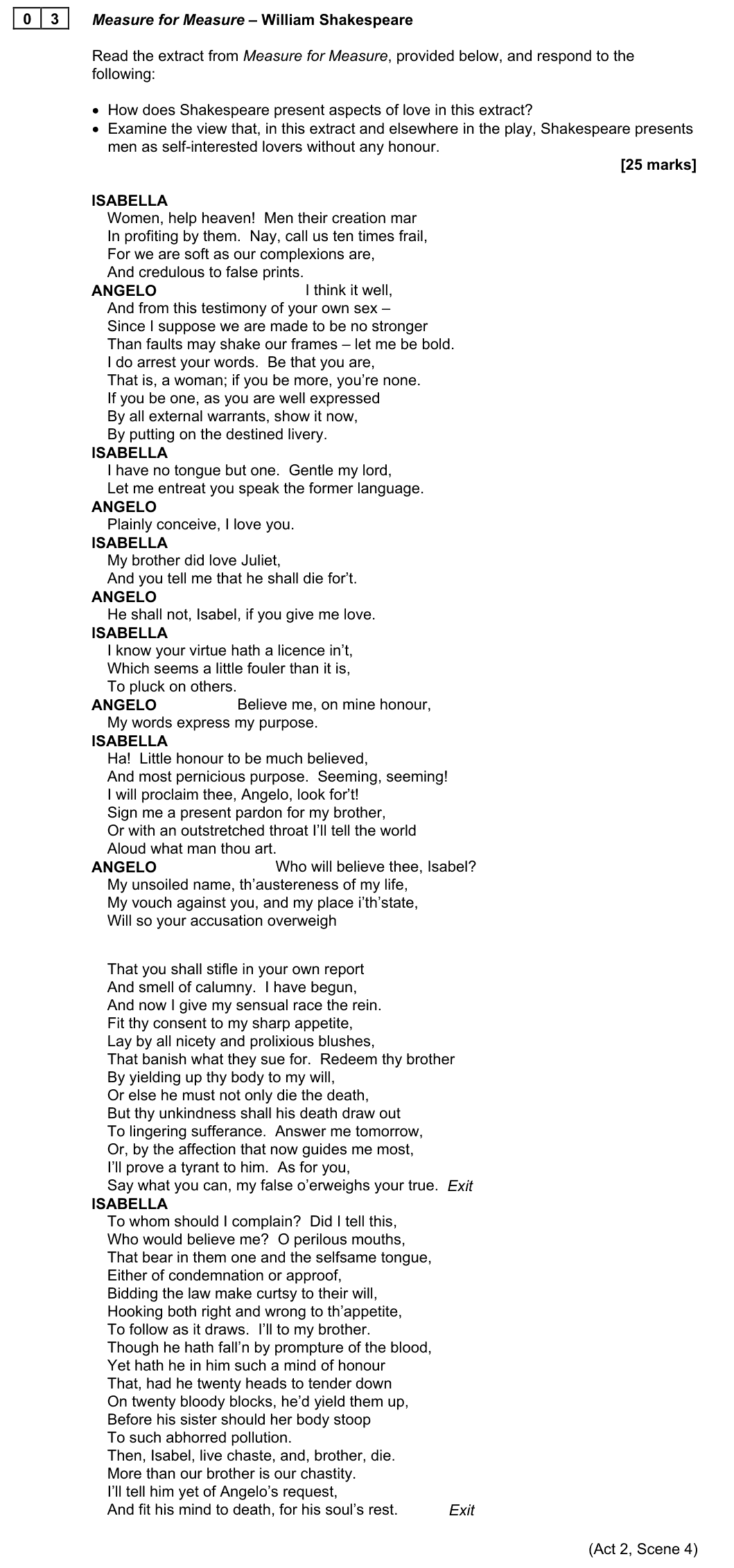
0 3
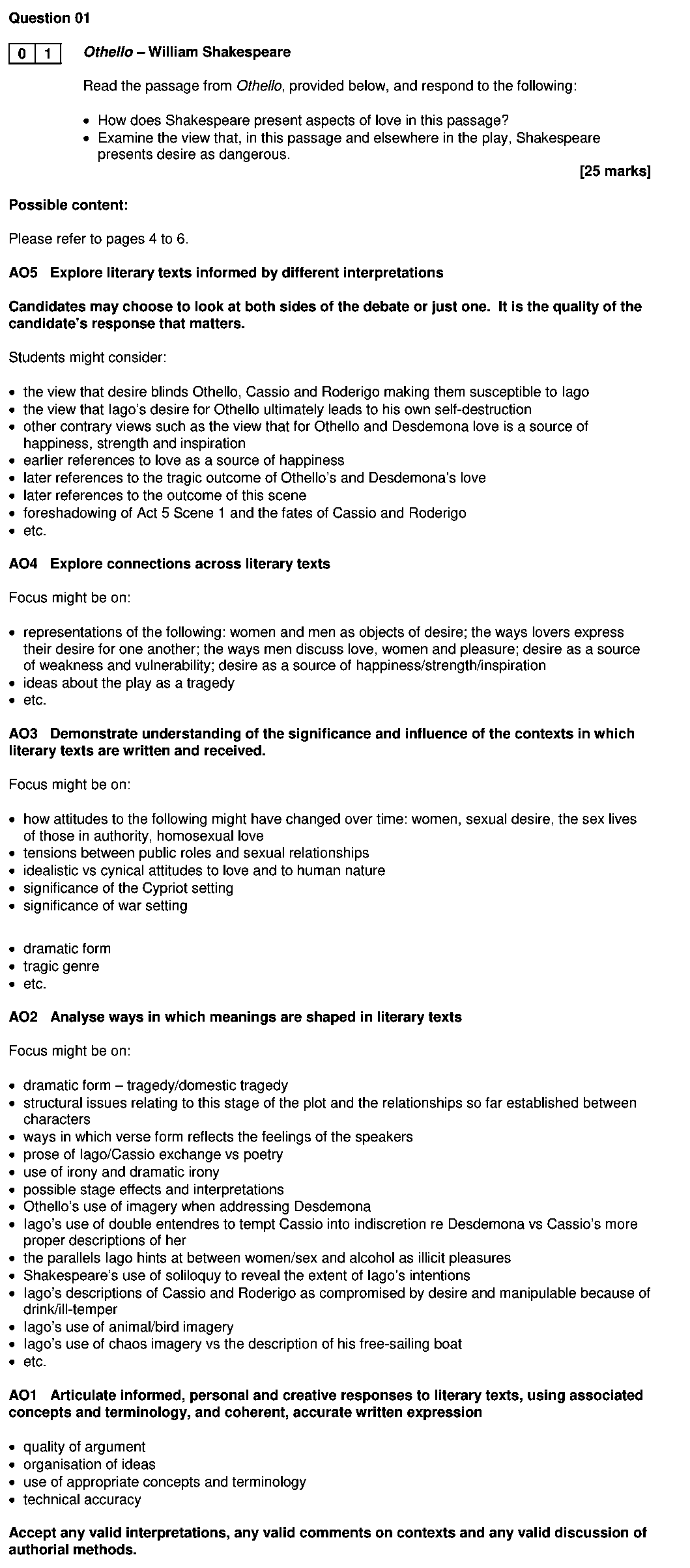
Measure for Measure – William Shakespeare
‘The literature of love tends to present women as selfless and compassionate.’
In the light of this view, discuss how Shakespeare presents women in this extract and
elsewhere in the play.
[25 marks]
DUKE
For this new-married man approaching here,
Whose salt imagination yet hath wronged
Your well-defended honour, you must pardon
For Mariana’s sake, but as he adjudged your brother,
Being criminal, in double violation
Of sacred chastity, and of promise-breach,
Thereon dependent, for your brother’s life,
The very mercy of the law cries out
Most audible, even from his proper tongue,
‘An Angelo for Claudio, death for death!’
Haste still pays haste, and leisure answers leisure,
Like doth quit like, and Measure still for Measure.
Then, Angelo, thy fault’s thus manifested,
Which, though thou wouldst deny, denies thee vantage,
We do condemn thee to the very block
Where Claudio stooped to death, and with like haste.
Away with him.
MARIANA O, my most gracious lord,
I hope you will not mock me with a husband.
DUKE
It is your husband mocked you with a husband.
Consenting to the safeguard of your honour
I thought your marriage fit; else imputation,
For that he knew you, might reproach your life
And choke your good to come. For his possessions,
Although by confiscation they are ours,
We do instate and widow you with all,
To buy you a better husband.
MARIANA O my dear lord,
I crave no other, nor no better man.
DUKE
Never crave him. We are definitive.
MARIANA
Gentle my liege! –
DUKE You do but lose your labour.
Away with him to death. (To Lucio) Now, sir, to you.
MARIANA
O my good lord! Sweet Isabel, take my part,
Lend me your knees, and, all my life to come,
I’ll lend you all my life to do you service.
DUKE
Against all sense you do importune her.
Should she kneel down in mercy of this fact,
Her brother’s ghost his pavèd bed would break,
And take her hence in horror.
MARIANA Isabel,
Sweet Isabel, do yet but kneel by me.
Hold up your hands, say nothing, I’ll speak all.
They say best men are moulded out of faults,
And, for the most, become much more the better
For being a little bad. So may my husband.
O Isabel, will you not lend a knee?
DUKE
He dies for Claudio’s death.
ISABELLA (kneeling) Most bounteous sir,
Look, if it please you, on this man condemned
As if my brother lived. I partly think
A due sincerity governed his deeds
Till he did look on me. Since it is so,
Let him not die. My brother had but justice,
In that he did the thing for which he died.
For Angelo,
His act did not o’ertake his bad intent,
And must be buried but as an intent
That perished by the way. Thoughts are no subjects,
Intents but merely thoughts.
MARIANA Merely, my lord.
DUKE
Your suit’s unprofitable. Stand up, I say.
(Act 5, Scene 1)
June 2017 · Paper 1 · Q4 25 marks Shakespeare extract the winters tale
0 4
The Winter’s Tale – William Shakespeare
‘Happy endings in the literature of love depend on problems being resolved and
characters getting what they deserve.’
In the light of this view, discuss how Shakespeare presents Paulina’s role in this
extract and elsewhere in the play.
[25 marks]
PAULINA It is required
You do awake your faith. Then all stand still;
Or those that think it is unlawful business
I am about, let them depart.
LEONTES Proceed.
No foot shall stir.
PAULINA Music, awake her, strike!
Music
’Tis time: descend; be stone no more; approach;
Strike all that look upon with marvel. Come,
I’ll fill your grave up. Stir; nay, come away.
Bequeath to death your numbness, for from him
Dear life redeems you. You perceive she stirs.
Hermione descends
Start not: her actions shall be holy as
You hear my spell is lawful. (To Leontes) Do not shun her
Until you see her die again, for then
You kill her double. Nay, present your hand.
When she was young you wooed her: now, in age,
Is she become the suitor?
LEONTES O, she’s warm!
If this be magic, let it be an art
Lawful as eating.
POLIXENES She embraces him.
CAMILLO
She hangs about his neck.
If she pertain to life, let her speak too.
POLIXENES
Ay, and make it manifest where she has lived,
Or how stol’n from the dead.
PAULINA That she is living,
Were it but told you, should be hooted at
Like an old tale: but it appears she lives,
Though yet she speak not. Mark a little while.
(To Perdita) Please you to interpose, fair madam; kneel,
And pray your mother’s blessing. Turn, good lady:
Our Perdita is found.
HERMIONE You gods, look down,
And from your sacred vials pour your graces
Upon my daughter’s head! Tell me, mine own,
Where hast thou been preserved? Where lived? How
found
Thy father’s court? For thou shalt hear that I,
Knowing by Paulina that the oracle
Gave hope thou wast in being, have preserved
Myself to see the issue.
PAULINA There’s time enough for that,
Lest they desire upon this push to trouble
Your joys with like relation. Go together,
You precious winners all; your exultation
Partake to everyone. I, an old turtle,
Will wing me to some withered bough, and there
My mate, that's never to be found again,
Lament till I am lost.
LEONTES O peace, Paulina!
Thou shouldst a husband take by my consent,
As I by thine a wife. This is a match,
And made between’s by vows. Thou hast found mine –
But how is to be questioned: for I saw her,
As I thought, dead; and have in vain said many
A prayer upon her grave. I’ll not seek far –
For him, I partly know his mind – to find thee
An honourable husband. Come, Camillo,
And take her by the hand; whose worth and honesty
Is richly noted, and here justified
By us, a pair of kings. Let’s from this place.
(To Hermione) What! Look upon my brother. Both your
pardons
That e’er I put between your holy looks
My ill suspicion. This’ your son-in-law,
And son unto the King, whom heavens directing,
Is troth-plight to your daughter. Good Paulina,
Lead us from hence, where we may leisurely
Each one demand and answer to his part
Performed in this wide gap of time since first
We were dissevered. Hastily lead away. Exeunt
(Act 5, Scene 3)
June 2016 · AS Paper 1 · Q1 25 marks Shakespeare extract othello
Othello – William Shakespeare
Read the passage from Othello, provided below, and respond to the following:
•
How does Shakespeare present aspects of love in this passage?
•
Examine the view that, in this passage and elsewhere in the play, ‘as wives Emilia
and Desdemona have much in common’.
[25 marks]
DESDEMONA
O, these men, these men!
Dost thou in conscience think – tell me, Emilia –
That there be women do abuse their husbands
In such gross kind?
EMILIA There be some such, no question.
DESDEMONA
Wouldst thou do such a deed for all the world?
EMILIA
Why, would not you?
DESDEMONA No, by this heavenly light.
EMILIA Nor I neither by this heavenly light: I might do’t
as well i’th’dark.
DESDEMONA Wouldst thou do such a deed for all the
world?
EMILIA The world’s a huge thing: it is a great price for a
small vice.
DESDEMONA In troth, I think thou wouldst not.
EMILIA In troth I think I should, and undo’t when I had
done it. Marry, I would not do such a thing for a joint
ring, nor for measures of lawn, nor for gowns, petticoats,
nor caps, nor any petty exhibition. But for all the whole
world! Ud’s pity, who would not make her husband a
cuckold, to make him a monarch? I should venture
purgatory for’t.
DESDEMONA Beshrew me, if I would do such a wrong for
the whole world!
EMILIA Why, the wrong is but a wrong i’th’world; and
having the world for your labour, ’tis a wrong in your
own world, and you might quickly make it right.
DESDEMONA I do not think there is any such woman.
EMILIA Yes, a dozen: and as many to th’vantage as would
store the world they played for.
But I do think it is their husbands’ faults
If wives do fall. Say that they slack their duties,
And pour our treasures into foreign laps;
Or else break out in peevish jealousies,
Throwing restraint upon us; or say they strike us,
Or scant our former having in despite –
Why, we have galls, and though we have some grace,
Yet have we some revenge. Let husbands know
Their wives have sense like them: they see and smell,
And have their palates both for sweet and sour
As husbands have. What is it that they do,
When they change us for others? Is it sport?
I think it is. And doth affection breed it?
I think it doth. Is’t frailty that thus errs?
It is so too. And have not we affections,
Desires for sport, and frailty, as men have?
Then let them use us well: else let them know
The ills we do, their ills instruct us so.
DESDEMONA
Good night, good night. God me such uses send,
Not to pick bad from bad, but by bad mend! Exeunt
(Act 4, Scene 3)
June 2016 · AS Paper 1 · Q2 25 marks Shakespeare extract taming of the shrew
The Taming of the Shrew – William Shakespeare
Read the passage from The Taming of the Shrew, provided below, and respond to the
following:
•
How does Shakespeare present aspects of love in this passage?
•
Examine the view that, in this passage and elsewhere in the play, Petruchio
underestimates the challenge of ‘taming’ Katherina.
[25 marks]
PETRUCHIO
Nay, come, Kate, come, you must not look so sour.
KATHERINA
It is my fashion when I see a crab.
PETRUCHIO
Why, here’s no crab, and therefore look not sour.
KATHERINA
There is, there is.
PETRUCHIO
Then show it me.
KATHERINA Had I a glass, I would.
PETRUCHIO
What, you mean my face?
KATHERINA Well aimed of such a young one.
PETRUCHIO
Now, by Saint George, I am too young for you.
KATHERINA
Yet you are withered.
PETRUCHIO ’Tis with cares.
KATHERINA I care not.
PETRUCHIO
Nay, hear you, Kate –
She struggles
In sooth, you scape not so.
KATHERINA
I chafe you, if I tarry. Let me go.
PETRUCHIO
No, not a whit. I find you passing gentle.
’Twas told me you were rough, and coy, and sullen,
And now I find report a very liar.
For thou art pleasant, gamesome, passing courteous,
But slow in speech, yet sweet as spring-time flowers.
Thou canst not frown, thou canst not look askance,
Nor bite the lip, as angry wenches will,
Nor hast thou pleasure to be cross in talk.
But thou with mildness entertain’st thy wooers,
With gentle conference, soft and affable.
He lets her go
Why does the world report that Kate doth limp?
O slanderous world! Kate like the hazel-twig
Is straight and slender, and as brown in hue
As hazel-nuts and sweeter than the kernels.
O, let me see thee walk. Thou dost not halt.
KATHERINA
Go, fool, and whom thou keep’st command.
PETRUCHIO
Did ever Dian so become a grove
As Kate this chamber with her princely gait?
O, be thou Dian, and let her be Kate,
And then let Kate be chaste and Dian sportful.
KATHERINA
Where did you study all this goodly speech?
PETRUCHIO
It is extempore, from my mother-wit.
KATHERINA
A witty mother, witless else her son.
PETRUCHIO
Am I not wise?
KATHERINA Yes, keep you warm.
PETRUCHIO
Marry, so I mean, sweet Katherine, in thy bed.
And therefore, setting all this chat aside,
Thus in plain terms – your father hath consented
That you shall be my wife; your dowry ’greed on;
And will you, nill you, I will marry you.
Now, Kate, I am a husband for your turn,
For by this light whereby I see thy beauty,
Thy beauty that doth make me like thee well,
Thou must be married to no man but me.
For I am he am born to tame you, Kate,
And bring you from a wild Kate to a Kate
Conformable as other household Kates.
Enter Baptista, Gremio, and Tranio
Here comes your father. Never make denial;
I must and will have Katherine to my wife.
(Act 2, Scene 1)
June 2016 · AS Paper 1 · Q3 25 marks Shakespeare extract measure for measure
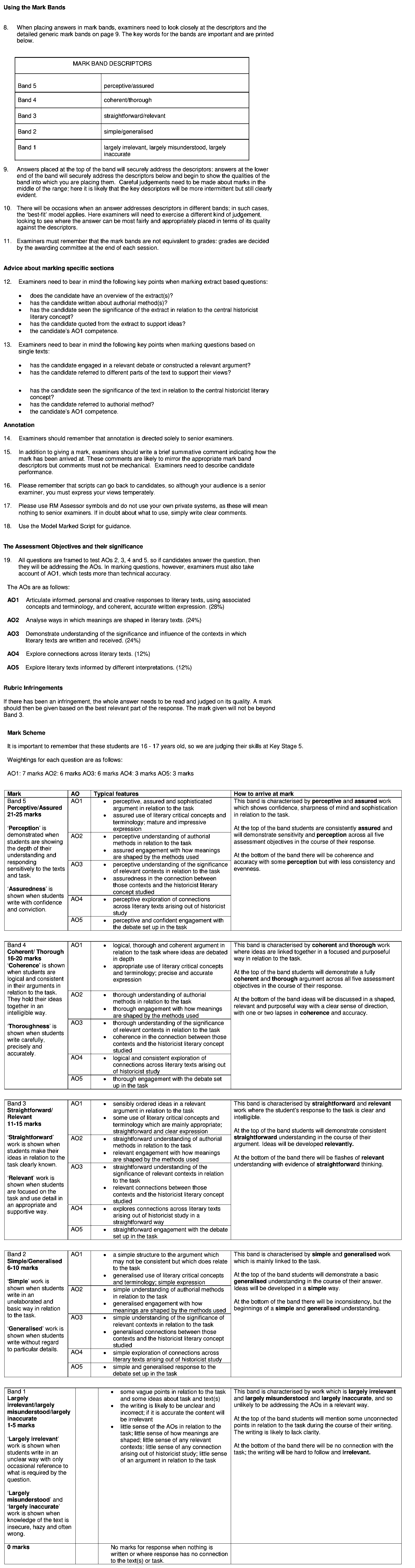
Measure for Measure – William Shakespeare
Read the passage from Measure for Measure, provided below, and respond to the
following:
•
How does Shakespeare present aspects of love in this passage?
•
Examine the view that, in this passage and elsewhere in the play, the Duke is
more concerned with public morality than with the private happiness of those he
rules.
[25 marks]
ISABELLA
But O, how much is the good Duke de-
ceived in Angelo! If ever he return and I can speak to
him, I will open my lips in vain, or discover his govern-
ment.
DUKE That shall not be much amiss. Yet, as the matter
now stands, he will avoid your accusation; he made trial
of you only. Therefore fasten your ear on my advisings.
To the love I have in doing good a remedy presents
itself. I do make myself believe that you may most
uprighteously do a poor wronged lady a merited benefit,
redeem your brother from the angry law, do no stain
to your own gracious person, and much please the
absent Duke, if peradventure he shall ever return to
have hearing of this business.
ISABELLA Let me hear you speak farther. I have spirit to
do anything that appears not foul in the truth of my
spirit.
DUKE Virtue is bold, and goodness never fearful. Have
you not heard speak of Mariana, the sister of Frederick,
the great soldier who miscarried at sea?
ISABELLA I have heard of the lady, and good words went
with her name.
DUKE She should this Angelo have married, was affianced
to her oath, and the nuptial appointed, between
which time of the contract and limit of the solemnity,
her brother Frederick was wrecked at sea, having in that
perished vessel the dowry of his sister. But mark how
heavily this befell to the poor gentlewoman. There she
lost a noble and renowned brother, in his love toward
her ever most kind and natural; with him the portion
and sinew of her fortune, her marriage dowry; with
both, her combinate husband, this well-seeming
Angelo.
ISABELLA Can this be so? Did Angelo so leave her?
DUKE Left her in her tears, and dried not one of them
with his comfort, swallowed his vows whole, pretending
in her discoveries of dishonour. In few, bestowed her
on her own lamentation, which she yet wears for his sake,
and he, a marble to her tears, is washed with them, but
relents not.
ISABELLA What a merit were it in death to take this poor
maid from the world! What corruption in this life, that
it will let this man live! But how out of this can she avail?
DUKE It is a rupture that you may easily heal, and the cure
of it not only saves your brother, but keeps you from
dishonour in doing it.
ISABELLA Show me how, good father.
DUKE This forenamed maid hath yet in her the continu-
ance of her first affection. His unjust unkindness, that
in all reason should have quenched her love, hath, like
an impediment in the current, made it more violent and
unruly. Go you to Angelo, answer his requiring with a
plausible obedience, agree with his demands to the
point. Only refer yourself to this advantage: first, that
your stay with him may not be long, that the time may
have all shadow and silence in it, and the place answer to
convenience. This being granted in course – and now
follows all – we shall advise this wronged maid to
stead up your appointment, go in your place. If the
encounter acknowledge itself hereafter, it may compel
him to her recompense, and here, by this is your brother
saved, your honour untainted, the poor Mariana
advantaged, and the corrupt deputy scaled. The maid
will I frame and make fit for his attempt. If you think
well to carry this, as you may, the doubleness of the
benefit defends the deceit from reproof. What think you
of it?
ISABELLA The image of it gives me content already, and I
trust it will grow to a most prosperous perfection.
DUKE It lies much in your holding up. Haste you speedily
to Angelo. If for this night he entreat you to his bed,
give him promise of satisfaction. I will presently to
Saint Luke’s. There, at the moated grange, resides this
dejected Mariana. At that place call upon me, and dis-
patch with Angelo, that it may be quickly.
ISABELLA I thank you for this comfort. Fare you well,
good father. Exit
(Act 3, Scene 1)
June 2016 · AS Paper 1 · Q4 25 marks Shakespeare extract the winters tale
The Winter’s Tale – William Shakespeare
Read the passage from The Winter’s Tale, provided below, and respond to the following:
•
How does Shakespeare present aspects of love in this passage?
•
Examine the view that, in this passage and elsewhere in the play, Hermione is
presented as more than just a passive victim of Leontes’ jealousy.
[25 marks]
HERMIONE
You’ll stay?
POLIXENES No, madam.
HERMIONE
Nay, but you will!
POLIXENES I may not, verily.
HERMIONE
Verily!
You put me off with limber vows; but I,
Though you would seek t’unsphere the stars with oaths,
Should yet say, ‘Sir, no going.’ Verily,
You shall not go. A lady’s ‘verily’ is
As potent as a lord’s. Will you go yet?
Force me to keep you as a prisoner,
Not like a guest; so you shall pay your fees
When you depart, and save your thanks. How say you?
My prisoner? Or my guest? By your dread ‘verily’,
One of them you shall be.
POLIXENES Your guest, then, madam:
To be your prisoner should import offending;
Which is for me less easy to commit
Than you to punish.
HERMIONE Not your gaoler, then,
But your kind hostess. Come, I’ll question you
Of my lord’s tricks, and yours, when you were boys.
You were pretty lordings then?
POLIXENES We were, fair Queen,
Two lads that thought there was no more behind
But such a day tomorrow as today,
And to be boy eternal.
HERMIONE Was not my lord
The verier wag o’th’two?
POLIXENES
We were as twinned lambs that did frisk i’th’sun,
And bleat the one at th’other. What we changed
Was innocence for innocence: we knew not
The doctrine of ill-doing, nor dreamed
That any did. Had we pursued that life,
And our weak spirits ne’er been higher reared
With stronger blood, we should have answered heaven
Boldly ‘Not guilty’, the imposition cleared
Hereditary ours.
HERMIONE By this we gather
You have tripped since.
POLIXENES O my most sacred lady,
Temptations have since then been born to’s: for
In those unfledged days was my wife a girl;
Your precious self had then not crossed the eyes
Of my young playfellow.
HERMIONE Grace to boot!
Of this make no conclusion, lest you say
Your queen and I are devils. Yet go on:
Th’offences we have made you do we’ll answer,
If you first sinned with us, and that with us
You did continue fault, and that you slipped not
With any but with us.
LEONTES (approaching) Is he won yet?
HERMIONE
He’ll stay, my lord.
LEONTES At my request he would not.
Hermione, my dearest, thou never spok’st
To better purpose.
(Act 1, Scene 2)

Work with an AQA English Literature A tutor

Essays stuck in the middle bands, or not sure what the examiners want from an analysis? Book a trial lesson with a specialist AQA English Literature A tutor.

Prefer email? Send an enquiry

If you are under 18, please include a parent's contact details. Enquiries go to enquiries@alevelenglishtutor.com and are deleted once handled. All tutoring is online.